Europe's Fuel Shortage Meets a Growing Sovereign Debt Burden
By Asymmetric Analytics
Analysis
Europe's energy squeeze now has two clocks. Gulf crude shipments have partly recovered, but refined fuels remain scarce and inventories depleted. At the same time, governments must refinance debt accumulated during earlier crises while coping with the economic effects of expensive imports.
The underlying problem is not a single intraday oil quote. It is the continuing gap between barrels leaving the Gulf and usable fuel reliably reaching customers, against Europe's heavy financing commitments.
More crude is moving. The fuel shortage persists.
The International Energy Agency's October Oil Market Report describes a partial reopening of Gulf oil flows. In September, Gulf crude exports climbed to 13.9 million barrels per day, more than 75% of prewar levels. Ship-to-ship transfers and expanded bypass routes helped exporters adapt to disruption.
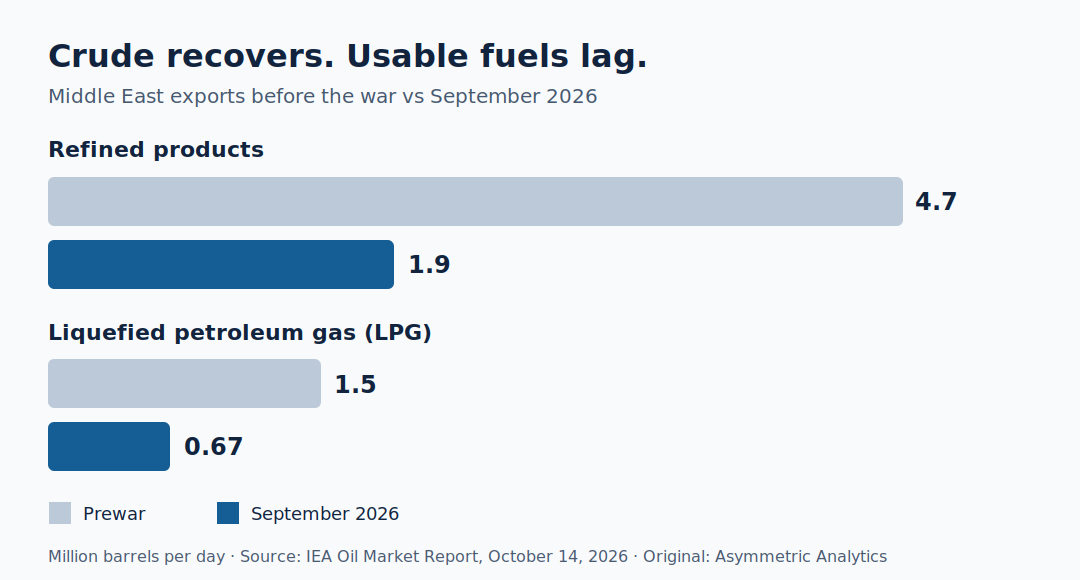
But Gulf refined-product exports recovered only to 1.9 million barrels per day, compared with 4.7 million before the war. Liquefied petroleum gas exports reached 670,000 barrels per day, against 1.5 million before the war. Crude barrels and usable fuels are not interchangeable: refiners need the right feedstock, operating capacity, ships and safe routes.
Meanwhile, the IEA estimates that global observed oil inventories were 509 million barrels lower at the end of September than at the end of February. Its 2026 world oil-demand forecast is down 2.6 million barrels per day year over year. Demand is weakening, yet the system continues drawing down inventories. This is the essential tension: declining consumption has not fully offset supply losses and logistical constraints.
The U.S. Energy Information Administration's October outlook likewise identifies costly shipping, war-risk premiums and detours as forces that can keep delivered energy expensive even when some export volumes recover.
Europe faces the shock with less room to maneuver
Eurostat's finalized September release placed euro-area annual inflation at 3.8%, up from 3.2% in August. Energy accounted for 1.71 percentage points of September's annual inflation rate. Higher fuel costs reach businesses through freight, manufacturing and household budgets, not merely through gasoline stations.
The European Central Bank raised its deposit facility rate to 2.50% , effective September 16. The ECB must contend with inflation even as energy costs damage real incomes and investment. That creates a particularly difficult policy combination: growth needs relief while price stability demands discipline.
France illustrates the funding problem in official numbers. Agence France Trésor's 2027 budget figures put the State's financing requirement at €339.7 billion, up €28.0 billion from the updated 2026 requirement. Expected State debt service is €72.9 billion. These are budget plans, not proof of imminent refinancing failure. They show how large refinancing obligations constrain the room for another energy-response package.
From expensive fuel to weaker growth
The transmission mechanism is straightforward: scarce usable fuels and costly freight raise business expenses; households lose purchasing power; investment slows; tax receipts come under pressure; and heavily indebted governments face rising financing demands. Benchmark bond yields and country-specific borrowing premiums can move in different directions because growth expectations, inflation and sovereign risk do not always change together.
Europe faces a stagflation squeeze: elevated fuel costs are eroding growth while inflation keeps monetary policy tight. Export workarounds have restored substantial crude shipments, and the EIA forecasts lower oil prices as supply chains recover. But refined fuels remain scarce, and the economic damage grows the longer the imbalance lasts.
The significant news is that the energy shock and sovereign-debt strain are no longer separable stories. Europe is being squeezed between the cost of imported energy and the cost of financing its response.
What we're watching
The decisive indicators are Middle Eastern refined-product and diesel exports, IEA inventory draws, tanker and war-risk freight costs, euro-area energy inflation, and France's government financing and debt-service costs. A sustained recovery in usable-fuel exports and falling freight premiums would weaken the crisis thesis. Further inventory depletion alongside widening European sovereign spreads would strengthen it.
Sources
Primary sources
IEA, Oil Market Report, October 14, 2026
EIA, Short-Term Energy Outlook, October 6, 2026
Eurostat, euro-area September inflation, October 16, 2026
ECB, September 10 monetary-policy decision
Sovereign financing
Agence France Trésor, State budget and 2027 financing requirement .