OpenAI's Reported Valuation Target Falls to $1.25 Trillion as AI Investors Reconsider the Price
By Asymmetric Analytics
Analysis
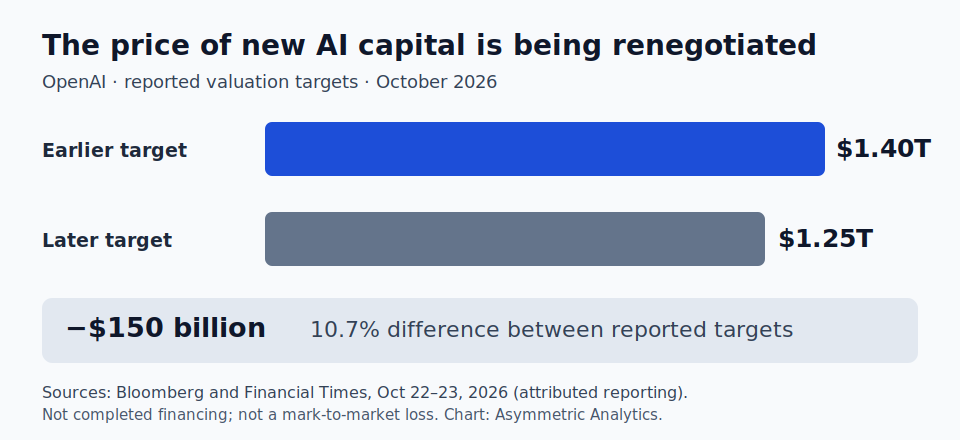
OpenAI is reportedly discussing a lower valuation target in its next funding round. Bloomberg and the Financial Times reported on October 22–23 that a planned financing of roughly $30 billion is being discussed at $1.25 trillion, down from an earlier $1.4 trillion target. That is a $150 billion, or approximately 10.7%, difference between reported targets. The reports accessible to our reviewers did not establish whether both figures use the same pre- or post-money basis.
This is a report about negotiations, not a completed transaction. OpenAI has not publicly confirmed the new terms. More importantly, a lower target is not a $150 billion realized loss on investors' holdings.
What changed — and what did not
A pre-money valuation estimates the value of existing shares immediately before a financing round. A post-money valuation includes the new capital. Comparing those two figures without adjustment can create a misleading picture.
In its March 31, 2026 financing announcement , OpenAI said it had closed a round with $122 billion in committed capital at an $852 billion post-money valuation. October's $1.25 trillion is a reported negotiating target for a different transaction, not a completed valuation, and the available evidence does not establish its pre- or post-money basis. A direct March-versus-October percentage comparison would therefore be misleading.
The figure below displays the two reported October valuation targets. It does not assume their pre- or post-money bases were independently confirmed.
Why the funding terms matter
AI development has two economic cycles running at different speeds. Customers can gain new capabilities quickly. Training models, deploying inference systems, and building data centers require extraordinary upfront spending, often long before the final returns are known.
That creates a financing question: How much are investors prepared to pay today for the earnings and productivity they expect years from now?
The cost pressure is visible in first-party corporate disclosures, not only in private-market rumors. Meta's October 21 earnings release reported third-quarter revenue of $64.6 billion, up 26% from a year earlier, but free cash flow of negative $2.12 billion. Meta projected $135–145 billion of 2026 capital expenditures, including principal payments on finance leases. Its reported operating earnings also included a $9.89 billion litigation-related charge, which should not be mistaken for AI construction costs.
Meta is a profitable incumbent with a large operating business. OpenAI is a model developer seeking outside capital. A highly leveraged data-center project faces yet another balance sheet. The three cannot be treated as interchangeable examples of financial distress.
Separately, Reuters reported October 15 that some investors discussing Anthropic's anticipated IPO were considering a valuation around $1.5 trillion, compared with earlier expectations of approximately $2 trillion. Those are investor expectations, not Anthropic's announced offering terms.
The more interesting divergence
AI technology may improve rapidly while the price investors will pay for the companies financing it becomes more disciplined. There is no contradiction.
If investors demand lower entry valuations or higher credit returns, marginal infrastructure projects can become harder to fund. That can slow orders for chips, new data-center construction, and capacity expansion even as existing AI services continue gaining customers. This is a possible transmission mechanism, not evidence that such a chain reaction has already occurred.
A different outcome is equally economically meaningful: stronger discipline could favor projects whose compute actually earns an attractive return, leaving the industry's most productive investments intact.
The signal today is more discriminating capital, not the disappearance of AI demand.
What we're watching
Financial Times reporting identified October 30 as a deadline for investor commitments in OpenAI's proposed round. The most useful next fact will be the actual financing terms: money committed, whether the round closes, its pre- or post-money basis, and any strategic compute-capacity arrangements.
We are also tracking Anthropic's public IPO documentation if released, Meta's operating cash generation relative to its spending plan, and the cost of credit for companies building AI infrastructure.
A strongly subscribed OpenAI round at confirmed attractive terms would weaken the thesis of broad investor retreat. A reduced raise, prolonged delay, or higher-cost financing across several independent issuers would strengthen the case for a genuine repricing of AI capital.
Technology can transform the economy without every investor or infrastructure project earning the return originally expected. The developing story is how the market decides which projects deserve its next dollar.
Sources and evidence status
Primary disclosures
OpenAI, March 31 funding announcement — historic closed round, $122 billion committed and $852 billion post-money.
Meta, October 21 third-quarter earnings and SEC 10-Q — revenue, cash generation, capex and legal-charge context.
Attributed reporting — not independently confirmed issuer terms
Bloomberg, October 22–23 and Financial Times, October 23 — proposed OpenAI fundraising amounts and revised valuation targets; no official signed term sheet obtained.
Reuters, October 15 — reported investor discussion of possible Anthropic IPO pricing, not an announced price.