Poland's Court Fight Moves From Legal Authority to Operational Control
By Asymmetric Analytics
Analysis
A constitutional court can decide whether a government's laws survive. Before its judges reach a ruling, however, someone must admit staff, receive documents, schedule cases and speak for the institution. Poland's decade-long dispute over its Constitutional Tribunal reached that practical question of power on October 30 and 31.
Brief
On October 31, Judge Anna Korwin-Piotrowska issued an order revoking earlier administrative authorisations, limiting the work of the Tribunal office and legal service, and suspending most routine staff attendance with pay unless she summoned them. She recommended that judges work remotely and suspended in-person document intake. A separate order called the Tribunal's General Assembly for November 3.
Those orders followed Korwin-Piotrowska's disputed October 30 declarations that Tribunal president Bogdan Święczkowski and vice-president Bartłomiej Sochański were suspended. Police deployed outside the Warsaw court. Three people were detained after crossing its fence. President Karol Nawrocki cut short a trip to Senegal and returned to Warsaw.
The legal authority behind the suspensions is contested. Nawrocki calls the episode a forcible takeover of a constitutional body. Prime Minister Donald Tusk's government says judges elected by the current Sejm, Poland's lower house of parliament, are valid and must be allowed to work.
The immediate issue is not only who has the stronger constitutional argument. It is who can operate the court while each side rejects the other's authority.
Standard
Korwin-Piotrowska's October 31 order changed the Tribunal's machinery. Existing authorisations were revoked. The office and legal service could perform only work she specified. Most employees were told not to report to the building while keeping their pay; summoned staff were excepted. Judges were advised to work elsewhere, and documents could be sent by post but not delivered to the intake office in person.
The order says its purposes are to restore the proper performance of the Tribunal's tasks and respond to a possible threat to judges' and employees' health or lives. That is Korwin-Piotrowska's stated justification. Her authority to replace Święczkowski and suspend him and Sochański is precisely what the opposing side disputes.
This distinction matters because constitutional review depends on operations. A court needs more than judges and a legal mandate. It needs a docket, meaning the organised list of cases awaiting action; staff who prepare files; a channel for new documents; and public officials willing to recognise its rulings.
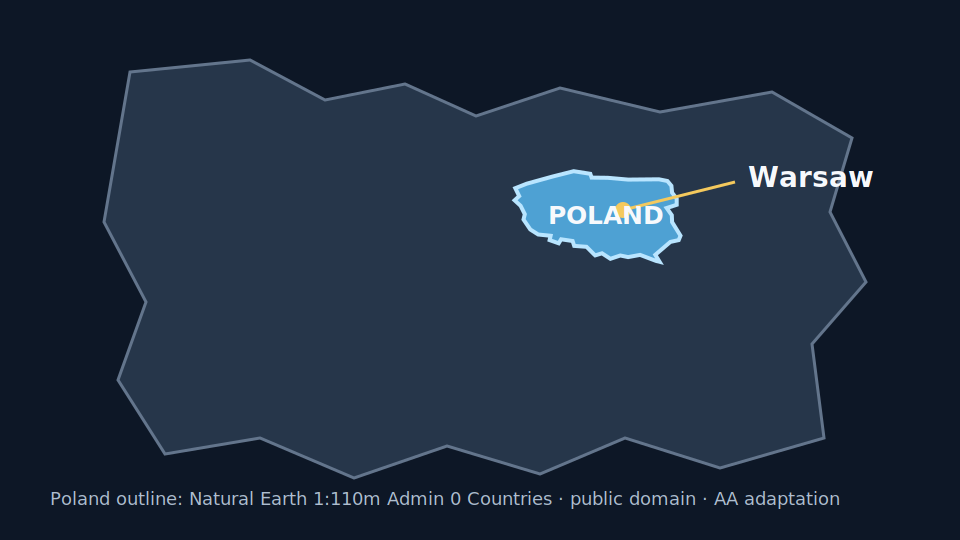
The Constitutional Tribunal sits in Warsaw. Poland's outline is adapted from Natural Earth 1:110m Admin 0 Countries, public-domain data; locator design and annotation by Asymmetric Analytics.
Nawrocki's October 31 statement says a constitutional body was taken over by force. He called for what he termed government-sent coercive forces to leave and announced urgent consultations with parliamentary groups. That language describes the president's position, not an agreed legal finding.
The government's position is equally direct. In an October 14 statement , the Prime Minister's Office said the new Sejm judges were lawfully elected and characterised Nawrocki's refusal to receive some of their oaths as a failure to perform a constitutional duty. It promised protection so those judges could begin regular work.
Detailed
The confrontation has two layers. The first is legal legitimacy: who was validly appointed, who may lead the Tribunal and whose interpretation of the constitution controls. The second is institutional capacity: who can open the doors, direct employees, accept a filing and assemble judges. The events of October 30–31 joined those layers.
On October 30, Korwin-Piotrowska purported to suspend Święczkowski and Sochański. Police secured the exterior of the Tribunal amid a protest. Three people were detained after entering over the fence; police said their role was to protect safety and public order rather than intervene in the Tribunal's adjudication. Nawrocki interrupted his Senegal trip and returned. His next-day statement said he had enabled Sochański to enter the building.
The operational orders followed on October 31. One restricted staff, authorisations and intake. The other convened the General Assembly for November 3. A General Assembly is the body of the Tribunal's judges acting collectively on institutional matters. Whether it meets, who attends and whether state bodies recognise its decisions will show which claim of authority has practical effect.
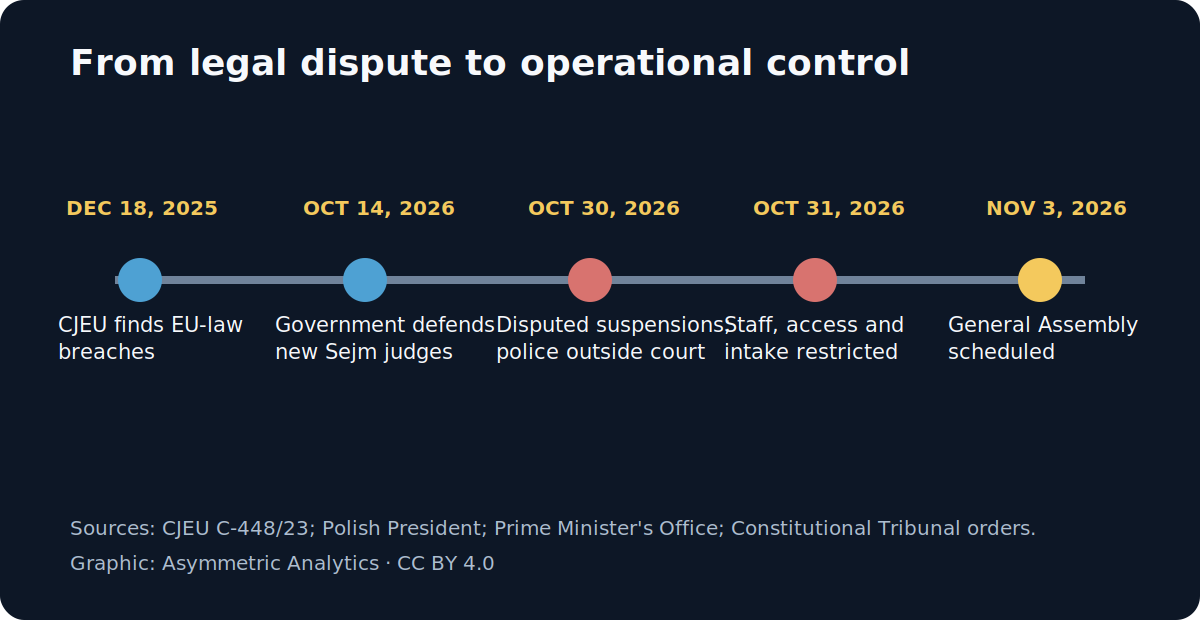
The sequence shows the shift from a legal judgment to rival claims and then operational control. Dates and actions come from C-448/23, the Polish Prime Minister's Office, the President and the Tribunal's October 31 orders. Graphic by Asymmetric Analytics, CC BY 4.0.
The European Union's role belongs in the legal layer. In Commission v Poland, C-448/23 , the Court of Justice of the European Union held on December 18, 2025 that Poland had failed to meet EU-law obligations. The judgment addressed the Tribunal's rejection of EU-law primacy and serious irregularities affecting appointments of three members and its president. It preceded the present confrontation. It did not direct the police deployment, choose the Tribunal's current leadership or order a takeover.
This produces a compact causal chain: contested judicial appointments created rival legitimacy claims; rival claims produced disputed leadership suspensions; the suspensions produced orders over staff, access and the docket; those controls now determine which institutional acts can be completed and which rulings other branches will recognise.
The market connection is indirect but real. Courts determine whether laws, taxes and government actions remain valid. If state institutions recognise incompatible authorities, legal uncertainty can reach public contracts, regulation and the risk premium lenders demand from the state. No market move cited here establishes that repricing. The observable test is whether the conflict begins to delay decisions or makes officials and counterparties uncertain about which rulings bind them.
Watch the November 3 assembly: whether it convenes, which judges participate and how public bodies treat its decisions. Also watch document intake, staff access and the recognition of new rulings. Those operational facts will show whether Poland has one functioning constitutional court or rival accounts of one.
Sources
Statement by President Karol Nawrocki , Presidency of the Republic of Poland, October 31, 2026.
Order concerning organisation of the Tribunal's work , Constitutional Tribunal, October 31, 2026.
Order convening the General Assembly , Constitutional Tribunal, October 31, 2026.
Premier: Przywracamy w Polsce praworządność. Nie cofniemy się o krok , Prime Minister's Office, October 14, 2026.
Judgment in Commission v Poland, C-448/23 , Court of Justice of the European Union, December 18, 2025.