XRP Ledger Crosses $1 Billion in Stablecoins. Wall Street Is Moving In.
By Asymmetric Analytics
Analysis
The financial revolution may arrive disguised as something remarkably familiar: the American dollar.
Ripple's RLUSD stablecoin lets financial institutions begin using blockchain with a dollar-denominated instrument. Once those dollars are on the XRP Ledger (XRPL), payments, tokenized securities, custody and exchange can connect on the same infrastructure.
RLUSD is the Trojan horse. XRPL is the financial infrastructure waiting inside the gates.
Brief
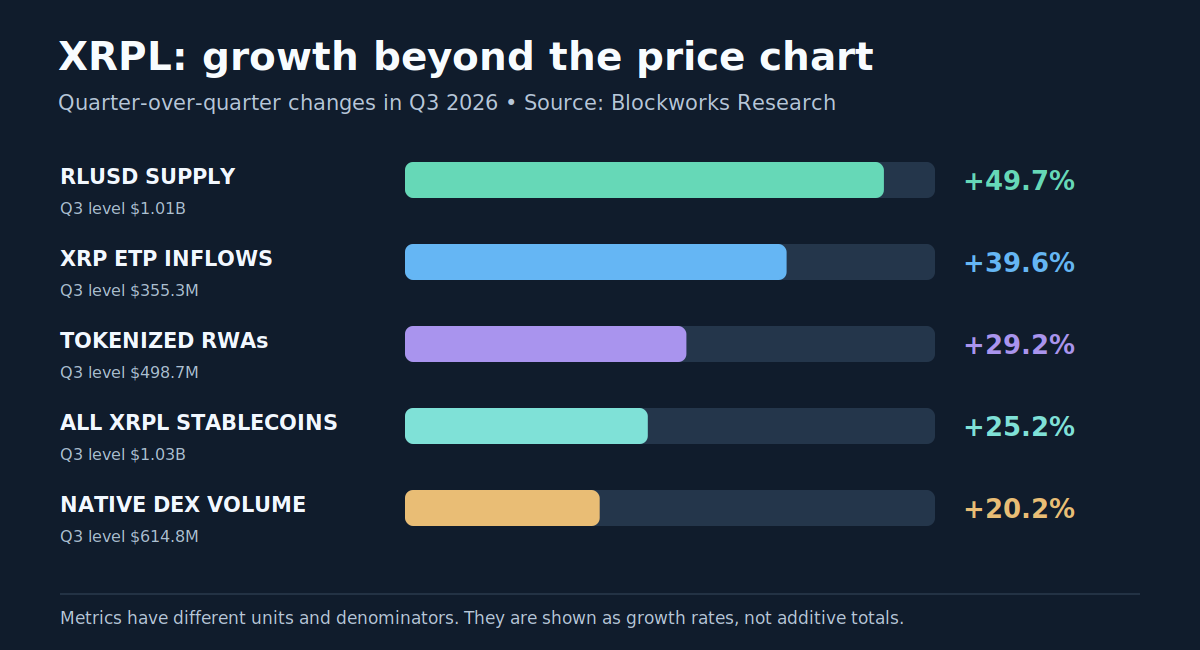
Blockworks Research's Q3 2026 XRP report says stablecoin supply native to XRPL reached $1.03 billion, an increase of 25.2% from the prior quarter. RLUSD accounted for approximately $1.01 billion, or 98% of that supply.
At the same time, distributed tokenized real-world assets rose 29.2% to $498.7 million, native decentralized-exchange volume rose 20.2% to $614.8 million, and global XRP investment products received $355.3 million in net inflows, a 39.6% quarterly increase.
The important development is not another crypto price prediction. It is the growing use of XRPL as infrastructure for real financial assets and dollar-denominated transactions.
Standard
A bank does not need to make a speculative bet on cryptocurrencies to recognize the usefulness of transferring digital dollars. That is what makes RLUSD a practical first step.
The Q3 figures show that this entry point is growing. RLUSD's XRPL supply reached about $1.01 billion, up 49.7% quarter over quarter. Across the ledger, stablecoin transfer volume increased 39.5% to $14.09 billion, according to Blockworks Research.
The institutional pieces are arriving alongside the dollars. On October 26, Aviva Investors announced its second tokenized money-market-fund share class on XRPL, following its U.S. dollar fund launch in July. Aviva reports more than £86 million invested across the two tokenized share classes. Its larger sterling fund has around £22 billion in total assets, but that entire amount is not tokenized.
The next day, BNY announced custody support for XRP and RLUSD . A major custodian can help institutions hold and move these assets using familiar governance and controls. Plans for additional tokenized products and direct RLUSD minting through BNY remain subject to approvals.
This is how financial networks grow: the first useful service brings participants onto the rails, and adjacent services give them more reasons to stay.
Detailed
The quarterly report describes growth along several separate dimensions. Stablecoin supply rose 25.2% to $1.03 billion. Distributed tokenized assets rose 29.2% to $498.7 million. The XRPL native exchange processed $614.8 million, up 20.2%. Global XRP exchange-traded investment products attracted $355.3 million in net inflows, bringing assets under management to $3.32 billion. These are different indicators, not figures to be added into a single total.
An additional distinction sharpens the picture: total payment volume grew 4.3% to 42.82 billion XRP even as the number of payment transactions fell 33.6%. The ledger carried larger average transfers, rather than a simple rise in every activity measure.
Why does RLUSD matter strategically? Traditional institutions already understand dollar liabilities, reporting and reserve custody. Beginning with a stablecoin gives them a familiar unit of account while exposing them to always-on digital settlement. Cross River's October banking integration illustrates how a dollar token can be presented through conventional payment and banking systems.
Once participants arrive, XRPL provides more than simple token transfers. They can use built-in issuance and exchange functions, participate in tokenized fund structures, and potentially connect payments with collateral and market liquidity. The Aviva launches are especially valuable evidence: these are issued fund share classes, not merely a partnership announcing the intention to tokenize.
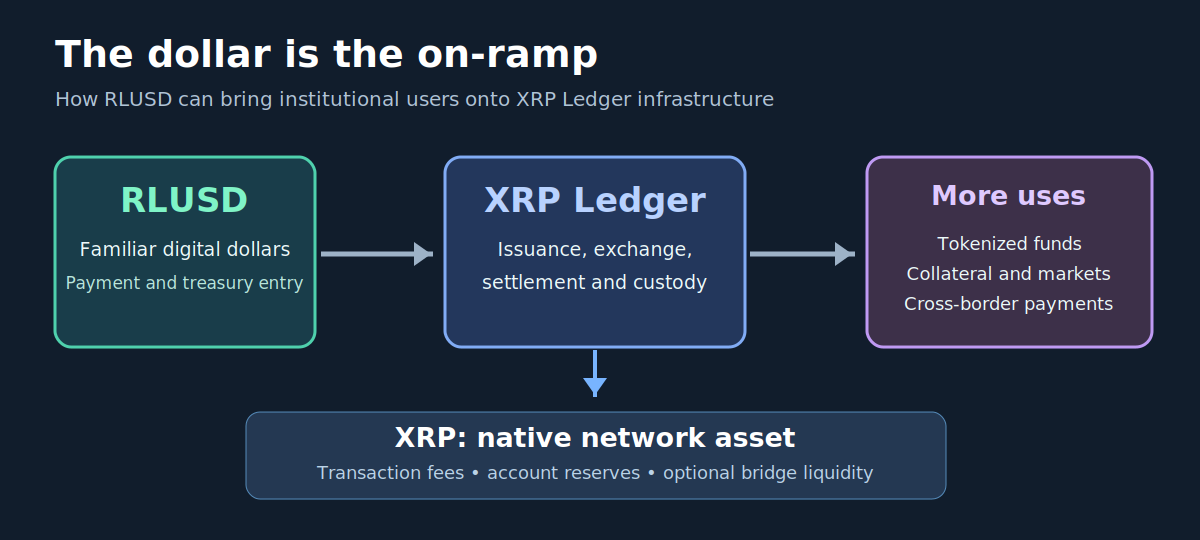
XRP is already part of that architecture. It is the ledger's native asset, used for transaction fees and account reserves. Its exchange and payment-path features can also use XRP as a bridge between currencies when that route offers useful liquidity. Direct transfers of RLUSD are possible without an XRP conversion; those mechanisms are complementary rather than interchangeable.
The larger economic story is the network effect. Dollars bring institutions; institutions bring custody, market makers, securities and commercial use cases; those services can attract more participants and more liquidity. The next milestones are observable: additional RLUSD distribution channels, tokenized assets in active use, growth in institutional payments and new XRP liquidity applications.
The XRP Ledger's billion-dollar stablecoin milestone is therefore more than a round number. Traditional finance is beginning to operate on a financial network built for digital value.
Primary sources
Blockworks Research: XRP Q3 2026 protocol report , October 30, 2026.
Aviva Investors: tokenized sterling liquidity-fund launch , October 26, 2026.
Aviva Investors: tokenized U.S. dollar fund launch , July 29, 2026.
BNY: expanded XRP and RLUSD custody , October 27, 2026.
Cross River: RLUSD embedded in core banking infrastructure , October 15, 2026.