The Fed Needs a New Yardstick. AI Is Rewriting the Rules of Economic Growth.
By Asymmetric Analytics
Analysis
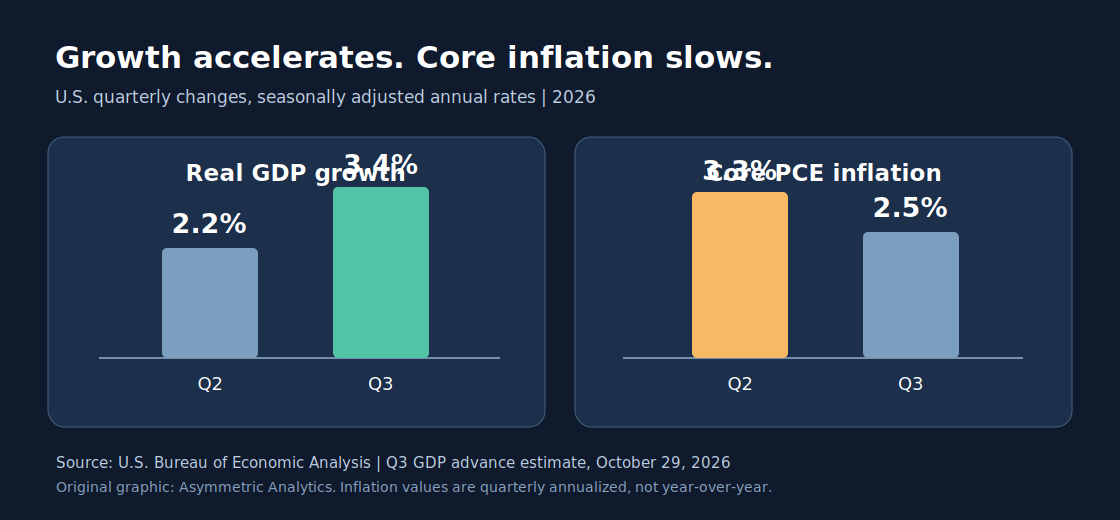
The American economy delivered an unusual combination in the third quarter: growth accelerated while core inflation slowed.
The Bureau of Economic Analysis reported that real GDP grew at a 3.4% annualized rate, up from 2.2% in the second quarter. Over the same period, the quarterly annualized increase in the core personal consumption expenditures price index eased from 3.3% to 2.5%. Real final sales to private domestic purchasers, a measure of private consumption and fixed investment, grew 4.9%.
A day earlier, the Federal Reserve held its benchmark policy rate at 3.75%–4.00%. Two policymakers wanted to raise it.
These numbers pose a question for an economy entering the AI age: What if faster growth is increasingly a sign of greater productive capacity rather than excess demand?
The distinction that matters
When more spending competes for a limited supply of products, prices tend to rise. Raising interest rates can restrain demand.
But when technology allows a factory, hospital, logistics network or software company to produce more useful output with the same labor and resources, the economy's capacity increases. Unit costs can fall even as real output grows.
That is the promise of AI and automation. An AI-assisted engineer may complete more work per hour. A warehouse may handle more orders with the same staffing. Better software may reduce the cost of delivering a service. If these improvements spread throughout the economy, growth can accelerate without requiring an equivalent increase in prices.
The central bank already watches productivity. Its October statement explicitly called productivity growth strong and investment robust. The question is whether policy gives those changes enough weight when interpreting growth and estimating how fast the economy can expand sustainably.
A better yardstick
Rather than treating a high GDP number as an automatic warning, policymakers should put four measurements beside it: real output per hour worked, unit labor costs, the breadth of price increases, and investment that demonstrably expands future capacity.
The Bureau of Labor Statistics reported that nonfarm business productivity rose 2.2% year over year in the second quarter while unit labor costs increased 1.4%. Those are useful signs of the relationship between output, labor and cost—not proof that AI caused the improvement.
AI capital spending is similarly not the same as achieved productivity. A new data center uses electricity, materials and financing before it produces any economic benefit. Deployment and measurable cost reductions must follow the investment.
Why it matters
If policymakers underestimate an economy's improving supply capacity, they risk restraining investment just as new technology could make production cheaper and more abundant.
The opposite mistake also matters: an AI investment boom can temporarily strain electricity supplies, construction capacity and credit markets, even before its productivity benefits arrive. The right measure is therefore growth relative to evolving productive capacity, not growth by itself.
What we are watching is whether output per hour accelerates, unit costs moderate, price pressures narrow, and businesses can demonstrate real efficiency gains beyond purchasing more computing equipment.
The Fed's challenge is not to stop measuring inflation. It is to recognize that the speed limit of the economy may be changing.
Primary sources
BEA: Third-quarter 2026 GDP advance estimate , October 29, 2026.
Federal Reserve: October FOMC statement , October 28, 2026.
BLS: Second-quarter labor productivity and unit labor costs , August 11, 2026.
Federal Reserve: Monetary policy strategy , August 2025.