Frankfurt Riots Expose Europe's Growing Economic and Social Strains
By Asymmetric Analytics
Analysis
The streets of Frankfurt became a battleground on Halloween night. Masked rioters smashed shop windows, looted stores and threw incendiary devices at police after a day of youth-led demonstrations across Germany.
Hesse officials reported 17 shops damaged, five looted, more than 100 police injured and 54 arrests. Some 1,000 to 1,500 violent participants were involved, according to police estimates. What began as a nationwide debate over young Germans' prospects ended in unusually serious urban disorder in the country's financial capital.
Brief
Protests organized by Gen Z regelt took place in 34 German cities on October 31. The movement demanded better education, affordable living conditions and greater investment in public services. It also opposed a possible return to compulsory military service. The daytime marches were mostly peaceful; the violence broke out later in Frankfurt and several other cities. Reuters and Tagesschau reported the events.
Federal Interior Minister Alexander Dobrindt called for prosecution of the rioters. Hesse authorities attributed involvement to violent extremist groups and individuals from migrant communities. These were criminal disturbances, not the declared program of the youth organizers.
The deeper story is a growing conflict over what Germany can afford—and whom its government intends to ask to pay the price.
Standard: The economic backdrop
Germany is trying to defend its place as a manufacturing powerhouse against energy costs, international competition and declining returns on some traditional industrial investments. At the same time, its younger generation faces expensive housing, strained schools and concerns about long-term living standards.
Now a new spending priority has moved to the center: rearmament.
The European Defence Agency estimates that EU defense spending reached €418 billion in 2025, and forecasts €454 billion in 2026. These are continent-wide expenditures, not Germany's alone. The scale illustrates the increasingly large claims that security policy places on public budgets.
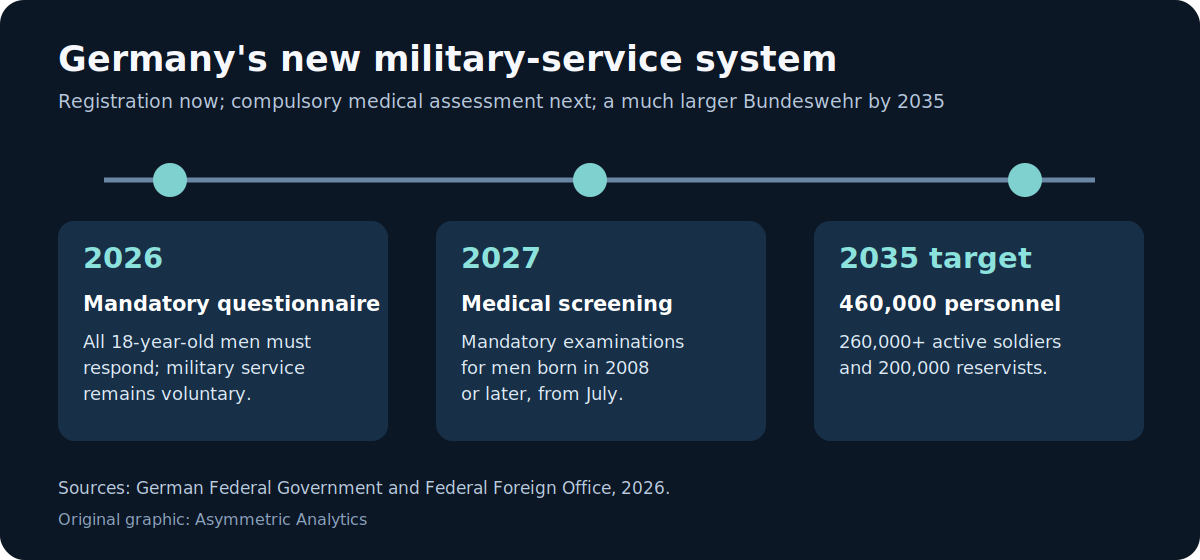
For young Germans, military mobilization is also personal. Under Germany's new military-service law , men turning 18 in 2026 must complete a military-service questionnaire. Medical examinations for the affected cohorts become compulsory in 2027. Military service itself remains voluntary for now, but parliament can subsequently authorize compulsory recruitment if security conditions or volunteer numbers require it.
Detailed: From household pressures to industrial priorities
The political tension is not difficult to understand. Citizens are being asked to accept more expensive lives and difficult public-service tradeoffs while governments commit extraordinary resources to military expansion.
There is also an industrial dimension. On September 7, Volkswagen announced plans to transform its Osnabrück automobile factory into a center for security and defense manufacturing under a proposed sale involving Aurelius Capital and Lower Saxony. Rafael Advanced Defense Systems was identified as an initial project partner.
A factory that struggles to sustain production for competitive consumer markets may find a new role supplying governments with military equipment. That can preserve jobs and industrial skills. It also changes the identity of the customer, the financing model and the competitive pressures that determine whether production is economically sustainable.
Europe's immediate challenge is to rebuild security without allowing the defense budget to become a substitute for restoring civilian industrial competitiveness.
Frankfurt's riots did not arise from one law, one factory or one budget decision. They belong to a broader European debate over whether governments can sustain social promises, industrial prosperity and a much larger military establishment at the same time.
The economic choices—and the public response to them—will help define Europe's next decade.