1914, 1939, 2026: The Dangerous Illusion That War Can Be Controlled
By Asymmetric Analytics
Analysis
The catastrophe of 1914 did not begin with the world's leaders deciding to fight a world war. It began with leaders deciding that one more confrontation could be managed.
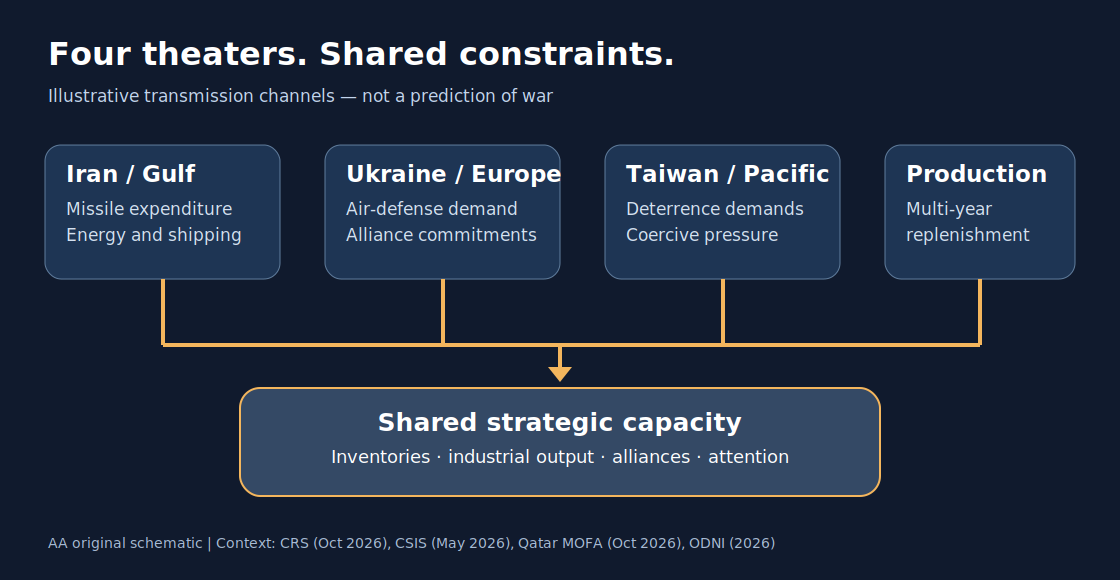
That is the historical parallel worth examining in 2026. The United States and Israel have been fighting Iran. Russia's war against Ukraine continues. European governments are confronting their own political and economic pressures. China is watching the cost of American commitments while maintaining pressure on Taiwan. Each theater has its own causes and participants. Yet they increasingly compete for the same weapons, industrial capacity, diplomatic attention and ability to absorb economic shocks.
The question is no longer simply whether Washington can prevail in one confrontation. It is whether success in one theater reduces its freedom of action in the others.
Brief
In an October 27 statement , Qatar's Foreign Ministry confirmed that mediation between Washington and Tehran remained active even as both sides raised the prospect of renewed escalation. The ministry specifically warned that further confrontation could threaten regional security and freedom of navigation through the Strait of Hormuz.
At the same time, U.S. defense stocks are under strain. An October 5 Congressional Research Service report quoted Pentagon inspector-general findings that Iran operations had produced strategic inventory shortfalls and exposed bottlenecks in replenishment. Replacing missiles requires far more time than launching them.
Now consider China. A prolonged American campaign in the Middle East can consume interceptors and long-range weapons also relevant to a crisis in the Western Pacific. Beijing does not need to start a war to benefit from an opponent's reduced strategic flexibility.
The great danger is the assumption that conflicts can be managed independently when the material and political resources required to fight them are shared.
Standard: The two historical warnings
In 1914, Austria-Hungary's confrontation with Serbia became a European and then global war through alliance obligations, mobilization timetables and political judgments that each additional step would remain controllable. The original decision-makers did not command the full sequence they unleashed.
In the 1930s, the world saw a different pattern: Japan's war in China, Italy's expansion, German aggression in Europe and competing economic blocs developed on separate clocks. The conflicts later became parts of one much larger war.
Today's situation combines features of both: several distinct confrontations, overlapping major powers, and incentives to act before the balance of power changes. The historical analogy does not establish that a new world war is coming. It identifies the mechanism by which individually limited decisions can produce collectively unlimited consequences.
Detailed: How a distant war changes the Taiwan calculation
The most consequential connection may be measured not in speeches but in missile inventories.
CSIS estimated in May that replenishing important U.S. munitions expended during the initial Iran campaign could require multiple years. Its estimates included approximately three or more years for Tomahawk, THAAD and Patriot systems, around two years for several ship-launched interceptors, and shorter periods for some other weapons. These are category-specific estimates, not a claim that the United States has run out of ammunition.
The distinction matters. A military can have sufficient capability for its current campaign while becoming less prepared for a second, larger conflict. It can also have money allocated to new production without the finished missiles arriving when needed.
Congressional researchers noted in October that the precise quantities expended remain nonpublic. Nevertheless, the Defense Department's own inspector-general reporting identifies both inventory shortfalls and industrial bottlenecks. The constraint is a combination of time, trained labor, specialized components, plant capacity and competing deliveries to allies.
For Beijing, that creates an intriguing strategic choice. China could prefer to avoid an immediate fight and watch the United States spend resources elsewhere. It could also seek leverage through maritime patrols, exercises, sanctions pressure or coercive inspections without committing to an amphibious invasion.
Taiwan is not entirely quiet. On September 29 , its Coast Guard Administration said it had deployed patrol ships to monitor a Chinese coast guard operation east of Taiwan and rejected Beijing's asserted jurisdiction. On October 30 , the agency reported two further incidents involving four Chinese coast guard vessels near Kinmen. These are specific maritime-pressure actions rather than evidence that an invasion has been scheduled.
Could China choose to escalate six or twelve months from now, after additional American expenditures? That is a scenario, not an established Chinese plan. The 2026 U.S. intelligence threat assessment said Beijing preferred to achieve unification without conflict if possible and did not have a fixed invasion timeline. Moreover, Brookings researchers have argued that diminished U.S. stocks do not automatically undo deterrence: Taiwan's defenses, allies, geography, economic costs and escalation dangers remain major considerations.
The important point is therefore not to predict a Chinese landing date. It is to understand that the decisions made in the Persian Gulf change the menu of options available in the Pacific.
The material bottleneck behind the missile bottleneck
Replacement estimates also assume the industrial supply chain can keep delivering specialized inputs. The U.S. Department of Defense's FY2026 budget justification says China accounts for over 60% of rare-earth mineral production and over 90% of downstream processing. It names rare-earth magnets, gallium and germanium as defense manufacturing vulnerabilities. The Government Accountability Office has likewise warned that the Pentagon cannot adequately map most of the more than 200,000 suppliers in its defense network.
A three-year weapons delivery schedule assumes that critical inputs can actually be obtained. Chinese export restrictions, disrupted processing or delays qualifying substitute components could make replenishment longer still. This is a potential Chinese strategic advantage that extends beyond the ships and missiles counted in any military balance.
The domestic political trap
Economic strain can also increase the political attractions of external confrontation. Scholars call this the diversionary-war mechanism: a leader can try to shift public attention from living standards and domestic grievances toward an external threat. A March 2026 University of Chicago research brief described evidence of such a mechanism in eastern Ukraine. It does not follow that every financially stressed country will choose war. But when a government ties domestic political legitimacy to confrontation, a costly exit can become harder to sell than continued escalation.
The feedback loop
A new round of Iran strikes could provoke wider retaliation, force additional missile-defense expenditures, disrupt shipping and increase energy costs. Energy shocks could weaken already strained European economies. Economic weakness could deepen domestic political pressure just as European governments face calls for higher defense expenditures.
Meanwhile, rebuilding depleted weapons inventories could redirect industrial capacity and scarce components. More orders may improve future production, but the physical output arrives on a timetable that cannot be compressed by political confidence alone.
This is why escalation management cannot be measured only by whether the first set of attacks achieved its targets. A campaign's second-order costs may be imposed in another hemisphere years later.
The decisions that matter now
The critical near-term indicators are concrete: whether Qatar's diplomacy prevents renewed Iran strikes; whether Iran and Gulf countries avoid attacks on shipping and civilian infrastructure; whether Pentagon production and delivery schedules begin closing the gap between weapons consumption and replacement; and whether Chinese maritime pressure around Taiwan stays below the threshold of a blockade or armed clash.
A wider war is not predetermined. Diplomacy is active, deterrence still matters, and the states involved have reasons to avoid a direct great-power confrontation.
But history's warning is clear: the side that starts a limited war does not necessarily get to decide how limited it remains.
Places in this story




United States, China, Russia, Iran, Taiwan
Made with Natural Earth