Japan's Cheap-Money Era Is Ending. America May Pay the Price
By Asymmetric Analytics
Analysis
Japan did not raise interest rates on October 30. Yet its central bank delivered a message with consequences far beyond Tokyo: decades of extremely cheap yen financing are no longer something global investors can safely take for granted.
The Bank of Japan held its overnight policy rate at 1.25% by an 8–1 vote. The dissenting board member wanted 1.5%. At the same time, the bank said underlying inflation had reached a level broadly consistent with its 2% target. The question is changing from how Japan escapes deflation to how it contains inflation without destabilizing financing at home and abroad.
Brief
Japan is a major source of global investment capital. Its investors have long bought foreign bonds and other assets, while leveraged traders have borrowed relatively cheap yen to finance positions elsewhere. Higher Japanese interest rates can change both decisions.
The United States has direct exposure. Japan remained the largest reported foreign holder of U.S. Treasuries in the latest available U.S. Treasury data, with $1.068 trillion in August 2026, down from $1.184 trillion a year earlier. That $115.6 billion decline in reported holdings does not by itself tell us whether Japanese investors sold bonds or how much came from custody and valuation effects. It does show why Japan matters to the market financing Washington.
If more investors find Japanese bonds competitive and leveraged yen-funded positions shrink, U.S. borrowers could face firmer competition for capital. The transmission may be gradual—or abrupt if crowded trades unwind together.
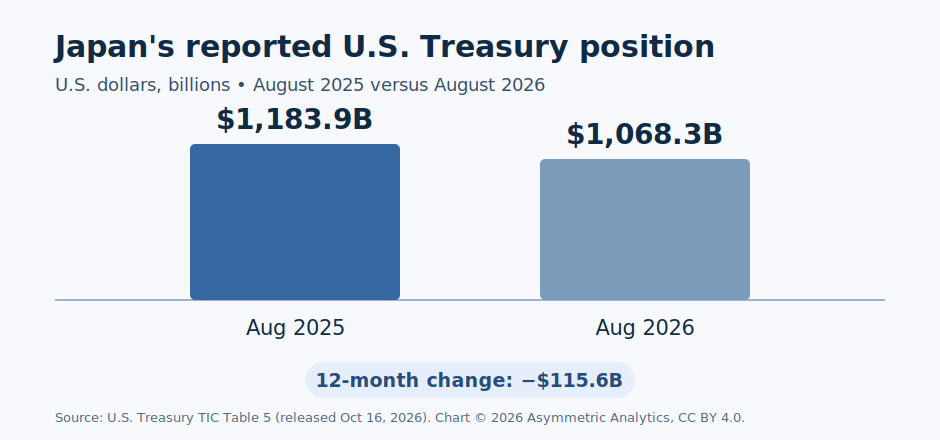
Japan-attributed Treasury holdings fell by $115.6 billion over the twelve months to August 2026. Source: U.S. Treasury International Capital Table 5, released October 16, 2026. Original Asymmetric Analytics chart, CC BY 4.0.
Standard
A carry trade starts with a simple idea: borrow in a currency where interest is relatively cheap, exchange the money, and invest in an asset promising a higher return. The investor earns the difference if the borrowing cost stays low and the funding currency does not rise enough to erase it.
Japan has spent decades offering unusually low interest rates. That made the yen useful as a funding currency. As the Bank of Japan raises the price of yen borrowing, the trade becomes less attractive. If the yen strengthens, investors who borrowed yen and hold dollar assets may need even more dollars to repay those loans. Some sell investments to close the position.
The Bank for International Settlements documented this mechanism in May 2026: large short positions in funding currencies can amplify the exchange-rate response when monetary policy tightens.
The U.S. government feels a related pressure through bond demand. Japanese institutions can compare the yield and currency-hedging cost of a U.S. Treasury with the return on a Japanese government bond. Better returns at home may make some foreign bonds less compelling. If enough marginal buyers step aside, Washington may have to offer higher yields to attract replacements.
The causal chain: BOJ normalization raises yen funding costs → some overseas investments become less attractive → carry trades may unwind and Japanese capital may rebalance → U.S. Treasury demand and global risk-asset liquidity can face pressure.
Detailed
The latest Japanese decision was a hold, not a rate hike. That distinction matters. The BOJ's October 30 policy statement retained the overnight call-rate guideline at approximately 1.25%. Hajime Takata's defeated proposal would have increased it to 1.5%. The bank's October Outlook projects only 0.7% real GDP growth in fiscal 2026, while indicating underlying inflation is broadly aligned with its 2% price-stability goal.
It is an uncomfortable combination: inflation requiring attention, growth with little room for error, and a vast financial system accustomed to low borrowing costs.
The normalization extends beyond the overnight rate. The BOJ announced that its annual exchange-traded-fund disposals would increase from ¥330 billion to ¥860 billion, measured at book value, beginning in January 2027. The sales remain measured over decades, not months. But the direction is unmistakable: the central bank is reducing extraordinary support rather than enlarging it.
For U.S. borrowing, watch the distinction between foreign holdings and foreign demand. Treasury International Capital data show that Japan-attributed holdings fell from $1,183.9 billion in August 2025 to $1,068.3 billion in August 2026, a decline of $115.6 billion. They also fell $35.6 billion between July and August 2026. Because the statistics are based mainly on custodial locations, these changes do not establish a precise Japanese selling flow or a single cause. The key question is whether future auctions continue finding sufficient buyers at prevailing yields.
The effects vary by investor. Higher Treasury yields offer more income on newly purchased bonds while reducing the market value of existing long-duration bonds. Banks, real-estate borrowers, infrastructure developers and other capital-intensive businesses pay more when higher benchmark yields filter into their financing. Highly valued equities can face pressure because distant future earnings are discounted at a higher rate.
Cryptocurrency enters the story through liquidity rather than any special connection to Japan. A forced unwinding of leveraged positions can prompt sales of readily tradable assets, including Bitcoin, regardless of their long-term prospects. Under a more orderly adjustment, meanwhile, carry traders might simply reduce exposures over time without a broad market shock.
There is a strong counter-case. U.S. Treasuries remain highly liquid global collateral, the dollar continues to play an exceptional role in financing and reserves, and Japanese institutions still compare after-hedging returns across markets. Higher Japanese rates do not automatically send capital home. Currency movements, domestic bond yields, hedging costs and U.S. inflation expectations all determine the result.
Who benefits, who pays? Japanese savers and new fixed-income buyers may benefit from better domestic yields. Leveraged borrowers, owners of existing long-duration bonds and businesses depending on cheap long-term capital face more difficult arithmetic if yields rise. The U.S. taxpayer can eventually face a larger interest bill when debt is refinanced at higher rates.
Our central question is not whether Japan increases rates again at its next meeting. It is whether the world's most important debt market can continue to finance huge borrowing needs as one of its largest foreign investor bases finds more attractive opportunities at home.
Watch BOJ decisions, Japanese government-bond yields, dollar/yen, currency-hedging costs, the Treasury's monthly country holdings and U.S. auction demand. If Japanese rates rise while U.S. demand stays strong and auctions clear comfortably, the adjustment may be orderly. If the yen rises quickly while leveraged positions contract, the market could experience a much sharper liquidity test.
Primary sources
Bank of Japan, Statement on Monetary Policy , October 30, 2026.
Bank of Japan, October 2026 Outlook and underlying inflation indicators .
U.S. Treasury, Major Foreign Holders of Treasury Securities (TIC Table 5) , August 2026 data.
U.S. Treasury, August 2026 TIC release , October 16, 2026.
BIS Bulletin 124, Monetary policy transmission to exchange rates: the role of currency carry trades , May 6, 2026.
Related AA investigation: [Japan's Energy Trap: When Imported Inflation Meets the Yen Carry Trade](/watching/ww-2026-10-20-japan-energy-trap-yen-carry-trade).