Europe's Thin Gas Cushion Turns Winter Weather Into a Global LNG Risk
By Asymmetric Analytics
Analysis
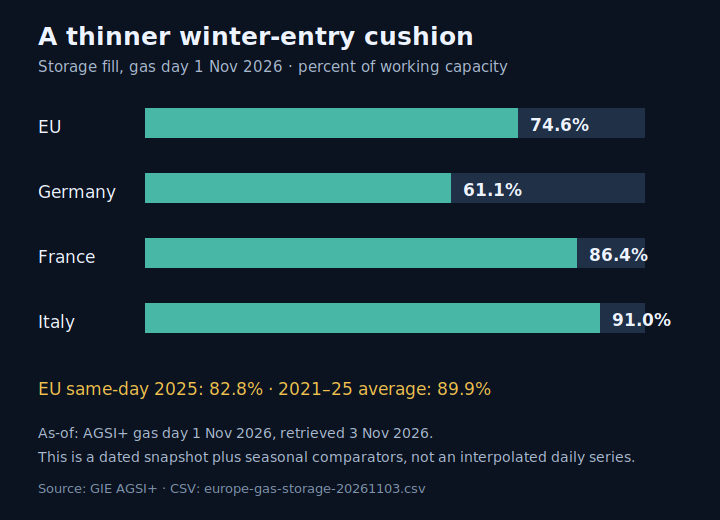
Europe is entering winter with its smallest natural-gas cushion in more than a decade. That turns an ordinary weather question—how cold will the next few months be?—into a contest over liquefied natural gas cargoes that can affect power bills and factory costs far beyond Europe.
The International Energy Agency's new Global Gas Security Review says European Union storage inventories began the 2026–27 heating season at their lowest level since 2013. Storage is the gas system's pantry: it is filled when demand is lower and drawn down when winter heating demand rises. A thinner starting stock leaves less room for a cold spell or supply failure.
Brief
The shortage follows a wider supply shock. The IEA says the effective halt of liquefied natural gas, or LNG, through the Strait of Hormuz caused loadings from Qatar and the United Arab Emirates to decline by more than 60 billion cubic metres year on year from March through October. LNG is gas chilled into a liquid so ships can carry it between regions that pipelines do not connect.
The agency projects global LNG supply will fall 3%, or almost 20 billion cubic metres, in 2026. Its November executive summary expects global gas demand to decline by about 1.5%, or nearly 65 billion cubic metres. That is a substantial revision from the IEA's July forecast of about 0.5%, or 20 billion cubic metres: high prices destroyed more demand in the Middle East, European industry used less gas and some Asian power systems switched from gas to coal.
Standard
Low storage does not mean Europe is about to run out of gas. The European Commission's October winter assessment said the system was flexible enough to meet winter demand. It pointed to greater LNG import capacity, more diversified supply and lower gas demand than before the 2022 crisis.
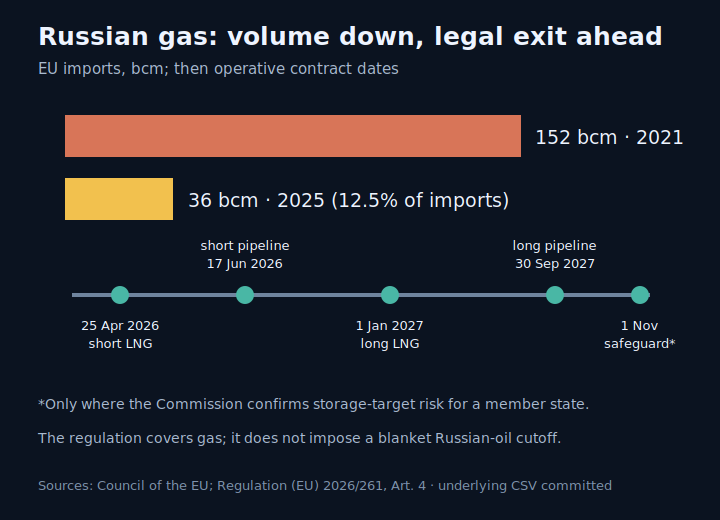
Europe is also changing the legal supply baseline. Under Regulation (EU) 2026/261, Article 4 , pre-June-2025 long-term contracts may continue Russian LNG only until 1 January 2027 and Russian pipeline gas until 30 September 2027. The Commission can move the pipeline date to 1 November 2027 for a member state at risk of missing its 2027 storage target. Earlier cutoffs already applied to qualifying short-term contracts—25 April 2026 for LNG and 17 June 2026 for pipeline gas. This regulation phases out Russian gas; it prepares a separate oil phase-out and is not a blanket Russian-oil cutoff.
The vulnerability lies at the margin. A flexible LNG cargo can be redirected to the buyer offering the best combination of price and contract terms. Europe, Asia and South America therefore compete for some of the same ships. When stored gas is scarce, Europe must compete more often in that spot market.
The causal chain: low storage reduces Europe's winter buffer → cold weather or an outage raises import needs → buyers bid for flexible LNG cargoes → spot gas and power costs can rise → energy-intensive factories face margin pressure and households face renewed inflation.
Detailed
The market is more resilient than it was in 2021–22, according to the Commission. More terminals can receive LNG, trading arrangements are more flexible, and demand has adjusted. Those changes make a physical shortage less likely. They do not guarantee a low price.
That distinction matters for industry. Fertilizer, chemicals, glass, ceramics and metals use gas as fuel, feedstock or both. A factory may be able to buy gas yet still cut output because the price makes production uneconomic. Lower industrial demand is therefore both part of the market's adjustment and evidence of its cost.
There is also a timing problem. Drawing heavily from storage can keep homes warm this winter but leave a larger refill job next spring. If flexible LNG remains scarce, competition can persist into 2027, even after peak heating demand passes.
The legal phase-out sharpens that refill problem: the long-term LNG cutoff arrives during winter, and most long-term Russian pipeline supply ends before the following heating season. Europe can replace volumes through conservation, non-Russian pipelines and LNG, but the marginal cargo is globally contested. The Commission and ENTSOG judge the network capable of meeting demand; their counter-case is about physical flexibility, not a promise of cheap delivered energy.
The counter-case is a mild winter combined with continued demand restraint and reliable alternative supply. Under that scenario, Europe's expanded import system could bridge the storage gap without another severe price spike. Destination-flexible contracts—agreements that allow cargoes to be redirected—also make supply more responsive than rigid point-to-point contracts did.
Watch winter temperatures, weekly storage withdrawals, LNG arrivals, European industrial gas use and the price gap between European and Asian hubs. The decisive signal is not whether storage falls; it always falls in winter. It is whether inventories fall so quickly that Europe must pay a growing premium to secure the next flexible cargo.
Primary sources
International Energy Agency, Global Gas Security Review 2026 , November 3, 2026, CC BY 4.0.
International Energy Agency, Global Gas Security Review 2026 executive summary , November 3, 2026, CC BY 4.0.
International Energy Agency, report release , November 3, 2026.
International Energy Agency, Gas Market Report Q3-2026 executive summary , July 2026, CC BY 4.0.
European Commission, EU gas-system winter assessment , October 8, 2026.