America's Labor Market Is Waking Up: 333,000 More Openings as Workers Regain Confidence
By Asymmetric Analytics
Analysis
After months of an unusually quiet American labor market, employers are advertising more positions, employees are changing jobs again, and fewer people are being laid off.
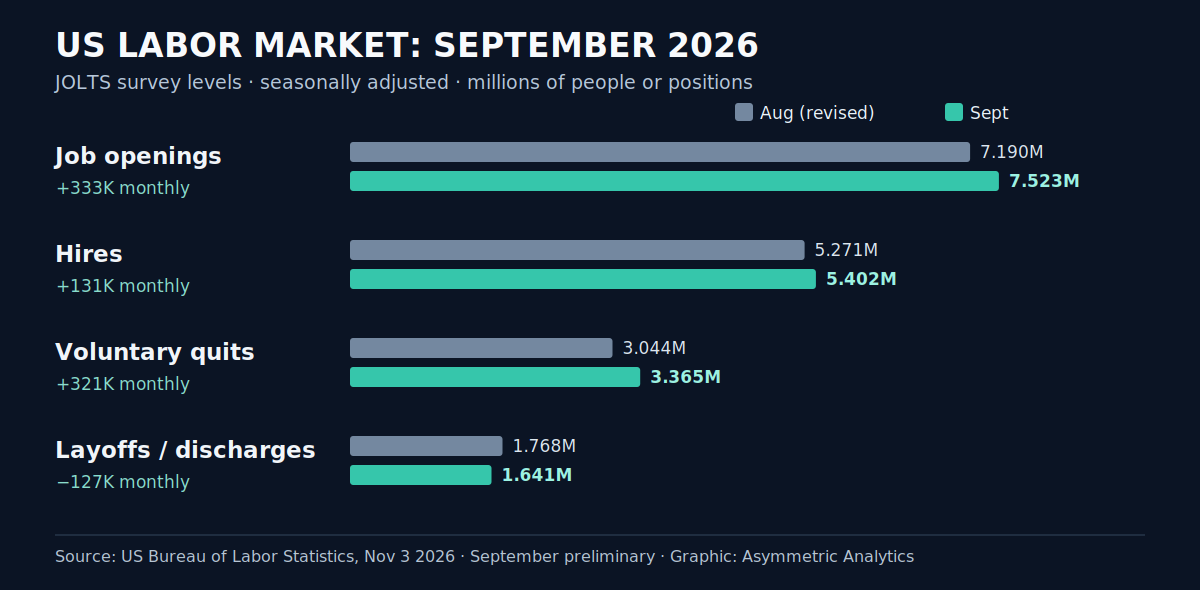
The Bureau of Labor Statistics' September Job Openings and Labor Turnover Survey , released November 3, reported 7.523 million job openings, up 333,000 from August's revised 7.190 million. Employers hired 5.402 million people during the month, 131,000 more than in August. Voluntary quits climbed by 321,000, while layoffs and discharges fell by 127,000.
These movements matter because a labor market is not merely a count of available jobs. It is a system of employers seeking workers, workers pursuing better opportunities, and households deciding how much economic risk they can afford.
Brief
The most revealing change may be the 321,000 increase in Americans voluntarily leaving their jobs. The quits rate rose from 1.9% to 2.1%. Employees generally become more willing to make that move when they expect another job, better pay or better working conditions to be available.
The same report found 1.641 million layoffs and discharges, down from 1.768 million in August. More job opportunities alongside fewer involuntary departures is a welcome combination.
A useful distinction: job openings are vacancies at the end of September; hiring and separations are flows measured throughout the month. The 333,000 additional openings are not 333,000 newly employed Americans. They are evidence of demand for labor that may turn into employment later.
Standard
There are signs of strength beyond one sector. Manufacturing openings rose from 530,000 to 584,000. Construction openings increased from 262,000 to 298,000. Professional and business services added 106,000 vacancies; state and local government outside education added 104,000.
But new factory job advertisements are not yet a factory hiring boom. Actual manufacturing hires fell by 34,000 to 313,000, even as manufacturing vacancies rose. Construction presents a more encouraging combination: openings gained 36,000 and hires rose 49,000.
That contrast is central to the story. A business can advertise a position because it anticipates expansion, needs a specialized worker, or cannot fill an existing vacancy. The economic acceleration arrives when that employer hires, invests, produces and sells more.
The quits increase also has a particular shape. Accommodation and food services accounted for 197,000, or roughly three-fifths, of the monthly gain. The improvement in worker mobility is real in the survey, but its concentration matters when interpreting how broadly confidence is spreading.
The causal chain: more available positions improve workers' outside options → workers are more willing to move → employers compete to attract and retain labor → successful hiring can expand production, household income and demand. If productivity improves alongside employment, more output can be produced without equivalent pressure on unit costs.
Detailed
America has been investing heavily in factories, data centers, power infrastructure and automation. The intriguing possibility is that a period of investment is beginning to translate into a stronger economy for workers. This JOLTS report offers an early test of that idea, not a verdict: it records labor flows, not the causes of those flows or the productivity of the resulting jobs.
The Federal Reserve faces a related challenge. When employers compete for a fixed pool of workers, wages and prices can accelerate. But if technology and capital investment increase output per worker, companies may be able to grow more rapidly without a proportional increase in costs. The distinction between more demand and more productive capacity is crucial to interest-rate policy.
For investors, a labor-market rebound with improving productivity is fundamentally different from a temporary demand surge. The first can support sustained earnings and real income; the second may force the Fed to keep borrowing costs higher.
September's figures deserve proportion. The BLS characterized openings and hiring as little changed at the statistical precision of its survey. August's openings estimate was also revised upward by 111,000. A single monthly increase is a signal worth investigating, not the whole economic cycle.
The next question is whether employers turn those openings into hires. September's combination of rising quits, rising hires and falling layoffs indicates a market becoming more active. Sustained payroll growth, real wage gains, industrial production and output per hour will show whether activity becomes a broader acceleration.
What would change our view
If vacancies retreat, completed hires fail to follow, or layoffs begin climbing while worker mobility weakens, this would look like a short-lived rebound rather than the start of a durable employment expansion. The strongest confirmation would be several months of firmer hiring alongside rising output and productivity.
Primary sources
Bureau of Labor Statistics, Job Openings and Labor Turnover Survey, September 2026 , released November 3, 2026.
Bureau of Labor Statistics, JOLTS latest numbers , September 2026.