France's New Speech-Law Proposal Raises a Bigger Question: Who Decides What Goes Unsaid?
By Asymmetric Analytics
Analysis
A law does not need to produce many convictions to change a public conversation. Sometimes the prospect of a prosecution is enough. Editors decline assignments. Speakers soften arguments. Citizens leave difficult questions unasked. None of those missing words appears in an official censorship statistic.
That possibility has become newly relevant in France. Following the October 23 racist attack near Trappes , which killed one person and injured seven, Green lawmakers introduced proposals to strengthen penalties for incitement to discrimination, hatred or violence. Senate proposal no. 125 was filed October 29; deputies Sabrina Sebaihi and Steevy Gustave filed a related proposal October 30.
Brief
The proposals would clarify that references to demographic replacement or remigration can amount to unlawful incitement when they portray a group as a threat because of its origin or ethnic or national belonging. The deputy text also proposes penalties of up to three years in prison and €75,000 in fines for covered speech by elected officials or candidates. These are proposals, not an enacted nationwide ban on immigration debate. LCP's account of the submitted text supplies the operative distinction.
The legislative aim described by the sponsors is to prevent racist rhetoric from encouraging discrimination and violence. The competing concern is whether politicians, publishers and ordinary citizens will interpret the legal risk more broadly than lawmakers intend.
The larger issue is not only what a court might eventually punish. It is what people choose never to say because they are unsure where the boundary lies.
Standard
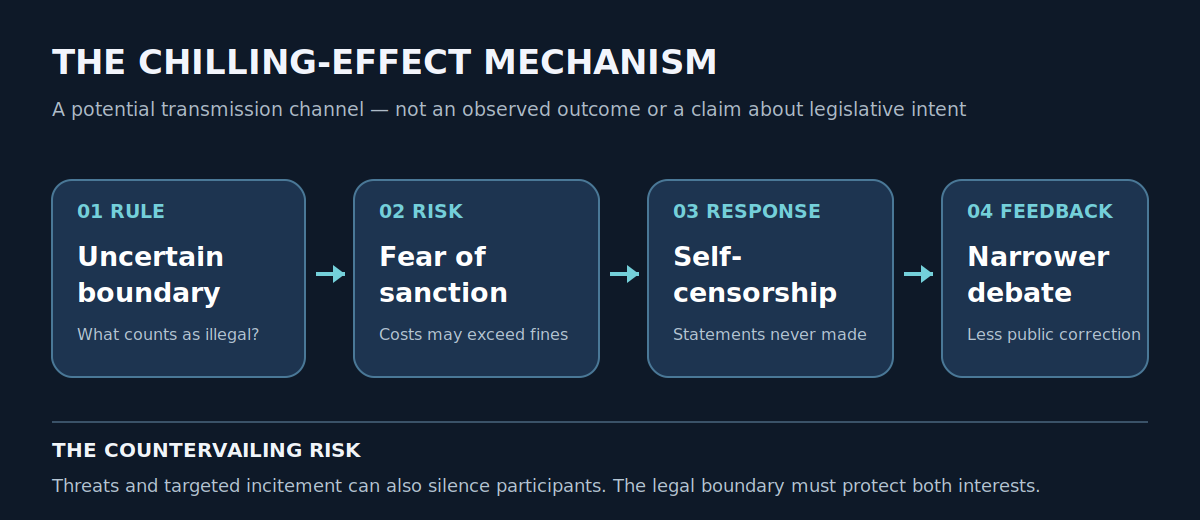
The Council of Europe's freedom-of-expression guidance explicitly recognizes that legal provisions and threatened sanctions can have a chilling effect on public debate. It calls for adequately defined offenses, proportional consequences and safeguards against abuse. This is not a claim that France's draft has already generated widespread self-censorship; it is a recognized mechanism by which a law can reach beyond its prosecutions.
The distinction between demographic observation and a theory of intentional demographic replacement is equally important. France's statistical agency, INSEE , estimates that immigrants accounted for 11.6% of the population in 2025, up from 7.4% in 1975. INSEE cautions that a change in collection methodology makes figures before 2024 not strictly comparable with 2024–25. The population is changing. Those statistics do not establish a coordinated conspiracy to replace French citizens. Nor does rejecting that theory settle legitimate policy questions about immigration levels, integration, public services or national identity.
A healthy debate requires room to investigate those questions with evidence, while maintaining legal protections against threats and incitement directed at people because of who they are.
Detailed
The possible causal chain runs as follows: an unclear legal boundary plus severe possible penalties → heightened perceived risk → risk-averse editors, employers and speakers → fewer contested claims aired or examined publicly → a weaker feedback loop between citizens and policymakers. Each arrow is a potential mechanism, not a measured result in France.
There is a genuine disagreement among French legal experts about whether the new bill would change much. In Public Sénat's November 2 reporting , press lawyer Christophe Bigot argued that existing legislation already captures discriminatory incitement and warned that expanding the offense could create a gray area for expression. Public-law scholar Thomas Hochmann argued that making the application more explicit could help courts enforce existing protections. The sponsors themselves say ordinary immigration debate remains legitimate.
Both sides are addressing real democratic interests. Dehumanizing or threatening minorities can deter participation in public life. But overly broad criminal rules can deter criticism, investigation and disagreement. A credible framework needs to protect against both kinds of silencing.
The economic consequence, if the chilling effect becomes persistent, would be indirect. Governments depend on difficult feedback to correct problems in education, public spending, labor markets, security and integration. If reporting and debate become less candid, poor policy can survive longer. That is a hypothesis about governance and institutional adaptability—not evidence that this French proposal has damaged economic growth, or proof of its sponsors' private intentions.
What would change our view
The immediate test is the bill's actual progress and wording: Does Parliament narrow the prohibition to demonstrable incitement and threats, or expand it to disputed political descriptions? If enacted, the decisive evidence would come from enforcement patterns, court decisions, journalists' and publishers' documented experiences, and whether lawful immigration-policy discussion continues openly. A tightly applied law without observable spillover would weaken the chilling-effect concern. A pattern of investigations or withdrawn reporting involving protected debate would strengthen it.
Primary sources
French Senate, legislative dossier for proposal no. 125, filed October 29, 2026 .
LCP, reporting and quoted parliamentary proposal, October 30, 2026 .
Council of Europe, Preventing Abuse of Law, freedom-of-expression guidance .
INSEE, France immigrant population, 1921–2025, June 4, 2026 update .