Ripple Isn't Replacing XRP With Stablecoins. It's Building the Markets XRP Was Designed to Connect.
By Asymmetric Analytics
Analysis
The popular argument goes like this: Ripple is issuing a dollar stablecoin, so it must be abandoning XRP. That conclusion confuses a currency being transferred with an asset that can connect currencies.
Ripple USD (RLUSD) can move dollars without converting them into XRP. But that is not the end of the design. It is where the larger network begins.
Brief
Every new stablecoin on the XRP Ledger creates another potential market in which XRP can serve as a bridge. A user holding a euro token may want to pay someone in digital dollars. Instead of requiring deep, separately funded markets for EURGH/RLUSD, EURGH/USDC and EURGH/USDT, an exchange can assemble a route through XRP when that route is cheaper.
This is not a proposed feature. The XRP Ledger's documented auto-bridging mechanism already lets XRP act as the intermediary between two issued assets on its native exchange. The question is whether market makers and payment providers will supply enough liquidity for that option to matter at institutional scale.
The strategic thesis: stablecoins need not replace XRP. They can create more reasons to use the market structure XRP was built to connect.
Standard
Consider the familiar problem of fragmented foreign-exchange markets. A euro stablecoin can be quoted directly against one dollar stablecoin, and then another, and another. Add other currencies, tokenized money-market shares and settlement assets, and the number of possible direct combinations grows rapidly. Capital must be made available across whatever markets participants actually trade.
The new GateHub Euro token, EURGH, provides a timely illustration. Dinaro's published terms describe a euro-denominated e-money token primarily intended for XRPL and Xahau, with redemption obligations against the issuer. GateHub's gateway terms list EURGH alongside bank-payment methods including SEPA and SEPA Instant. Those documents establish intended rails and contractual structure; they are not evidence of a particular amount of active EURGH/XRP trading.
Imagine a payer with EURGH and a recipient who wants RLUSD. There are two economically relevant possibilities:
Direct route: EURGH converts into RLUSD in a liquid direct market.
XRP route: EURGH converts into XRP, which converts into RLUSD through two markets.
XRPL's native exchange can combine direct and XRP-mediated liquidity. Its cross-currency payment machinery can also use a cheaper XRP path, provided sufficient offers exist. XRP does not have to be the destination currency, and the recipient need not choose to hold XRP.
This is why the launch of more regulated assets on XRPL has a second-order consequence. It increases the set of possible currency conversions that could use XRP as a common intermediary. Ripple's own account of stablecoins on XRPL identifies RLUSD alongside USDC, EURØP and Singapore-dollar token XSGD. A broader menu of useful assets can attract more participants, which can make shared liquidity more useful.
Detailed
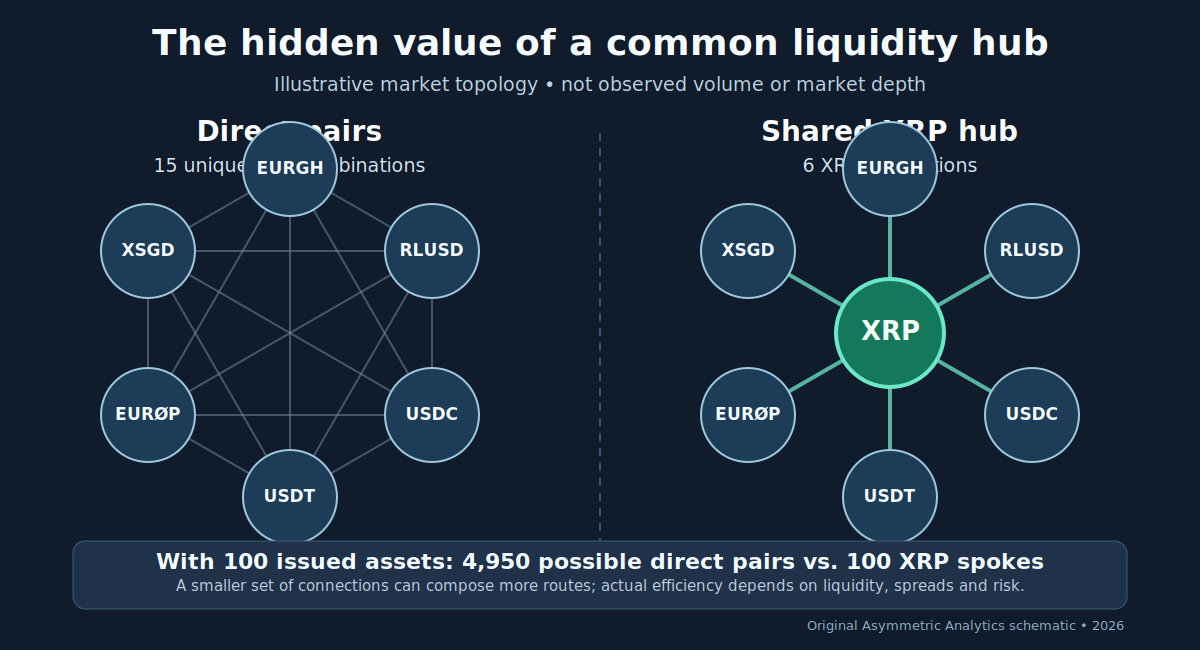
The mathematics is simple. Among six issued assets, there are 15 distinct pair combinations. Connecting each of those six assets to a common XRP hub requires six spokes. For 100 issued assets, the corresponding counts are 4,950 direct combinations and 100 hub connections.
These are possible market connections, not an assertion that all combinations trade or that every direct pair requires a separate bank account. Real market makers concentrate liquidity in high-volume pairs. Nevertheless, the comparison explains why a shared intermediary can become valuable as the number of assets grows: routes can be composed from fewer liquid building blocks.
The mechanism also has an economic flywheel. More useful on-ledger assets can attract traders and payments; demand for conversion can attract market makers; deeper XRP pairs can make XRP paths more competitive; better conversion economics can attract further activity. Each step must happen in the real market, rather than merely in a protocol diagram.
What is XRP's economic role? Network fees and account reserves create direct but relatively modest uses for XRP. Bridge markets are a different category: liquidity providers may hold XRP inventory, quote both sides of markets, and continuously buy and sell it to complete settlement flows. If XRP becomes a widely used settlement hub, the capital needed to support attractive trading depth and tight spreads could become more important than the small amount burned in transaction fees.
That observation is not a formula turning payment volume into market capitalization. The same XRP can be reused many times. Capital requirements depend on volatility, depth, inventory turnover, market-maker financing, netting and whether trades are ultimately routed through XRP at all.
Ripple has described the instruments as complementary. Its stablecoin strategy explicitly contemplates direct stablecoin use where XRP is unnecessary, alongside XRP bridge settlement where it offers an efficient route. That is consistent with what the ledger actually does.
The competitive test is therefore demanding. A two-leg XRP route must overcome two spreads and any market impact. A deep direct pair may be preferable. Other chains, stablecoins and bank settlement systems can also concentrate liquidity around a different hub. Regulatory restrictions, issuer-specific trust lines and redemption access matter as much as software design.
But the conceptual mistake is to look at a stablecoin and say, that asset can be transferred without XRP, therefore XRP has no role. That ignores currency exchange, where an additional asset is not simply another substitute for XRP. It can also be another endpoint that XRP has an opportunity to connect.
What would change our view
The bullish network thesis becomes more persuasive if XRPL data show rising XRP-mediated conversion volume, tighter effective spreads, deeper XRP/issued-asset order books and more payment corridors using those paths. It weakens if stablecoin growth produces almost exclusively direct transfers, shallow XRP markets or better-priced routes elsewhere. Those measurements matter more than the count of token announcements.
RLUSD can be the entry point. More assets can create more exchange routes. XRP's opportunity is to become the shared liquidity between them. That is the economic proposition worth measuring.
Primary sources
XRP Ledger: Cross-Currency Payments .
XRP Ledger: Decentralized Exchange .
Dinaro: EURGH terms via GateHub .
GateHub: Gateway and supported payment methods .
Ripple: Global stablecoins on XRPL , June 12, 2025.