When AI Makes the Index Fragile: The Capital Contest Behind a Narrow Market
By Asymmetric Analytics
Analysis
Imagine that artificial intelligence continues to improve, businesses become more productive, and millions of customers adopt new software—and that the stock market still suffers a painful correction.
There is no contradiction. Technologies are engines of future economic activity. Stocks are financial claims on expected future cash flows, bought at today's prices and discounted at prevailing interest rates. A great invention can change civilization without rewarding every investor who purchases the most celebrated companies at the wrong valuation.
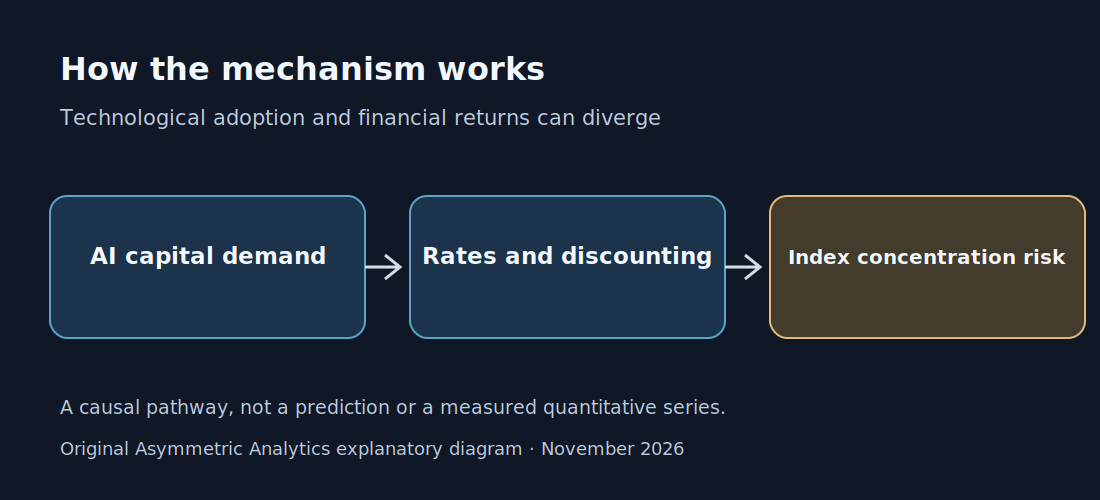
That distinction is increasingly important as the AI capital buildout becomes intertwined with a narrow group of large companies, expensive electrical infrastructure, long-lived data centers and a bond market competing to finance both private projects and government deficits.
The question is not simply whether AI is a bubble. It is whether the financing structure of the AI transition is more fragile than the technological transition itself.
1. BlackRock's changing position is a clue, not an abandonment
BlackRock's Q4 2026 global investment outlook embraces AI's economic significance while emphasizing scarcity, bottlenecks and the need to finance an immense infrastructure buildout. Its November portfolio positioning lists U.S. equities as neutral, short-term Treasuries overweight and longer-term Treasuries neutral, even as the firm continues to favor particular AI and technology opportunities.
That combination is instructive. One can believe AI will transform the economy and still become more selective about the prices investors pay to own that transformation.
The market does not need an AI collapse for a rerating. It needs a smaller gap between what a business eventually earns and what the previous share price assumed it would earn.
This is especially important when index performance is driven by companies sensitive to overlapping assumptions: continued enterprise spending, cheap or available power, sufficient semiconductor supply, low enough long-term financing costs, and regulatory permission to construct new infrastructure.
2. The index hides more than it reveals
A capitalization-weighted index assigns more weight to companies with greater market values. When a small number of large firms grow faster than others, they can dominate headline returns. That concentration is not inherently unhealthy: successful companies should be represented in proportion to their market values.
The vulnerability emerges when the businesses share highly correlated economic assumptions.
Consider several kinds of AI exposure. Semiconductor suppliers depend on equipment orders and manufacturing capacity. Cloud providers must invest heavily before all customer revenue arrives. Electric utilities and grid developers require permits and large upfront capital. Software vendors depend on pricing power and adoption. Technology financiers depend on interest rates, credit conditions and their access to investor capital.
These firms have different business models, yet their valuations may react together when investors revise a common belief about AI capital spending, profitability or the cost of money.
A narrow index can therefore look stronger than the average company's earnings experience and can fall quickly when a common assumption changes.
3. The Treasury market is part of the AI story
Capital has alternative uses. The U.S. government issues debt, households save, pension funds allocate portfolios, and businesses finance infrastructure. As yields on government securities rise, the future profits of a company generally become less valuable in today's dollars, all else equal.
The public series for ten-year Treasury yields and ten-year real yields allow researchers to compare observed financing conditions with changes in equity valuations. Their movements do not by themselves establish causality.
A rise in real yields can result from several forces. Stronger expected productivity might increase the return on capital. Inflation risk and government borrowing needs can raise term premiums. Central bank policy can change short rates. Different causes produce different effects on corporate cash flows and equity valuations.
This creates the paradox: improved prospects for productivity may support future earnings while higher real rates lower what investors are willing to pay for those earnings today.
The relationship is not mechanically bearish. Strong companies can outgrow their discount-rate headwinds. But the margin for disappointment shrinks when prices assume both strong future growth and abundant financing.
4. Cash-rich champions and capital-hungry challengers are not equivalent
Not every participant in the AI economy faces the same financing risk.
Large cloud and software firms may be able to fund enormous investments from operating cash flows. Young infrastructure firms, data-center developers, smaller software companies and their suppliers may rely much more heavily on external equity or debt. A high-rate environment can therefore redistribute opportunities toward firms with balance-sheet strength.
This matters for competition. If the largest companies can keep building through a credit tightening while smaller innovators cannot, the technological ecosystem may become more concentrated. Yet that does not guarantee monopoly profits: competition among major providers can also compress returns despite continuing user adoption.
Power, grid connections and chip availability add another layer. Capital cannot instantly create a transformer, transmission right-of-way or specialized semiconductor manufacturing tool. Economic scarcity may raise costs for the very firms whose valuations depend on scaling quickly.
BlackRock's weekly commentary repeatedly emphasizes selectivity around these real-world constraints. The challenge is to distinguish scarcity that creates pricing power for a supplier from scarcity that reduces the margins of its customers.
5. Three paths for the AI capital cycle
Scenario 1 — Productivity outruns costs. Enterprise adoption translates into measurable productivity and profits. Infrastructure capacity becomes available, financing remains manageable, and high capital spending generates durable revenue. Market breadth may widen as beneficiaries emerge outside the largest technology firms.
Scenario 2 — Valuation correction without a technology collapse. AI adoption continues but near-term revenue is slower than expected, power and construction costs remain high, and equity investors demand higher returns. Share prices fall despite rising use of AI. The underlying technology becomes cheaper or more available while investors suffer.
Scenario 3 — Financial and industrial bottlenecks reinforce one another. Credit spreads widen as new projects need funding; data-center and electricity delays reduce expected returns; weaker valuations further constrain smaller firms' financing. Industry consolidation increases even while advanced models continue improving.
None is an index forecast. These are causal alternatives with observable conditions.
6. Where digital assets enter the picture
Crypto assets and stablecoins are sometimes grouped together as one liquidity trade. They are not identical.
Bitcoin and speculative crypto tokens may react strongly to broad risk appetite or leverage unwinds. Payment networks and stablecoin infrastructure, meanwhile, can experience operational adoption even in a weak speculative market. Dollar-backed stablecoin issuers can also create demand for short-dated Treasury securities, which is different from solving the government's long-duration borrowing challenge.
A future in which tokenized settlement networks process more transactions but speculative token prices decline is entirely plausible. So is a period in which easier liquidity benefits nearly every risk asset before real-world utility has materially changed.
For investors, the useful question is not whether blockchain is the future. It is which cash flows, fees, collateral structures and risk exposures actually accrue to the security or token they own.
7. A better measure of the transition
We should separate three scoreboards: technological progress, real economic adoption and financial return.
Technological progress asks whether models become more capable at a lower unit cost. Adoption asks whether enterprises generate higher output, lower costs or better services. Financial return asks whether the owners of particular securities earn enough cash flow relative to what they paid and the risks they assumed.
These three measures may move in different directions for years.
In the long run, the greatest economic benefit from a technological revolution may accrue to consumers and businesses using it—not necessarily to every company selling the infrastructure that made it possible.
That is why a strong AI thesis can coexist with a cautious market thesis.
What would change our view
1. Market breadth: Does equal-weighted index performance and earnings growth improve relative to the capitalization-weighted market over several quarters? 2. Financing conditions: Are real Treasury yields (the FRED DFII10 series) and credit spreads increasing without corresponding improvement in AI-linked free cash flow? 3. Economic adoption: Do enterprise productivity gains, data-center utilization and recurring AI revenue increase enough to justify the capital expenditure required? Greater breadth and durable cash generation weaken the fragility thesis; persistent funding stress and narrower earnings leadership strengthen it.
Primary evidence
BlackRock Investment Institute, Q4 2026 Global Investment Outlook .
BlackRock Investment Institute, weekly market commentary .
ELSI trail
AI capital expenditure, operating cash flows, real Treasury yields, equity concentration, supply-chain bottlenecks and productivity are connected but distinct mechanisms. A falling stock price cannot by itself measure a decline in technology adoption.