The AI Revolution Meets the Permission Economy
By Asymmetric Analytics
Analysis
The machines are advancing faster than the systems needed to accommodate them. The decisive obstacle may increasingly be neither money nor invention, but the right to build.
The one-minute reading
Amazon Web Services has abandoned a proposed data-center development at a former university campus in Loudoun County, Virginia. In a county where data centers provide nearly two-fifths of the local government's budget, the world's best-financed computing industry encountered something it could not simply buy: local consent on its original terms.
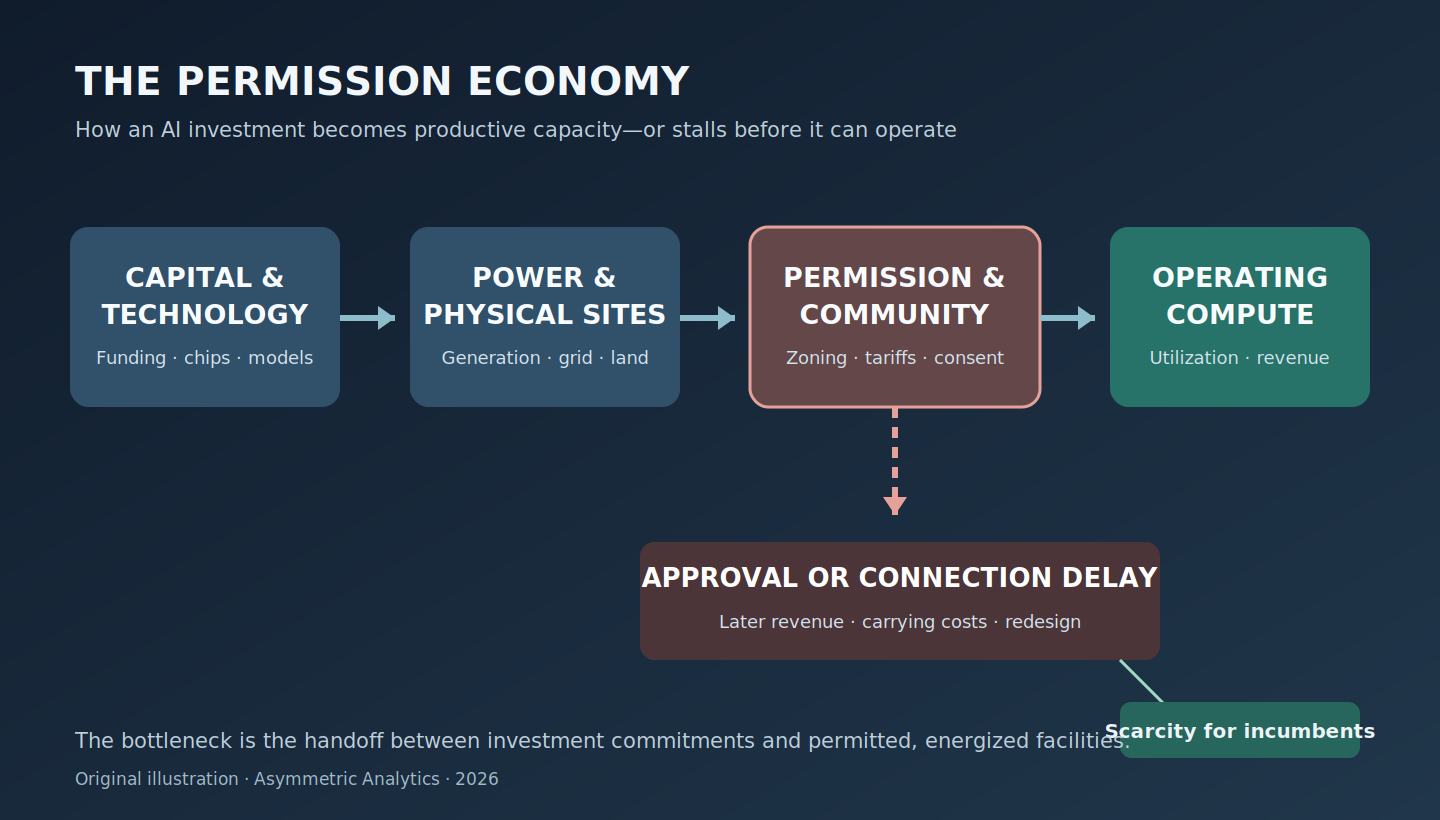
That event does not mean Data Center Alley is going dark. Loudoun has tens of millions of square feet of approved, unbuilt data-center space. The sharper finding is that AI infrastructure now faces a growing permission economy: grid connections, electrical generation, land-use approvals, residential acceptance and political negotiations increasingly determine where—and how fast—capital can become useful computing capacity.
This is not merely a story about frustrated developers. Local people have legitimate reasons to ask who pays for substations, transmission lines, industrial noise and land conversion. Those demands are changing utility rules and development economics. The outcome will help decide which investors earn the returns projected for AI, which communities accept the transition and which nations can deploy advanced computing at scale.
We are developing technologies capable of accelerating civilization while discovering how difficult it is to accelerate civilization itself.
The five-minute analysis
The scale of the mismatch is striking. The International Energy Agency's 2026 analysis projects global data-center electricity consumption nearly doubling from 485 terawatt-hours in 2025 to 950 TWh in 2030. That is a projection for all data centers, not just AI, but AI-focused facilities account for a rapidly growing portion. PJM's 2026 forecast puts annual growth of its regional summer electricity peak at 3.6% over ten years, compared with 0.3% projected in 2021.
Servers can be ordered faster than major transmission corridors and generation assets can typically be built. A developer can sign financing commitments before all of its land-use and electricity questions have been settled. A government may welcome the investment in principle while neighborhood residents oppose a particular site.
The result is not a single national cap on innovation. It is an uneven map of permission. Some campuses advance. Others are redesigned, delayed or abandoned. The implications can be counterintuitive: delays hurt prospective projects but may increase the value of already-energized capacity; stronger cost-allocation rules may raise a developer's expense but reduce the political opposition that would otherwise block the entire project.
We think the important market question is shifting from 'How much AI infrastructure has been announced?' to 'How much can be built, energized, operated and monetized on the announced schedule?'
The global question follows naturally: if the ability to connect electricity, build infrastructure and coordinate public decisions determines AI deployment, physical and institutional capacity becomes a source of strategic advantage.
---
1. The place that made the internet possible now confronts the next wave
Northern Virginia did not become Data Center Alley by accident. Fiber connections, access to major customers and decades of favorable local economics created a dense network of computing facilities. Concentration reinforced itself. Once networks, energy infrastructure, suppliers and specialists gathered in one place, newcomers had good reason to join them.
It was an unusually successful model of economic development.
By FY2026, data centers generated approximately $1.2 billion in real and personal property tax revenue in Loudoun County , representing 39% of its overall budget. For FY2027 the county projects $1.3 billion and 40%. Public revenues support services far beyond the data-center properties themselves.
Then came Amazon's Ashburn campus.
AWS acquired the former George Washington University Virginia Science and Technology Campus and pursued a development of four data-center buildings. Residents opposed the project. Following negotiations, the county announced on October 22 that AWS intended to withdraw its application, forgo legal action over development there, convey approximately 25 acres valued at $65 million for public purposes and offer another $5 million for the county housing trust fund. Loudoun would expedite rezoning of the other 97 acres for housing and mixed uses. Those terms remain preliminary; the university's operations will continue for several years.
The announcement was a reversal of a site plan—not a corporate withdrawal from the Northern Virginia cloud market. But the agreement illustrates the new bargaining power of communities: an infrastructure developer may have considerable capital and still discover that its preferred development is unacceptable.
At the same time, Loudoun's own figures show 35.7 million square feet of approved but unbuilt data-center space. Between 2022 and May 2026, the county approved 32 of 39 legislative applications. There is no evidence here of a regional demand collapse. There is evidence that expansion is becoming more selective and contentious.
That distinction is essential. A new constraint can be economically decisive without bringing an entire industry to a halt.
2. What the original Luddites can teach us
In 1811, skilled textile workers in England began attacking machinery that threatened established work arrangements. The name Luddite eventually became a synonym for irrational opposition to progress. The real history was more revealing.
The UK National Archives describes a movement responding to wage reductions, changing methods of production and the displacement of skilled labor. Nottinghamshire workers protested falling wages; in other regions, mechanization undermined occupations and customary relationships between employer and worker. Their actions included violence and destruction. Their economic grievances were nevertheless genuine.
The useful analogy is not that today's homeowners are textile workers or that local planning hearings are machine-breaking. They are not. The analogy concerns the distribution of benefits, costs and power during technological transition.
A new technology can improve national productivity while imposing immediate losses on particular people. Those people may oppose the transition, demand compensation, insist on safeguards or seek political protection. A society that mistakes every objection for ignorance fails to understand the economic incentives driving resistance.
Yet the opposite mistake is equally serious. Existing stakeholders can use procedural power to preserve valuable privileges or block infrastructure whose wider social benefits exceed its local costs. Institutions may respond to every new burden with delay rather than a workable bargain.
Both mechanisms can be true at once. The task is to distinguish legitimate cost correction from obstruction that merely transfers costs onto everyone else.
3. Why a data center is not just a building
From a distance, a data center appears to be a large industrial structure packed with computers. Economically, it is the visible end of a much longer infrastructure chain.
It needs land and zoning. It needs transformers, switchgear, backup systems, cooling, trained operators and high-capacity fiber connections. Above all, it needs electricity delivered at the required scale and reliability. That in turn depends on generation, transmission, substations and regulatory agreements. A delay anywhere in this chain can delay the entire project.
The grid numbers show why this is no longer a side issue. The IEA's revised 2026 outlook projects approximately 950 TWh of global data-center electricity use by 2030. PJM projects summer peak demand rising to more than 222 gigawatts by 2036, from roughly 154 gigawatts today. That growth is not all attributable to AI, but data centers and AI are important drivers.
There is a second constraint that capital markets often underappreciate: physical lead time. Electricity generation projects, large transformers and transmission corridors do not arrive with the same cadence as new chips or software releases. Some can be accelerated through standardization and reuse; others must pass through engineering, land acquisition, permitting, litigation and construction.
An infrastructure forecast that counts every announced megawatt as if it were already operating is not a deployment forecast. It is a wish list awaiting physical and political execution.
4. The local cost problem is real—and measurable
A data center can generate substantial public revenue while producing relatively few permanent jobs per acre compared with some alternatives. It may also impose localized construction disruption, visual impacts, industrial noise and the need for nearby electrical facilities. Residents reasonably ask whether their neighborhood must accept those consequences for benefits that flow across a wider tax base.
Electricity creates a particularly important distribution problem. When a utility invests in new generation or wires, regulators must decide which customers should pay the resulting costs. Developers may enter the system on forecasts that later change, leaving utilities with underused assets or customers with contested bills.
Virginia commissioned unusually detailed work on this. In its 2024 data-center assessment , the Joint Legislative Audit and Review Commission modeled additional 2040 generation and transmission costs for a typical Dominion residential customer of approximately $14 to $37 per month, depending on the level of data-center growth and policy scenario. These are scenario estimates, not observed increases today.
The state's response has been concrete. In November 2025, the Virginia State Corporation Commission approved a new GS-5 rate class for customers requiring 25 megawatts or more, effective January 2027. It also established minimum payment commitments for contracted electricity capacity. Such rules are intended to put more of the infrastructure risk on the large users that cause it.
That is not a retreat from technological progress. It is an attempt to correct its pricing.
And this matters to the broader thesis: a credible bargain over costs may be one of the strongest accelerators of AI deployment. Communities can become more willing to host facilities when developers pay transparently, infrastructure benefits are tangible and the rules are durable.
5. When capital encounters the calendar
Our earlier investigation, When AI Reprices Money, examined the financial implications of large-scale AI investment. The Permission Economy adds an important timing dimension to that analysis.
Imagine two otherwise similar data-center projects. Each expects to open on a particular date, lease capacity to customers and recover its financing and construction costs over years of operation.
Project A secures zoning and power connections and opens roughly on schedule. Project B spends longer in approvals, grid construction or local litigation. Even if B's eventual hardware is excellent, its opening date has slipped. Financing costs, construction commitments and organizational expenses continue, while expected operating cash flows move farther into the future.
For a heavily financed project, the difference can be substantial. The relevant questions are how long the delay lasts, who bears its cost, whether contracts compensate for it and how rapidly hardware economics change in the meantime.
But the effects are not uniformly negative for the industry. If B is delayed, available space in A—or at another existing energized campus—may command greater economic value. Scarcity can reward owners of operational megawatts while punishing developers who merely hold undeveloped sites.
This is the central asymmetry:
Permission risk destroys value for some prospective projects while creating scarcity value for some existing ones.
Investors should therefore separate AI demand, announced capital expenditure, financed construction, power-contracted capacity, electrically energized facilities and cash-generating utilization. Those are six different milestones. They are too often compressed into one optimistic growth number.
A further complication is efficiency. Better hardware and inference software can reduce energy required for a given task. Yet if that makes AI cheaper and more useful, applications may proliferate. Whether efficiency reduces aggregate electricity demand or stimulates it depends on adoption and pricing. It cannot be answered by chip benchmarks alone.
6. The permission economy is wider than data centers
The same structure appears elsewhere.
New electrical generation faces permitting and interconnection procedures. Transmission lines must cross communities that may receive few direct benefits from the power flowing through them. Advanced nuclear reactors require safety and regulatory approval. Housing supply is often constrained not by the inability to construct homes but by legal restrictions on where they can be built.
In each case, the technological ability to produce something can exceed the institutional willingness or capacity to authorize its deployment.
AI intensifies the problem because the technology is advancing quickly and because its consequences are not confined to an industrial site. Businesses can reorganize professional work, change demand for human skills and challenge assumptions about the value of organizational knowledge. Workers, institutions and governments will respond with their own claims for protection and adjustment.
We should be careful not to pretend these are all the same kind of resistance. A homeowner demanding that industrial development pay for an adjacent substation is not equivalent to an incumbent lobbying to prohibit a competitor. An electricity regulator applying reliability standards is not equivalent to a protectionist protecting a monopoly.
Nevertheless, the shared pattern matters: technological capability must pass through systems of political authority and social consent before it becomes economic reality.
The better those systems are at pricing costs and making timely decisions, the more readily new technologies can deliver their potential benefits.
7. A geopolitical race in the ability to build
AI competition is routinely described in terms of chips, algorithms, talent and capital. Those remain essential. But large-scale deployment also requires electricity, industrial equipment, construction capacity, land, access to energy resources and coordinating institutions.
A nation able to approve and connect new power rapidly may possess an advantage even when its underlying computing technology is similar to a rival's. A region that cannot build generation or transmission may find that its research strength is partly stranded.
That does not prove that the fastest permitting jurisdiction will win. Speed without sound engineering can create outages, waste capital or impose severe public costs. Centralized decisions can build quickly and still build the wrong assets. Strategic advantage depends on useful capacity, not simply on construction starts.
The distinction creates a serious question for the United States and other advanced economies. Can democratic institutions protect local rights, allocate costs fairly and still make timely decisions about infrastructure on which national competitiveness increasingly depends?
Countries may arrive at different bargains. Some will emphasize industrial zoning, integrated energy development or dedicated power supplies. Others will distribute new facilities across less crowded regions. Some may accept higher costs to protect residential landscapes. Those choices form a geographic market in permission, not merely a regulatory debate.
The winners may be jurisdictions where institutional reliability, power availability and community agreements reinforce one another.
8. Three paths from here
The first path is accelerated accommodation. Utilities recover infrastructure costs from the large users that create them. Developers invest in local benefits and more compatible sites. Governments publish predictable standards and enforce firm decision timelines. The result is a durable operating bargain: not permission without conditions, but permission that can be secured with confidence.
The second is fragmented resistance. Projects are negotiated case by case, rules change midstream and litigation becomes a routine cost of expansion. Investment moves toward places with more predictable treatment. Existing powered facilities gain scarcity value; the region as a whole pays more for incremental infrastructure.
The third is strategic divergence. Some regions improve permitting and grid coordination, while others continue to struggle. Differences in deployment capability gradually become differences in the cost of compute, the availability of AI services and the pace of productive adoption.
These are scenarios, not forecasts. We can test which one is emerging.
Watch five indicators: the time between data-center application and usable power; the spread between announced and energized megawatts; new large-load tariffs and cost-sharing agreements; canceled or substantially redesigned projects relative to approvals; and realized computing utilization against the financing assumptions made at project launch.
Loudoun's next policy decision offers an immediate test. A proposed pause on some data-center and substation applications has been deferred to the county's November 17, 2026 meeting. Its scope and implementation will matter more than the rhetoric surrounding it.
9. What would change our interpretation?
A serious thesis needs clear disconfirming evidence.
If permitting times fall, large projects obtain power on schedule and communities accept better cost-sharing agreements, the permission bottleneck may be easing rather than worsening.
If abundant new generation and grid investment drive rapid expansion with stable rates, energy availability may prove less binding than feared.
If technological efficiency consistently reduces aggregate electricity demand despite wider adoption, current load projections may turn out high.
And if the Loudoun and Prince William reversals remain relatively isolated while most approved campuses proceed without long delay, they will be exceptions worth reporting—not evidence of an economy-wide development blockade.
The IEA's own forecasts acknowledge multiple scenarios. Our argument does not require every proposal to fail. It requires that the gap between announced capacity and deliverable capacity becomes financially and strategically important enough for markets and policymakers to price explicitly.
The real question
The Industrial Revolution showed what happens when new productive capabilities overturn familiar economic arrangements. It also showed how the people absorbing concentrated losses can resist developments that promise broad future gains.
Artificial intelligence is confronting both lessons simultaneously.
The technology is improving. Capital continues to seek exposure to its possibilities. But the grids, neighborhoods, institutions and political agreements needed to support those possibilities move on their own schedule.
It would be a mistake to call every opponent of infrastructure a Luddite. It would be just as mistaken to ignore the considerable cost of never reaching a decision.
The defining competition may be between societies capable of translating technological possibility into operating reality and societies that cannot.
The next AI breakthrough may occur in a laboratory. The next AI bottleneck may be decided in a county hearing room.