When Allies Become Variables: Is America Repricing Its Security Commitments?
By Asymmetric Analytics
Analysis
American alliances have been described for decades as commitments: promises of shared defense, access, intelligence, weapons and diplomatic support. But a commitment is also a relationship with costs, conditions and changing strategic value.
For Washington, security relationships stretch across NATO, Israel, Ukraine, Saudi Arabia and the wider Gulf. They are not interchangeable. Some rest on mutual-defense treaties; others involve arms sales, intelligence support, sanctions, military aid and access to facilities. Their economic significance also differs enormously.
The question is whether the United States might change the terms under which it sustains these relationships as military commitments and public financing compete for resources; the evidence below establishes the diversity of existing commitments, not a uniform change in all of them.
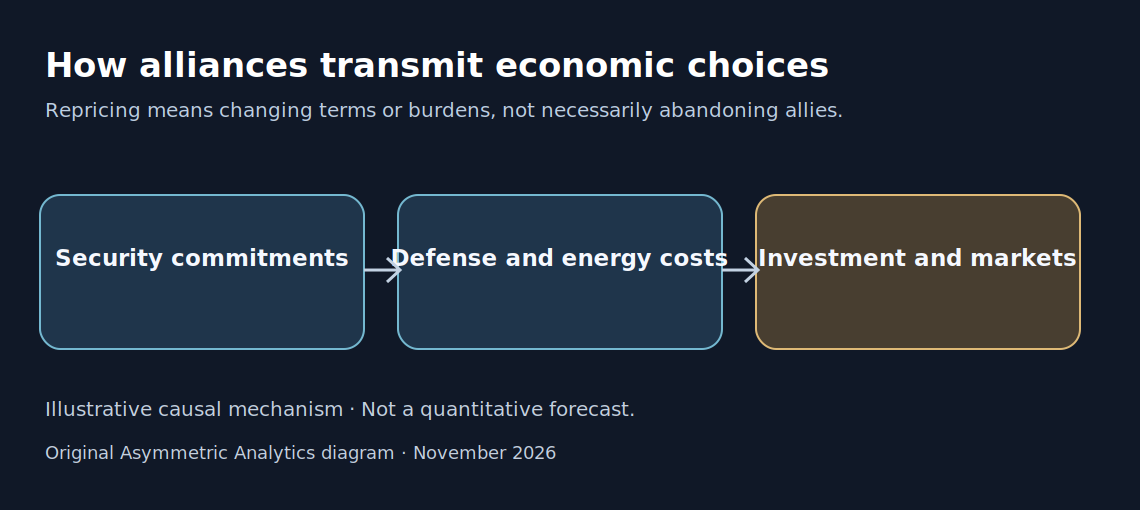
Repricing an alliance is not the same thing as abandoning an ally. It can mean asking partners to carry more of the defense burden, changing the composition of support, prioritizing a different strategic theater, or renegotiating access and procurement. Those choices can change markets well before a formal diplomatic rupture.
1. Every security relationship has a different contract
The North Atlantic Treaty establishes a collective-defense structure among NATO members. Its Article 5 is a commitment rooted in a treaty, although each member determines the action it considers necessary under the terms of the agreement.
Israel is a different case: extensive U.S. assistance, intelligence coordination, weapons transfers and diplomatic support exist without the same NATO mutual-defense treaty. The Congressional Research Service's review of U.S. foreign aid to Israel provides a foundation for distinguishing appropriated military aid from future arms sales and broader strategic cooperation.
Ukraine is different again. American intelligence and equipment have supported Kyiv's defense, but Ukraine is not a NATO member, and changes to particular categories of support need to be distinguished from a blanket termination of U.S. involvement.
Saudi Arabia presents a further variation. On January 13, 2026, President Donald Trump formally designated the kingdom a major non-NATO ally . That is a real legal and diplomatic designation, but it is not equivalent to Article 5 membership. A November 2025 White House fact sheet also described a strategic defense agreement and significant economic cooperation.
These distinctions are central. There is no single dial labeled American support that can be turned up or down for all partners at once.
2. The most expensive security umbrella is the one nobody measures
Military cooperation creates benefits: deterring aggression, protecting trade routes, establishing predictable international relationships and sharing intelligence. It also creates expenses and exposure.
Keeping forces forward deployed requires bases, maintenance, logistics, personnel, fuel and readiness. Supplying partners during active conflict may reduce domestic stocks faster than industry can replenish them. Defending tankers or civilian infrastructure can impose repeated operating costs.
These commitments can be strategically worthwhile even when the financial burden is substantial. A trading power dependent on stable maritime routes may find that the avoided economic losses outweigh the defense budget required to keep them functioning.
But the calculation changes when several regional crises occur simultaneously. A weapon, aircraft, ship or industrial production line devoted to one theater is not fully available for another. A dollar spent on overseas readiness is also a dollar unavailable for other public priorities unless the government raises revenue or borrowing.
A serious alliance debate must consider both the cost of maintaining commitments and the economic cost of allowing them to weaken.
3. NATO burden sharing is the obvious example
European NATO members have debated defense expenditures and capabilities for years. The SIPRI military expenditure database allows consistent comparisons, while national budgets and NATO reporting are needed to distinguish actual expenditures from announcements.
The strategic issue is not simply an accounting target. Spending becomes military capacity only when procurement, training, maintenance and industrial deliveries convert it into usable forces.
An ally that increases its defense budget but still lacks ammunition, transportation or communications capacity may remain dependent on American support. Another ally may contribute valuable intelligence, bases, industrial facilities or specialized capabilities that are not captured by a crude comparison of annual military spending.
For the United States, burden sharing can free resources for other commitments. But demanding rapid changes in partner spending can also produce political tensions and implementation delays.
The financially rational arrangement depends on the contribution each partner makes to collective security, not just whether it meets an single spending percentage.
4. Saudi Arabia links security to energy markets
The Gulf provides a direct example of how alliances become economic variables.
Saudi Arabia is a major energy producer, and regional instability can affect global oil markets through disrupted exports, damaged infrastructure or risk to shipping. The United States may benefit from security cooperation that helps maintain stable trade, while Saudi leaders may seek assurances, access to defense systems and diplomatic support.
The U.S. designation of Saudi Arabia as a major non-NATO ally illustrates closer formal cooperation at a time when military and economic relationships are being recalculated.
But there are limits to straightforward narratives. Major non-NATO ally status does not establish that Saudi Arabia has entered a NATO-style guarantee. Nor does it prove the United States will bear every cost of regional stability. Each actual agreement and obligation must be read separately.
Energy markets react to expected supply and transport risk, not merely the wording of bilateral announcements. The most useful indicators are shipping volumes, the operational state of export infrastructure, defense deployments and the actual terms of security cooperation.
5. Israel and the problem of combining aid with autonomy
If policymakers were to reduce direct U.S. military aid to Israel, that would not necessarily end weapons purchases, intelligence exchanges or political cooperation. These are separate channels.
A partner can seek greater domestic financing and industrial autonomy while continuing to buy American equipment. Equally, a reduction in one form of assistance may increase other demands on procurement, technology transfers and diplomatic coordination.
The fiscal and industrial consequences matter. Aid financed by the United States, foreign military sales paid by an ally, direct grants, and domestic production each affect taxpayers and manufacturers differently.
For investors, defense orders resulting from a change in the mix of assistance are not the same thing as a net increase in U.S. strategic strength. The effect depends on readiness, production capacity and what alternatives are forgone.
6. Ukraine tests the link between intelligence and political leverage
Ukraine's military position depends on a complex mix of domestic forces, European finance, international intelligence and weapons systems. Hypothetically, an interruption or resumption of a particular intelligence-sharing channel could have operational effects without implying that every element of American support has changed. This is a scenario, not an attributed October 2026 event.
This relationship creates leverage, but it also creates reputational consequences. Allies observing changes in one theater may reassess assumptions about future American reliability elsewhere.
The opposite interpretation must be considered: adjusting support may be intended to obtain a negotiated outcome, conserve scarce military stocks or encourage greater allied responsibility. A change in policy is not automatically evidence of betrayal or strategic retreat.
The key questions are what actually changed, for how long, whether partners could substitute for the interrupted capability and what agreement, if any, followed.
7. How security commitments transmit into capital markets
A major security realignment can affect risk premiums, energy prices, defense procurement, sovereign debt and currency expectations.
Investors may demand a higher return to finance exposed infrastructure when they believe protection is uncertain. Governments may increase borrowing for defense as allied guarantees become less predictable. Industrial firms may expand domestic production, but only if order commitments are reliable enough to justify capital expenditure.
Financial markets can also overreact to political rhetoric that never becomes policy. A leader's negotiating statement is not a treaty amendment, and a headline announcing a weapons purchase is not a delivery receipt.
We need to compare changes in formal agreements and real budget flows with observable market effects, not infer one from the other.
8. Three ways this could develop
Scenario 1 — Managed burden sharing. The United States retains major relationships while partners assume more financing and procurement responsibility. Coordination improves and U.S. resources are reallocated without major security gaps.
Scenario 2 — Fragmented commitments. Political bargaining and uneven industrial delivery create uncertainty. Allies pursue costly redundancy, borrowing increases and the same threats require more total expenditure.
Scenario 3 — Strategic prioritization. Washington reduces exposure in some theaters and concentrates resources on other threats. Some partners become more autonomous; others face greater regional risk. Net outcomes vary considerably by geography.
These are analytical alternatives, not predictions of a particular leader's next decision.
What would change our view
1. Formal commitments: Do treaties, aid appropriations, security agreements and defense access arrangements actually change, or only the rhetoric surrounding them? 2. Capability delivery: Do increased allied defense budgets translate into inventories, trained forces and sustainable manufacturing capacity? 3. Risk premiums: Do energy freight costs, sovereign funding conditions and major infrastructure investment respond persistently to identifiable security changes? 4. Strategic behavior: Do partners build credible substitutes, or remain reliant on U.S. systems even after announced policy changes?
The alliance-repricing thesis is weaker if underlying assistance and capability remain stable. It is stronger when contracts, budgets and military operations demonstrably change together.
Primary evidence
North Atlantic Treaty, official NATO text .
United States, Saudi Arabia major non-NATO ally designation, January 2026 .
White House, U.S.-Saudi strategic defense and economic cooperation, November 2025 .
Congressional Research Service, U.S. Foreign Aid to Israel .
ELSI trail
Alliance commitments, NATO collective defense, U.S. military aid, Saudi security arrangements, Ukraine intelligence support, defense manufacturing, energy security and sovereign borrowing are related but different mechanisms. Security spending must be distinguished from actual delivered capability.