America's European Trap: Can Washington Regulate Away the AI Productivity Boom?
By Asymmetric Analytics
Analysis
The United States has spent decades trying to make computers more powerful. It now faces a different question: Will it allow the electricity, buildings, transformers and transmission lines needed to put that computing power to work?
The answer could help determine whether the United States or China captures the greatest economic advantages of the artificial-intelligence revolution. In 2025, American private AI investment reached $285.9 billion, according to Stanford's 2026 AI Index . The comparable figure was $20.9 billion for Europe. America enjoys extraordinary financial depth and a commanding lead in installed data-center infrastructure. Yet the latest political backlash asks the country to slow the construction of the very facilities required to turn capital into computing power.
That is the European trap: when infrastructure becomes scarce, governments are tempted to allocate scarcity rather than remove the constraint that created it.
The danger is not that every new data center is a good investment. It is that the country could allow a politically convenient permitting freeze to stand in for an energy and infrastructure strategy, at precisely the moment its most important strategic competitor is building to compete.
Texas changes the equation
On November 3, Texas voters elected Gina Hinojosa governor, ending Greg Abbott's tenure after her inauguration in January 2027. The Texas Secretary of State's returns recorded 5.23 million votes for Hinojosa and 4.52 million for Abbott.
Hinojosa's own campaign platform calls for an immediate moratorium on new data centers until lawmakers enact protections for communities and reconsider existing subsidies. She argues that Texans should have a say over the electricity, water and land costs created by giant computing facilities. These are substantive questions. No household should be asked to finance a private developer's power connection without disclosure and a defensible allocation of costs.
There is a revealing complication in this story: Abbott, a Republican, had already moved against the industry's expansion. On August 3, his office ordered comprehensive verification and audits of proposed data-center grid connections. The Texas conflict therefore does not divide neatly into a party that builds and a party that regulates. Both have faced public pressure over utility bills, water consumption and the speed of development.
The crucial distinction is between rules that make new capacity financially and physically sustainable and rules that prevent it from being built at all.
A developer should pay for its incremental power infrastructure. A utility should be able to verify that a proposed 500-megawatt load is real. Water use must be accounted for. But none of those requirements inherently demands an indefinite prohibition on construction. A clear standard can protect the public while giving an investor the certainty needed to finance a power plant, transmission upgrade or new cooling system.
The real resource behind artificial intelligence
A data center may look like a warehouse. Economically, it is closer to an industrial plant. Its productive machinery is a collection of processors, networking equipment and cooling systems. Its feedstock is a reliable supply of electricity.
This distinction matters because the physical demands of AI are rising even as individual computations become dramatically more efficient. The International Energy Agency estimates that global data-center electricity consumption was 485 terawatt-hours in 2025 and could reach 950 by 2030. AI-focused facilities are expected to grow faster still. Faster chips do not necessarily mean smaller total electricity demand when lower costs enable more complex workloads, more users and entirely new industries.
Electricity is only one bottleneck. A large new facility requires a grid connection, transformers, switchgear, land, cooling and financing. When any one item is unavailable, the entire investment may sit idle. A new AI campus without a completed substation cannot make up the difference with a cleverer language model.
This creates a feedback loop. Demand for AI services encourages investment in hardware and power. More affordable computing encourages wider use. Wider use creates demand for additional capacity. Governments can reinforce the cycle by allowing infrastructure supply to respond, or interrupt it by making the approval process unpredictable.
The geopolitical competition is already close
It would be comforting to assume the United States can afford several years of delays because American AI models are comfortably ahead. The evidence no longer supports that comfort.
Stanford's 2026 AI Index finds that the performance gap between leading American and Chinese models has narrowed substantially; the countries have exchanged the lead on some benchmarks. The United States still produces more notable frontier models and attracts far more measured private AI investment. But China has advantages in the physical economy and has demonstrated an exceptional ability to deploy industrial automation.
The International Federation of Robotics reports that Chinese factories installed 354,000 industrial robots in 2025, accounting for 59% of worldwide installations. The United States installed nearly 38,500.
Those numbers measure different things. A robot installation is not an AI model; venture investment is not a complete national accounting of computing resources; Chinese state-guided investment is not fully captured in private funding totals. But viewed together, they show why this contest is larger than a scoreboard of chatbot performance.
America is exceptionally strong at inventing and financing digital systems. China is exceptionally capable of translating technologies into manufactured and deployed physical systems. The next stage of AI competition will require both.
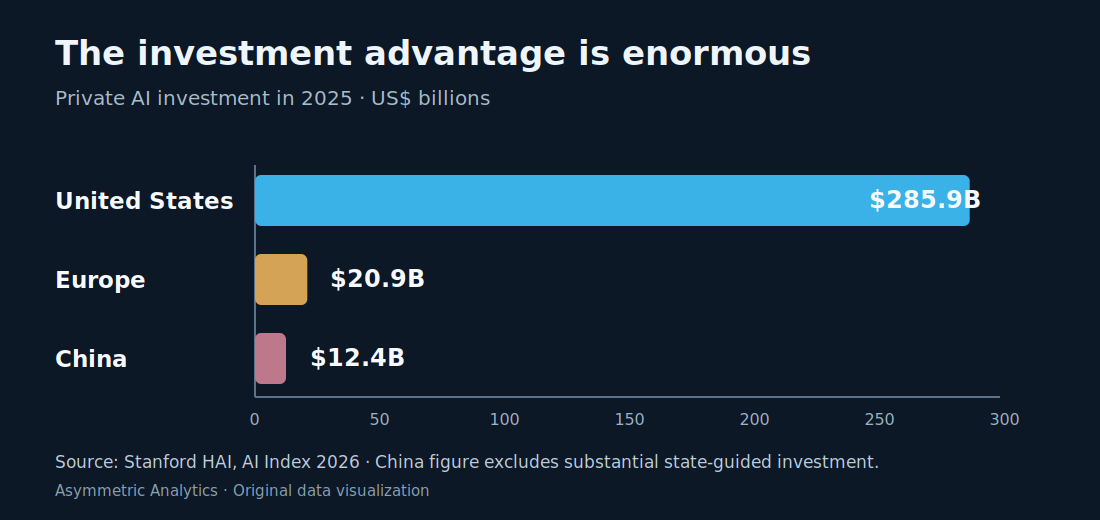
Private AI investment in 2025, U.S. dollars. Source: Stanford HAI AI Index 2026. These figures do not include Chinese state-directed investment on a comparable basis.
What Europe reveals
Europe offers a visible example of the economic costs of combining expensive energy with slow infrastructure decisions.
The IEA's Electricity 2026 report finds that EU electricity prices for large energy-intensive industrial customers remained more than twice corresponding U.S. levels in 2025. The European Commission's own analysis identifies fragmented regulation, complex permitting and grid constraints as obstacles to European data-center capacity. The Commission is itself proposing reforms to accelerate electricity access and infrastructure delivery.
Europe's broader economic challenges also reflect demographics, financing, imported energy and industrial structure. Permitting alone did not create them. Nevertheless, the mechanism is straightforward. If a factory or computing facility must wait years for power, that delay raises the cost of capital and reduces the number of investment projects that can be financed.
The comparison is not about whether the United States should copy every European law. It is about avoiding a system in which every new industrial proposal faces several overlapping processes while no institution takes responsibility for creating the supply needed to satisfy demand.
Rationing scarcity or expanding supply?
Imagine a community where electricity demand grows faster than generation and transmission capacity. There are two broad responses.
One is to limit new customers through moratoria, quotas and prolonged approvals. That can relieve short-term pressure, and in emergencies some restrictions are unavoidable. But prolonged rationing also makes scarce existing connections more valuable, raises barriers to new competitors and pushes investment toward jurisdictions that will build.
The other is to make the expansion of supply the centerpiece of policy: require data centers to pay the costs they cause, approve additional generation, accelerate grid upgrades, standardize land and water disclosures, encourage firm and flexible energy supplies, and reject speculative requests that tie up the connection queue.
This is not a choice between affordability and growth. Done properly, paying for incremental grid costs and expanding electricity supply can serve both. The hard part is making rules predictable enough that new capacity actually arrives.
The test for Texas—and for other states—is therefore measurable: do the new requirements culminate in more generation, better transmission and bankable projects? Or do they simply preserve a queue of projects waiting for permission to exist?
Why an AI lead might compound for generations
The strategic stakes reach beyond cloud companies' profits.
Better AI can accelerate the design of new industrial processes. AI-assisted engineering can shorten research cycles. Robotics can help translate software improvements into physical manufacturing. Industrial deployment produces data about where systems fail, which helps build better systems. In principle, these gains feed back into national productivity and military-industrial capacity.
That is how a technology advantage can compound. It is also why it is too simple to say that the first country to achieve the most powerful AI model will rule for a millennium. Technologies spread, capital shifts, competitors adapt and political institutions change. A hundred years of dominance is possible as a scenario; it is not an established forecast.
The more useful question is whether the United States can retain the ability to produce, distribute and profit from AI on a massive scale while competitors narrow the technical gap. If the advantage in models becomes smaller, the advantage in affordable electricity, deployment and execution becomes larger.
The strongest argument for restrictions
Residents facing a rising utility bill are not imagining their financial burden. A town asked to support a huge new electricity user has a legitimate interest in whether transmission investment will raise local rates or whether the facility's cooling system will strain water supplies.
There is also genuine financial risk. Some speculative data-center requests may never be built. The IEA notes that investment pipelines exceed the projects likely to come online. A rushed approval process that forces households to subsidize stranded assets would itself damage public support for infrastructure expansion.
The appropriate distinction is between cost discipline and a blanket slowdown. Make developers demonstrate credible demand, financing, grid plans and payment commitments. Then give viable projects a reliable path to construction. That approach tests the business case without making every proposed facility hostage to indefinite review.
What we're watching
Texas will show whether an administration elected partly on opposition to data centers can turn that opposition into clear, growth-compatible rules. Watch the duration and scope of any moratorium, the timetable for new legislation, decisions on cost-sharing for grid interconnection, and the number of projects permitted after the rules are enacted.
Nationally, watch whether equipment and grid-connection bottlenecks improve, whether utilities can add supply fast enough to keep retail rates manageable, and whether AI infrastructure investment begins moving offshore rather than merely between American states.
Internationally, track not just model quality but the installed amount of computing capacity, reliable electricity delivered, Chinese industrial-robot deployment, and evidence that AI is increasing measured productivity in the wider economy.
What would change our view
A successful Texas framework that protects residential ratepayers and water supplies while accelerating approved capacity and new power generation would weaken the thesis that today's backlash threatens long-run competitiveness. So would evidence that efficiency gains allow significantly more AI output without continued growth in power needs, or that China's apparent deployment advantages do not translate into sustained productivity.
But if permitting freezes spread while grid queues lengthen and China continues installing industrial capacity at scale, the strategic cost of America's policy choices will become harder to ignore.
The United States does not have to choose between public safeguards and technological leadership. It does have to build the electricity and infrastructure that make both possible.
The danger is not that America lacks the technology to win the AI age. It is that it might fail to build the physical economy required to use it.