The Arsenal of Democracy Meets the Factory of the World
By Asymmetric Analytics
Analysis
What We're Watching | October 31, 2026 | Original investigation — draft for owner review
Brief
China accounted for 34.4% of global manufacturing value added in 2024, twice the United States' 17.2% share, according to the National Science Foundation. America still possesses formidable weapons, capital markets and alliances. But sustained military power also requires the capacity to make and replace equipment at scale.
At a March 2026 U.S. Senate hearing, defense officials projected that Ukraine could produce roughly six million drones in 2026. America's narrower Drone Dominance procurement program aims to purchase more than 200,000 by 2027. These measures have different denominators, but together they expose the manufacturing challenge created by inexpensive, attritable weapons.
Central question: Can America restore the industrial depth that sustains its military reach without sacrificing the prosperity it is intended to protect?
Standard: Military power ultimately depends on productive capacity
In 1944, the United States was producing ships, aircraft, vehicles, artillery and ammunition at a scale no other industrial power could match. Its factories were not merely supporting the war. They were part of the reason victory became possible. American industry furnished allies, replaced lost equipment and transformed economic capacity into sustained military power.
Eighty-two years later, the United States still operates the most elaborate system of military power projection on Earth. It possesses aircraft carriers, stealth aircraft, nuclear submarines, long-range strike systems, extraordinary intelligence capabilities and strong alliances. Yet its largest strategic competitor has become the world's dominant manufacturing power in several critical sectors.
And modern warfare is producing a remarkable reversal: the small, inexpensive drone is forcing militaries to rediscover the strategic importance of industrial production.
The war with Iran exposes the question. The United States can strike at enormous distances with highly sophisticated weapons. Iran and other adversaries can impose costs through drones, missiles, regional bases and vulnerable energy systems. Repeated operations consume scarce defensive interceptors, while the Gulf crisis transmits military risk into energy prices, shipping and public finance.
This does not prove American military decline is inevitable. It establishes a question that is increasingly hard to avoid: has the United States invested more effectively in projecting power than in sustaining it economically and industrially?
I. The historical inversion
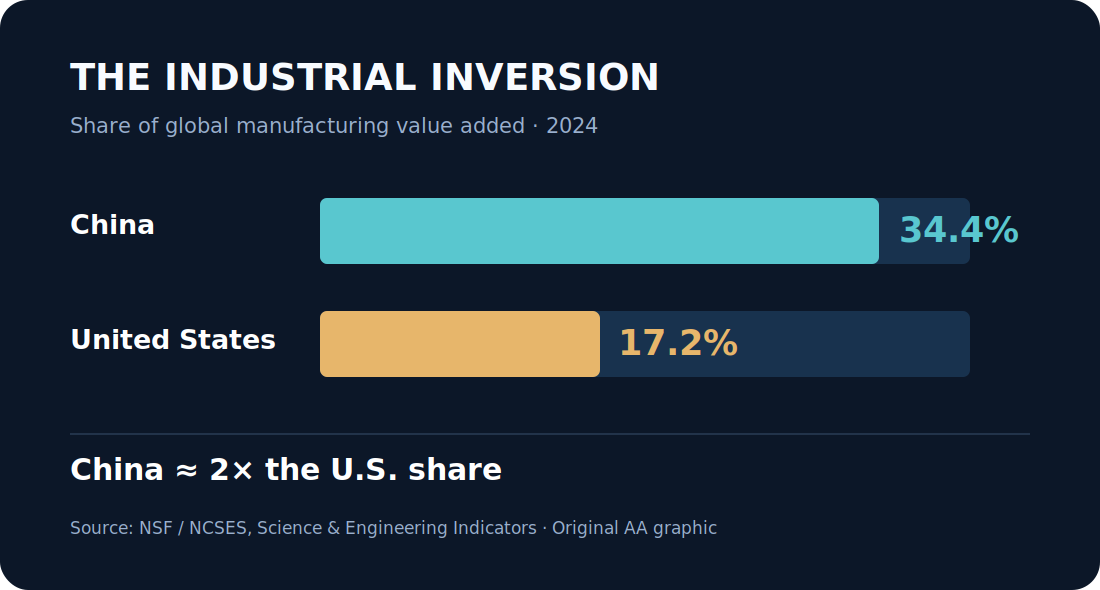
The manufacturing figures are striking because they describe actual value added rather than merely gross exports. China's 2024 share was almost exactly twice the American share.
Shipbuilding provides another measure of the gap. The Congressional Research Service reports that China won approximately 71% of new global commercial ship orders by gross tonnage in 2025. Shipbuilding orders are not equivalent to deployable naval power. Commercial vessels are not destroyers, and a navy requires sensors, crews, weapons and doctrine. But yards, welders, engines, steelmaking, supplier networks and repair capacity are relevant across maritime industries.
America retains a different kind of economic power. The NSF estimates the United States produced 43% of global knowledge- and technology-intensive services value added in 2024, versus China's 11%. American strengths in software, advanced design, research, finance and aerospace remain formidable.
That distinction is the point. The coming competition will test whether technological leadership can be converted into sufficient physical output—and whether manufacturing scale can be converted into effective military capability.
Neither is automatic.
II. The wars America chose—and the bills that remain
The United States has conducted major wars and interventions from Korea and Vietnam through Iraq and Afghanistan, alongside extensive operations elsewhere. Their origins, objectives and outcomes were different; they cannot responsibly be treated as one identical ideological crusade. But they share one economically important feature: sustained military commitments absorb money, human capital, industrial capacity and political attention.
Brown University's Costs of War project estimates roughly $8 trillion in appropriations and obligations tied to post-9/11 wars, including future veterans' care. That number is not simply money already spent on combat, and it is not the entire national debt.
Even so, the scale illustrates the opportunity cost. Imagine even a fraction of those resources committed over decades to shipyards, semiconductor fabrication, electricity grids, industrial tooling, engineering education and transport infrastructure. We cannot know the exact counterfactual result; we can recognize the foregone alternatives.
The arithmetic becomes harder in a highly indebted government. Borrowing expands today's options but creates future interest obligations. Higher debt service reduces the budgetary flexibility available when weapons stocks suddenly must be rebuilt.
The question is not whether military spending produces anything. It produces security, employment, innovations and sometimes deterrence that averts more costly wars. The question is whether the marginal global commitment delivers benefits commensurate with its fiscal and industrial burden.
That is a different question from asking whether the United States should maintain a strong defense.
III. Trump promised peace. How did Washington arrive at war with Iran?
During the 2024 election, Donald Trump emphasized ending conflicts and avoiding new wars. Yet on February 28, 2026, the United States and Israel launched military operations against Iran. The Trump administration described preventing Iranian nuclear weapons, reducing missile threats and protecting American security as major objectives. Congressional Research Service .
The discrepancy between campaign rhetoric and actual policy deserves investigation rather than an easy theory of hidden control.
Campaign money is relevant. OpenSecrets' 2024 Trump contributor records identify major financial support from Miriam Adelson, an outspoken pro-Israel donor, alongside enormous support from other donors, including Elon Musk and Timothy Mellon. Those records concern individuals and affiliated political committees, not a racial or religious population.
Policy advocacy is relevant, too. Israel's government has consistently advanced arguments for confronting Iran's military and nuclear capabilities. American Christian Zionists, interventionist foreign-policy thinkers, defense-industry organizations and some security officials have advocated forceful approaches for different reasons. Others inside the American political and military establishment have warned about escalation, mission expansion, stockpiles and costs.
A serious causal investigation must distinguish documented donations, documented access, documented lobbying and documented policy preferences from a further claim that any one donor or constituency caused the war. The latter requires evidence of decision-making influence, not merely aligned interests.
The United States has also its own genuine reasons to worry about Iranian missile capabilities, attacks on American forces and nuclear proliferation. Recognizing those interests does not establish that launching or continuing a particular war best serves them.
The WWW question is therefore sharper than 'Who secretly controls Washington?' It is which actors shaped the decision, what interests they advanced, what alternatives were rejected, and who bears the eventual costs.
IV. Iran demonstrates the new economics of military power
The modern military budget can buy remarkable technical performance, but weapons are not interchangeable. A ballistic missile interceptor cannot simply be replaced by a cheaper quadcopter. A carrier's air wing and an FPV attack drone solve different problems.
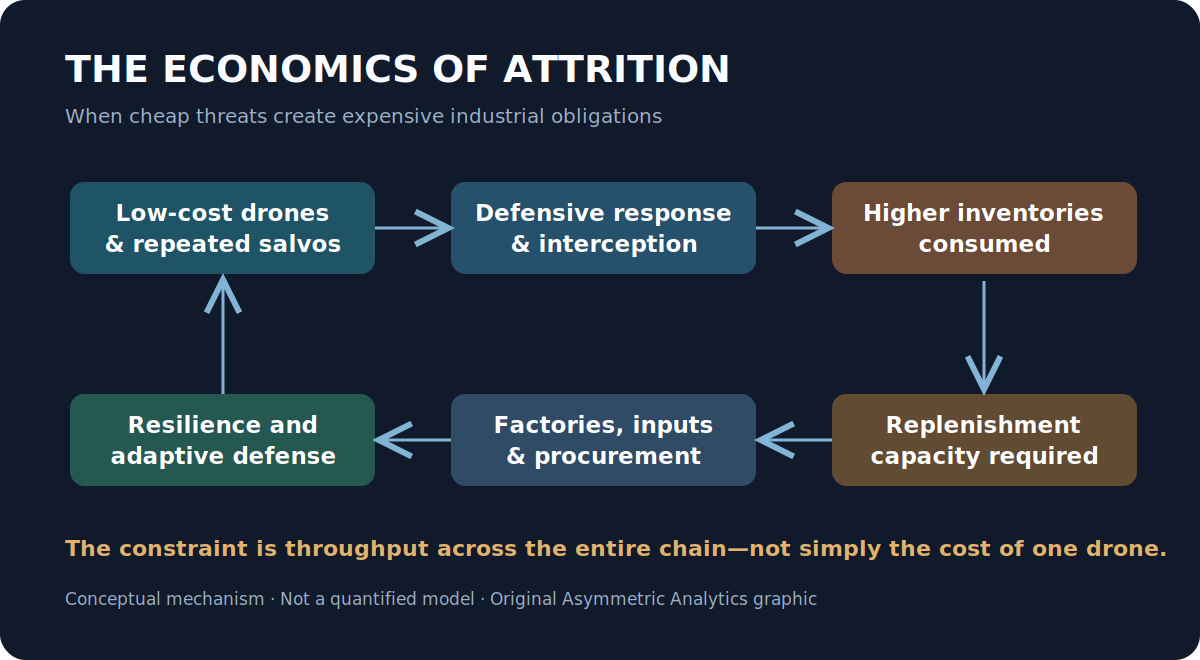
Nevertheless, modern wars increasingly force expensive defensive resources to respond to relatively inexpensive threats.
In its October 5 assessment , the Congressional Research Service described concerns about depleted inventories, defense-industrial production limits and the trade-off between supplying allies and replenishing American stocks. Officials have said the United States has sufficient munitions; detailed inventory figures remain sensitive.
An independent CSIS analysis in July estimated substantial reductions in Patriot and THAAD inventories, warning that continued operations could affect readiness elsewhere. Those are estimates, not declassified inventories.
The conflict also exposes the limits of geographic containment. Iran can threaten American bases, regional partners and the energy infrastructure that links Gulf producers to the rest of the world. At an October 6 briefing , Qatar's foreign ministry confirmed mediation and message exchanges between Washington and Tehran. Diplomatic contacts do not themselves mean the military risks are contained.
A military operation can be tactically effective while its broader economic or political outcome remains unsettled. A strike may destroy a facility without producing a durable agreement. In the meantime, each additional week of confrontation consumes supplies, increases regional risk and narrows diplomatic room.
For an expensive military architecture, attrition can become a strategic problem even without a battlefield defeat.
V. The drone industrial revolution—and China's hidden position inside it
The most revealing development comes from Ukraine, not from a marketing presentation about future weapons.
At a March 2026 U.S. Senate hearing , Pentagon witnesses projected roughly six million Ukrainian drones in 2026, about 500,000 a month. The separate U.S. Drone Dominance Program states an objective of purchasing more than 200,000 drones by 2027; its first phase ordered 30,000. Those are official projections and procurement goals, not verified final manufacturing output.
Different denominators matter: one is a country's projected annual production, the other is a procurement target within one American program. But the contrast still identifies an industrial challenge: moving from successful technology demonstrations and limited orders to enormous, repeatable production.
China occupies a central position in that system.
The U.S.-China Economic and Security Review Commission estimated Chinese company DJI had almost 70% of the global drone market and more than 90% of its consumer segment in 2025. These are commercial-market shares, not estimates for every military drone.
The dependence runs deeper than final assembly. CSIS researchers identify Chinese-origin carbon fiber, rare-earth magnets, lithium-ion cells and specialized electronic materials as supply-chain bottlenecks for unmanned systems. Even a drone with an American label can rely on upstream inputs processed or produced in China.
And Beijing possesses potential leverage through export controls. On October 19, China's commerce ministry adjusted licensing rules for specified drone-related products , effective November 18. A license requirement is not a comprehensive ban. Yet supply disruption can happen through delay, uncertainty, compliance cost or restrictions on particular components.
This produces a strategic paradox: countries preparing to compete militarily with China may still need Chinese industrial inputs to mass-produce an increasingly important class of weapons.
The United States is responding. Domestic drone procurement, component localization, autonomous systems and inexpensive counter-drone technologies all seek to change the trajectory. They could succeed. But expansion has to be measured in delivered units, qualified components, sustained monthly throughput and repair cycles—not only appropriated dollars.
### The bottleneck after the mine
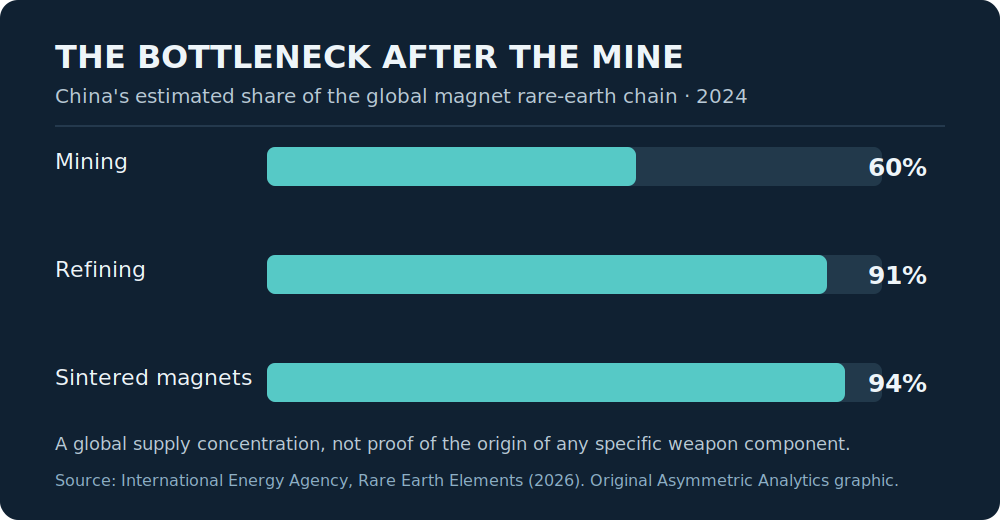
The next dependency lies between raw material and finished weapon. The International Energy Agency estimated that in 2024 China supplied 60% of magnet rare-earth mining, 91% of refining and 94% of sintered permanent-magnet manufacture. Mining is the most visible stage; separation, metalmaking, magnet fabrication and component qualification are harder to replace quickly. These shares apply to the global supply chain. They do not reveal the Chinese content of any particular American missile.
The U.S. Government Accountability Office identified a defense production network of more than 200,000 suppliers. In one F-35 parts-mapping effort, investigators found country-of-origin information for fewer than 10% of the lower-tier suppliers of components and raw materials. The practical vulnerability is not that every American weapon necessarily contains Chinese parts. It is that the Pentagon cannot reliably see every dependency far below its prime contractors, precisely where substitutions and manufacturing qualifications can be slowest.
The replenishment clock is already long even before any hypothetical export interruption. In a May 27 CSIS assessment , analysts estimated one to four years to restore seven heavily used munition types to pre-Iran-war inventory levels on then-current delivery projections; Tomahawk, THAAD and Patriot required three or more years. Those are production forecasts, not a complete public inventory and not proof that each weapon depends on Chinese rare-earth inputs. If supply restrictions, failed qualifications or demand from allies slow a bottleneck, the relevant lead time could lengthen.
This is why a six-to-twelve-month period of heavy American commitments matters as a strategic scenario, not a forecast of Beijing's invasion timetable. Consumption can occur in weeks; replacement takes years. The United States and its allies can shorten this exposure by buying inventory before a crisis, diversifying processing and magnets, qualifying substitutes, expanding recycling and aligning long-term orders with actual industrial investment. None of these changes happens merely because a budget line is increased.
VI. The wrong economics of war?
The older procurement model emphasized exquisite performance: fewer systems, each with extraordinary capabilities, supported by specialized contractors and long development cycles.
That model remains valuable for tasks only highly advanced systems can perform. The error would be assuming it covers the entire battlefield.
An adversary's inexpensive drone may require detection, tracking, electronic warfare, a gun system or a missile. The rational defensive response depends on available alternatives and the protected asset, not simply the price of the attacking drone. The general challenge is the cost exchange and the ability to withstand repeated salvos.
In a long contest, what matters is a system of production:
Research and design → components → qualified manufacturing → procurement orders → delivery → battlefield attrition → feedback → redesigned mass production.
No single link substitutes for the others. America can develop brilliant systems and still face component shortages. China can produce at scale and still encounter weaknesses in combat experience, interoperability, logistics or sophisticated military design. Ukraine has demonstrated unusually rapid wartime adaptation but remains exposed to foreign supply and finance.
The industrial advantage belongs to the country, or coalition, able to connect all these stages under stress.
VII. Who benefits—and who pays?
Several actors may pursue objectives that do not fully align. Israeli officials have emphasized weakening Iran's military and nuclear capacities. American national-security officials have pointed to protection of forces, deterrence and nonproliferation. Some ideological advocates of intervention see the war as advancing regional security aims. Defense contractors may benefit commercially from replenishment orders. China could gain relative strategic latitude if American attention and inventories are absorbed in the Gulf, but it simultaneously suffers from disruptions to energy trade.
A potential benefit to an actor is not proof that the actor caused the conflict.
The costs are distributed differently: American taxpayers finance operations and replenishment; service members and families bear immediate personal risks; civilians across the Middle East bear destruction and insecurity; Gulf governments face threats to their infrastructure; and energy importers absorb transport and fuel disruptions.
The 'who benefits?' question should therefore track policy objectives, measured outcomes, procurement flows, energy exposure and opportunity cost rather than substitute conjecture for documented decision-making.
### The political temptation of another front
War can also change the domestic political incentives of governments facing economic disappointment, debt pressure or fading public trust. A foreign adversary offers a competing explanation for hardship; mobilization can redirect attention from policy failures. In the Becker Friedman Institute's March 2026 research brief , researchers report empirical evidence that Russian proxy-initiated violence in eastern Ukraine escalated in association with domestic unrest and opposition protest. This is evidence for a political mechanism in that studied case—not proof that American, European or any other leaders initiated the current conflicts to distract voters.
The mechanism matters for economic forecasting because it can become self-reinforcing: deteriorating living conditions make political leaders more vulnerable, external confrontation can briefly offer a unifying narrative, and the costs of that confrontation can deepen the original economic strain. The crucial evidence would be leaders' actual decisions, contemporaneous internal records, measurable mobilization and public attitudes—not simply the fact that a war coincided with unpopular domestic policy.
VIII. The feedback loop that could shape the next century
Three dynamics now reinforce one another.
First, America's worldwide military commitments can consume inventories and create financing needs. Second, the government must acquire new industrial capacity while managing debt service and other obligations. Third, the competitor around which much of the defense strategy is organized is deeply embedded in global manufacturing and critical component supply chains.
The result is not inevitable American defeat. It is a risk of strategic overextension: commitments expand faster than the financial and industrial systems required to support them.
But the contrary case is serious. The United States has leading aerospace manufacturers, powerful innovation networks, advanced semiconductor design, global capital markets, military allies and demonstrated capacity to mobilize when incentives change. An alliance production network that combines American design and capital with Japanese, Korean, European, Australian and Ukrainian industrial capabilities could alter the arithmetic. China, meanwhile, faces demographic, financial and geopolitical constraints of its own.
The decisive variable is not whose GDP is larger, or who manufactures more consumer goods. It is who can translate productive resources into sustained, adaptive security capability without exhausting the economy on which that capability depends.
What would change our view?
Evidence of rapid, cost-competitive American drone mass production with verified non-Chinese component supply would weaken the dependency thesis. Faster missile-interceptor replenishment and greater deployment of inexpensive air defenses would reduce the perceived imbalance. Conversely, repeated procurement slippages, component export restrictions and extended military operations without negotiated end states would strengthen it.
We should track actual factory throughput, parts provenance, repair capacity, interceptor replacement lead times, military spending, debt-service costs, port and shipyard output, and confirmed diplomatic outcomes—not simply announced commitments.
The final question
In World War II, the United States became the arsenal of democracy because it could turn industrial capacity into military power on a scale no adversary could match.
Today, America retains astonishing military capabilities, but China operates the world's largest manufacturing base and dominates several of the supply chains that feed the newest generation of inexpensive weapons.
History does not repeat itself neatly. The United States and China have different strengths, technologies and alliances from those of the 1940s.
But a principle endures:
A nation cannot indefinitely separate the power it projects from the productive economy that sustains it.
The next century may be shaped less by who owns the most expensive weapons than by who can design, manufacture, replace and continuously improve the systems needed to endure.
---
Evidence and Source Notes
1. NSF: Global manufacturing and knowledge-intensive value added, 2024 .
2. USCC: Made in China 2025 evaluation — drones, supply chains and shipbuilding .
3. CRS: China shipbuilding and global orders .
4. Brown University: Costs of War, federal budget .
5. CRS: US munitions and missile defenses in Iran .
6. CRS: US operations against Iran's missile and nuclear programs .
7. CSIS: Diminished interceptor inventories .
8. CSIS: Drone component bottlenecks .
9. U.S. Senate: March 5 hearing on Ukrainian drone production and U.S. manufacturing .
10. U.S. Department of Defense: Drone Dominance Program purchase goals and timeline .
11. Qatar Ministry of Foreign Affairs: October 6 U.S.–Iran mediation briefing .
12. China MOFCOM: October 19 drone-related export-control revision .
13. OpenSecrets: Trump 2024 contributor records .
14. IEA: Rare Earth Elements — 2024 mining, refining and sintered magnet shares .
15. GAO: Defense Industrial Base — foreign supplier dependency and visibility .
16. CSIS: Rebuilding U.S. Missile Inventory — multiyear replacement schedules .
17. Becker Friedman Institute: Diversionary Escalation, 2026 research brief .
Places in this story




United States, China, Iran
Made with Natural Earth