Brexit as Strategic Escape? The Trade-Off Between Market Access and Economic Autonomy
By Asymmetric Analytics
Analysis
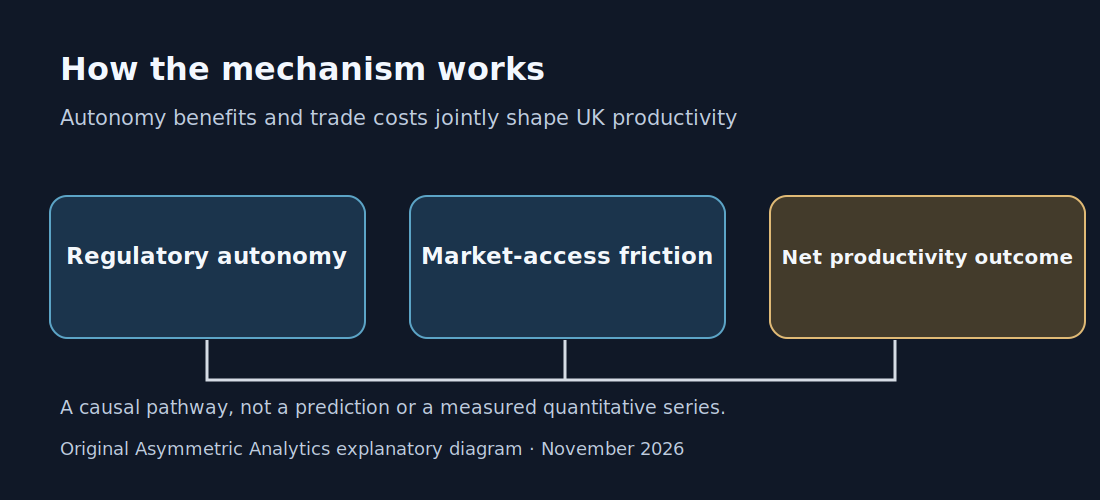
Britain's departure from the European Union has produced two stories that often talk past one another. The first is about the immediate economic cost of leaving a vast integrated trading market. The second is about the long-run opportunity to set rules without waiting for a continent-wide political compromise.
Both stories can be true. The difficult question is whether the second can eventually outweigh the first.
For investors and companies deciding where to build the next factory, hire engineers, or establish a regional headquarters, this is not an abstract constitutional debate. It is a decision about market size, compliance, energy, capital, labor and the probability that government policy will let a business grow.
The most useful way to assess Brexit is therefore not to ask who won the referendum. It is to ask what economic mechanisms Britain lost, what discretion it acquired, and how efficiently it has used that discretion.
1. The cost is not imaginary
The UK's independent Office for Budget Responsibility continues to assume that the post-Brexit Trade and Cooperation Agreement will reduce long-run UK productivity by around 4% compared with continued EU membership. Its model also assumes lower trade intensity due to new non-tariff frictions.
These are forecast assumptions about a counterfactual world, not an observed measurement that Britain suddenly became 4% poorer on one date. The counterfactual cannot be observed directly, and the OBR explains the judgment through the economic literature connecting trade openness, specialization, competition and productivity.
But those mechanisms are real. A manufacturer selling across the Channel may now need additional documentation, origin proofs, regulatory certifications or customs arrangements. Each is a relatively small friction. Repeated across thousands of shipments and business decisions, they can influence where companies build additional capacity.
The UK government's trade statistics show why the relationship with Europe remains economically significant. The continent remains a major nearby market, even as British companies pursue opportunities elsewhere. Distance still matters to freight, professional services, corporate networks and value chains.
2. Europe's own institutions acknowledge its growth problem
It would be a mistake to compare an idealized European single market with the real British economy. The European Union is not a frictionless growth machine.
In its 2025 survey of the EU and euro area , the OECD identified persistent barriers to services trade, limited business scale-up, weak productivity growth, fragmented capital markets and rising regulatory burdens. Its detailed single-market productivity chapter explains how firms can struggle to expand across internal borders even without an external customs barrier.
Europe's savings are substantial, but much of its capital does not reach young companies with high-growth potential. Many businesses are efficient within their national markets but cannot easily become genuinely continental-scale competitors.
That is the strongest legitimate economic criticism of the EU structure: the benefits of size can be weakened when regulation, finance, electricity systems and services markets remain fragmented.
The European Commission's own competitiveness agenda acknowledges the challenge. It also complicates the claim that Brussels can only become more centralized and restrictive: the institutions are proposing simplification and growth-oriented reforms. The question is whether they can implement them effectively.
3. What autonomy actually buys
Brexit gives British institutions greater discretion over certain regulatory and economic decisions. That freedom may be valuable in fast-moving areas such as artificial intelligence, financial services, biotechnology, industrial permitting or emerging digital infrastructure.
But an option has value only when exercised successfully.
Britain could enact simpler approval processes, coordinate electricity investment, reduce barriers to new business formation, and make domestic capital more available to innovative firms. If those policies increase expected after-tax returns and reduce delay, some businesses may prefer the UK despite the smaller integrated market.
Or Britain could maintain much of the EU's regulatory structure while adding its own compliance regime. It could create domestic planning obstacles, high taxes or unpredictable industrial policy that dilute the practical benefit of autonomy. In that case, firms would face the cost of departure without receiving an offsetting productivity advantage.
The independent-policy thesis therefore demands empirical evidence: lower business startup and scale-up costs, more investment in traded sectors, stronger productivity per hour, growing export competitiveness, and high-value job creation. A declaration of sovereignty is not itself an economic outcome.
4. The continental energy problem
A second potential divergence concerns industrial energy.
Europe has endured major energy-price shocks and has increasingly relied on global liquefied-natural-gas markets. High delivered costs can weaken chemicals, fertilizer, metals and other energy-intensive production, causing investment to migrate.
Brexit does not give Britain an independent energy island. The UK and continental Europe share exposure to international gas markets, electricity interconnectors and the global costs of industrial inputs. Britain could improve domestic planning and energy supply, but it cannot simply legislate cheap fuel into existence.
That matters when advocates point to German or French industrial weakness and infer that Britain must automatically benefit. A competitor's problems do not guarantee a new British investment. Firms may instead choose the United States or Asia, where energy costs, market demand, capital and industrial scale are more attractive.
A successful British autonomy strategy would have to outperform the actual alternatives—not just the weakest European country in a difficult year.
5. The investment decision happens at the margin
Suppose an American or Asian company is choosing between a British facility, one in the European Union, and one in the United States. The company will consider the number of customers it can serve without regulatory friction, electricity prices, labor quality, financing costs, taxes, permitting and the reliability of supply chains.
EU membership can lower access costs to a much larger nearby market. UK autonomy can potentially lower local operating costs or increase the flexibility of new industries. The United States may offer deeper capital markets and a larger high-income consumer base. Which option wins depends on the project.
The economics of Brexit will increasingly be determined by these repeated marginal choices. One factory decision is not decisive; hundreds of decisions across technology, manufacturing, finance and services can change an economy's growth path over a decade.
This also explains why a narrow focus on headline GDP is insufficient. Investment, productivity per hour, business entry, exported value-added, wages, and fiscal revenue may show different trajectories. Political changes, global rates, energy crises and pandemic aftereffects complicate a simple before-and-after test.
6. The capital-market question
London remains an important financial center. The ability to attract international capital, create liquid markets for growth companies, and support the commercialization of new technology may matter more to future British prosperity than one high-profile trade agreement.
But regulatory independence can cut both ways. More flexible rules may invite investment; duplicative or less predictable supervision may raise the cost of serving customers across borders. Capital providers care not just about whether regulation is light, but whether its rules are stable, transparent and enforceable.
The UK needs to demonstrate that independent policy can improve the return on productive capital—not simply generate a new set of political announcements.
7. Three plausible futures
Scenario 1 — Autonomy dividend. Britain makes regulatory approvals faster, improves energy supply and capital formation, and attracts expanding businesses that value agility more than seamless EU market access. Productivity gradually improves relative to the OBR's existing counterfactual assumption.
Scenario 2 — Integration cost persists. Trade friction remains important, domestic reforms are insufficient, and businesses continue to locate marginal investment nearer their main European customers. New trade agreements offset only part of the loss.
Scenario 3 — Both economies reform. The EU genuinely improves capital-market integration and reduces internal business barriers while Britain also simplifies domestic rules. Absolute prosperity can improve on both sides, leaving the relative Brexit assessment dependent on changes in trade and investment rather than a predetermined ideological contest.
These are analytical scenarios, not probabilities.
What would change our view
1. Annual ONS productivity and business investment: Does UK output per hour and non-financial investment improve persistently relative to a transparent peer basket over the next five years? 2. OBR forecast updates: Do official estimates of trade-intensity and productivity losses narrow, widen or remain near the current counterfactual assumptions? 3. EU reform delivery: Do OECD-identified barriers in services and capital-market integration measurably decline, reducing Britain's potential regulatory advantage? A durable UK improvement together with a shrinking estimated trade penalty supports an autonomy dividend; the reverse undermines it.
Primary evidence
UK Office for Budget Responsibility, Brexit analysis (July 2026 update) .
OECD Economic Surveys: European Union and Euro Area 2025 .
OECD analysis of productivity and Single Market barriers .
UK Department for Business and Trade, core trade statistics .
ELSI trail
Brexit, UK market access, EU Single Market, trade frictions, regulatory autonomy, productivity and capital formation belong to one causal argument, but they are distinct entities and mechanisms. The distinction between observed trade costs and potential future regulatory gains is essential to understanding the investment choices.