Crypto Adoption May Strengthen the Dollar, Not Replace It
By Asymmetric Analytics
Analysis
There is a quiet contradiction at the center of the digital-currency story. New payment technology can make it easier to operate outside a country's banks without making it easier to operate outside the U.S. dollar.
Brief
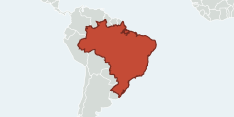
The International Monetary Fund's 2026 assessment of Brazil described a significant domestic crypto market and growing cross-border flows, especially through U.S.-dollar stablecoins. The IMF did not say the Brazilian banking system was collapsing. Its assessment found systemic risks contained while identifying reasons for regulators to improve supervision and measurement.
Those distinctions lead to our thesis: the next stage of crypto adoption may expand the reach of the dollar even when transactions migrate away from conventional bank accounts and payment rails. A digital token can be a new way to hold and transfer a familiar currency.
This would create winners and losers that do not line up neatly with the usual "crypto versus fiat" argument. Users may gain payment access. Domestic banks may face competitive pressure. Issuers may direct reserves into short-term U.S. government securities. The dollar's international network may extend, even as some governments lose visibility into cross-border flows.
But additional stablecoin balances do not automatically represent new dollars flowing into Treasuries. Much depends on what the buyer sold to obtain the tokens.
Standard: Three layers people mistake for one
We need to separate three questions:
What is the unit of account? A dollar stablecoin is designed to track the dollar. The thing being priced, saved and transferred remains dollar-denominated, even if no traditional bank account changes hands in the transfer.
What moves the payment? The token can travel on a public or permissioned blockchain, through intermediaries and wallets. Different networks may compete on reliability, costs, compliance and settlement arrangements. The use of a chain does not by itself prove that the chain's native investment token will capture a large share of economic value.
What backs the claim? A stablecoin issuer may hold Treasury bills, repos, bank deposits or other permitted reserves. The issuer's portfolio is an entirely separate layer from the blockchain carrying the token. It creates credit, interest-rate, liquidity and redemption questions even when the transfer itself settles quickly.
This separation explains how decentralizing the movement of money can simultaneously centralize the denomination of money. It also explains why the relevant beneficiaries may include U.S. Treasury bill markets, stablecoin issuers and dollar-linked service businesses—not automatically holders of a particular public cryptocurrency.
Detailed investigation
### Brazil is a test case, not proof of monetary breakdown
In its July 23, 2026 Financial System Stability Assessment , the IMF portrayed Brazil's banking system as resilient overall while highlighting rapid digital innovation, the strength of Pix instant payments and significant crypto market activity. The assessment called for stronger oversight of crypto-asset service providers, customer asset protection and rules for stablecoin issuers.
The companion 2026 Article IV report stated that cross-border crypto flows—especially those using stablecoins pegged to the U.S. dollar—had risen since 2017, without currently affecting financial stability. That is the evidence baseline. It does not justify saying that institutions have lost control of Brazil's money or that consumers have universally abandoned the real.
The mechanisms are nevertheless consequential. A Brazilian importer, exporter or household may use a dollar stablecoin for value transfer, savings or access to offshore liquidity. If a transaction merely replaces an existing dollar wire with a stablecoin transfer, the monetary consequence could be limited. If it replaces a deposit denominated in reais with an offshore dollar claim, the shift can affect domestic funding and currency demand.
We must therefore trace what activity was displaced, not simply count blockchain transactions.
Brazil's response is also concrete. Banco Central do Brasil announced on August 7, 2026 anti-fraud rules for virtual-asset service providers, including additional scrutiny of certain transfers over US$10,000 to foreign providers or self-hosted wallets. The announced measure is scheduled to take effect January 1, 2027. It reflects risk-management concerns, not proof of a systemic crisis.
Why the IMF is paying attention
Dollarization is the adoption of a foreign currency as a store of value, pricing reference or medium of exchange. It does not require a country formally to abandon its own legal tender. People may simply prefer some dollar exposure when they worry about inflation, currency depreciation, payment access or the local financial system.
A traditional route to dollars often involves bank accounts, physical banknotes, correspondent banking and foreign-exchange controls. A dollar stablecoin may allow a smartphone user to acquire and transfer a dollar-denominated claim with fewer of those steps, though converting between fiat and tokens still creates costs, identity checks and counterparty dependencies.
In an August 7, 2026 policy speech , the IMF estimated that nearly 99% of the stablecoin market is denominated in U.S. dollars and put global stablecoin market value at approximately $300 billion at the time. The Fund emphasized that reported transaction volume includes heavy crypto-market trading and automated activity; gross on-chain throughput should not be confused with payment demand.
The speech explained a double-sided consequence. Stablecoins can offer faster or cheaper cross-border payment options. But they can also make currency substitution easier and, depending on where users obtain their dollars, redirect deposits away from domestic financial institutions.
There is important new research here. An IMF working paper published October 2, 2026 constructed estimates of $21.4 trillion in gross international stablecoin flows from 2018 to 2025 across 188 countries and found persistent increases around capital restrictions and currency crises. The authors' methodology and causal identification deserve skeptical review. This is staff research, not an IMF official forecast or a count of newly created dollars, and gross flows can count repeated transfers.
The IMF's October 2026 departmental paper similarly frames dollar-denominated stablecoins as both a possible payments improvement and a potential source of currency substitution and financial instability where institutions and legal safeguards are weaker.
The dollar gets a new distribution network
The U.S. government has openly recognized this opportunity. On July 18, 2025 , Treasury Secretary Scott Bessent said dollar stablecoins could reinforce the dollar's reserve-currency role, extend access to the dollar economy and increase demand for U.S. Treasuries.
That statement is a policy objective, not proof that stablecoins have already lowered American borrowing costs or that future adoption is inevitable.
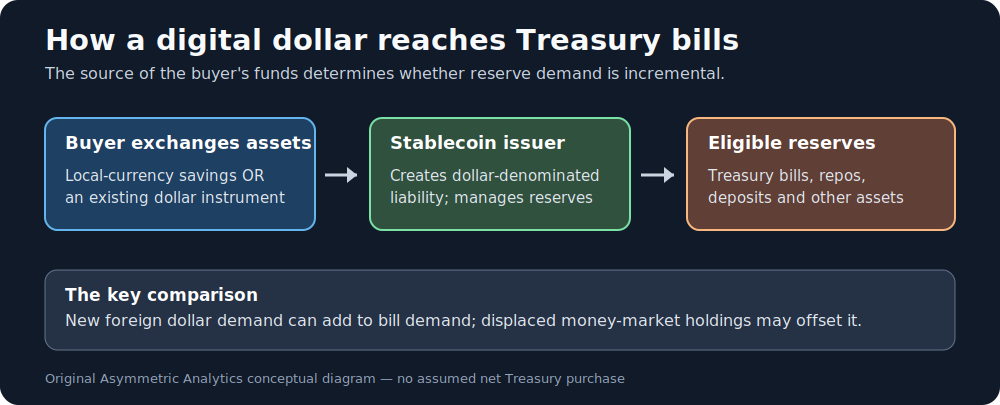
The mechanism is clear enough to test. Imagine a user outside the United States obtaining $100 in dollar stablecoins. The user holds a claim denominated in dollars. The issuer backs that liability with qualifying reserves, potentially including short-term Treasury bills, the government's short-maturity borrowing instruments. If the issuer receives net new resources and invests them in bills, digital dollar demand can translate into Treasury-bill demand.
This has become a real balance-sheet business. In its July 31, 2026 second-quarter report , Tether reported roughly $184.6 billion in issued USDt tokens at June 30, with reserves concentrated in government-backed short-term securities and liquidity facilities. These are issuer-reported, attestation-backed claims; they should not be described as a completed comprehensive audit or as all Treasury holdings.
The reserve effect is not confined to one issuer. The relevant assets include dollar stablecoins such as USDT and USDC, while the actual reserve composition and jurisdiction can differ substantially by product.
Here is the complication: gross Treasury buying is not net-new financing
Suppose someone sells $100 of a U.S. money-market fund and buys $100 of stablecoins. The stablecoin issuer uses the proceeds to purchase Treasury bills, but the money-market fund may have previously held Treasury bills itself. The demand could be a reallocation among existing holders, not a net increase in demand for the U.S. government's debt.
Now suppose someone converts $100 equivalent from a local-currency bank deposit into dollar stablecoins and the issuer buys bills. That may be new demand for dollar securities, but it can also create a funding loss for the original bank and foreign-exchange pressure in the source market.
Alternatively, if an investor exchanges existing dollars in a bank deposit for tokens, the net effect depends on how the bank, issuer and reserve managers adjust their portfolios. We cannot infer the effect from a stablecoin market-cap chart alone.
The U.S. Treasury's own Borrowing Advisory Committee discussion explicitly warned that growing stablecoin demand for Treasury bills might be partly offset by reduced purchases from banks or traditional cash investors. Treasury also flagged possible bank deposit consequences. This is the most important counterweight to the simplistic "each new stablecoin is new Treasury demand" narrative.
Another distinction matters: Treasury bills and longer-dated Treasury bonds finance different maturities. Demand concentrated in very short securities may lower yields or ease issuance there without doing the same thing to the ten- or thirty-year borrowing costs that feature in sovereign-debt sustainability debates.
A short detour: a digital dollar is not necessarily a Federal Reserve dollar
Central bank money and private money serve related but different roles. A bank deposit is a claim on a bank; a privately issued stablecoin is generally a claim subject to its issuer, reserve and legal structure. Neither becomes a direct Federal Reserve obligation simply because it is denominated in dollars.
This matters most during stress. A stablecoin can transfer instantly between wallets while its issuer's ability to honor large redemptions depends on the liquidity, marketability and legal ownership of reserve assets. Settlement speed is not the same thing as risk-free convertibility.
The IMF's May 2026 remarks on tokenized finance make the related point that policy must address the new infrastructure and its backstops, not merely observe that tokens travel more quickly.
Who could benefit, and who could lose?
Users and merchants can gain an alternative to expensive cross-border transfers, especially when traditional banking access is poor. Savings are not uniform: on-ramps, off-ramps, exchange rates and compliance fees can erase part of the advantage.
Stablecoin issuers and distributors may gain scale, customer relationships and income on eligible reserves. Their business faces run risk, supervisory costs and competition.
U.S. dollar infrastructure and possibly Treasury markets may gain broader reach. The net Treasury benefit depends on how adoption is funded and how reserves are invested.
Domestic banks in adopting countries may face deposit substitution, though stablecoins might initially replace existing dollar deposits or cash rather than local-currency bank balances. The strongest risk appears where foreign currency is hard to access and bank confidence is weak; strong evidence of economy-wide disintermediation is not yet established for Brazil.
Central banks and regulators may gain cheaper payment technology alongside new challenges in collecting data, preserving currency demand and enforcing capital-flow rules.
Public blockchain investors should distinguish use of a network from value capture by its native token. USDC or USDT can operate on various networks; bridge assets, local bank rails, tokenized deposits and instant-payment services compete for particular settlement needs. More stablecoin transactions are not automatically evidence for higher prices of XRP, XLM, LINK, ETH or another unrelated token.
The alternative future: better banking and payments may win
The strong counter-case starts in Brazil itself: Pix already operates as a powerful domestic instant-payment network. It shows that a public financial system can improve speed and access without requiring households to adopt a foreign-currency stablecoin.
Competition could also come from commercial-bank tokenized deposits, improved correspondent banking, regulated interoperable payment systems, and central bank digital money. Domestic regulation may raise compliance costs or restrict cross-border movements. Users may conclude that stablecoin counterparty and redemption risk outweighs convenience.
There is no inevitability here. A dollar token is appealing only if it solves a real problem better than alternatives, at an acceptable risk-adjusted cost.
Three paths for global monetary influence
Digital-dollar expansion. Dollar stablecoins are widely used for cross-border commerce and savings. Some demand displaces local-currency assets; reserve managers hold more short-term dollar securities. The U.S. dollar's network extends beyond banks, though the net impact on government borrowing costs remains an empirical question.
Payment modernization without major dollarization. Domestic instant-payment rails and interoperable bank liabilities improve quickly. Stablecoins remain useful mainly for crypto markets and select remittance corridors. Global payment technology changes more than currency preferences do.
Fragmentation and regulatory pushback. Currency crises and rapid outflows prompt tighter rules; reserve failures or redemption stress erode stablecoin confidence. Countries build segmented digital-money systems, and public trust or regulatory access becomes the limiting factor instead of blockchain throughput.
These are alternatives, not stages in an inevitable sequence.
What we're watching—and what would change our view
To test the digital-dollar thesis, we need measurements of stablecoin net outstanding supply by currency and issuer, the country of ultimate users, the proportion used for non-crypto payments, reserve duration and quality, and the source of funds used to purchase stablecoins. In Brazil, compare remittance and trade-payment corridors, deposits by currency, Pix usage and the central bank's reporting changes. At the U.S. end, monitor Treasury-bill holdings by issuer and changes in traditional money-market and bank demand.
The thesis strengthens if a growing share of dollar-stablecoin use represents new foreign demand for dollar assets rather than recycling within crypto or substitution out of existing dollar securities, and if regulators observe meaningful banking or monetary effects in exposed countries.
It weakens if the majority of apparent growth is repeated intra-crypto trading, domestic deposits are little affected, reserves simply replace Treasury holdings previously owned by other dollar investors, or competing domestic payment systems remove the main reason to use stablecoins.
The conclusion is not that crypto has replaced sovereign money. It is that the ownership of monetary infrastructure, the denomination of money, and the assets that back money can move in different directions. Once separated, a counterintuitive possibility becomes visible: a payment revolution marketed as an alternative to conventional finance may extend the international reach of the dollar.
Primary sources and provenance
IMF: Brazil Financial System Stability Assessment , July 23, 2026.
IMF: Brazil 2026 Article IV Consultation , July 23, 2026.
IMF: Stablecoins, Promise, Risks, and Policy Choices , August 7, 2026.
IMF research: International Stablecoin Flows, Capital Controls and Currency Crises , October 2, 2026; original staff working paper, not institutional Fund policy.
IMF: Foreign Currency Stablecoins and Macro-Financial Stability , October 2026 departmental paper.
U.S. Treasury: Secretary Bessent statement on the GENIUS Act , July 18, 2025.
U.S. Treasury: Treasury Borrowing Advisory Committee , 2025.
Tether Q2 2026 disclosure , July 31, 2026; issuer-stated figures with attestation, not comprehensive audit.
Brazil Central Bank: August 7, 2026 virtual-asset service rules , with announced January 1, 2027 effective date.