The Crypto Supply Shock: Who Really Owns the Float?
By Asymmetric Analytics
Analysis
In digital markets, the important question is not only how many tokens exist. It is how many can be bought without convincing an existing owner to change their mind.
Brief
Recent discussion about large digital-asset holders raises an important question: what happens when institutions acquire more digital assets than short-term sellers are willing to supply?
The question is good. The evidence needs discipline. An on-chain wallet balance is not a verified purchase; a withdrawal from an exchange is not necessarily a permanent withdrawal from trading; and an ETF fund's assets can rise because prices increase, even when no new tokens are purchased.
Our working thesis is narrower and more interesting than the headline: a durable increase in long-term ownership could reduce the supply offered for immediate sale, allowing comparatively modest incremental demand to move prices substantially. But the reverse also holds. Long-term holders can become sellers, custodians can move coins between addresses, and ETF investors can redeem shares.
The mechanism is testable. We should study net holdings, exchange liquidity, order-book depth, new supply, leverage and redemption behavior at the same time.
Standard: Price is set at the margin
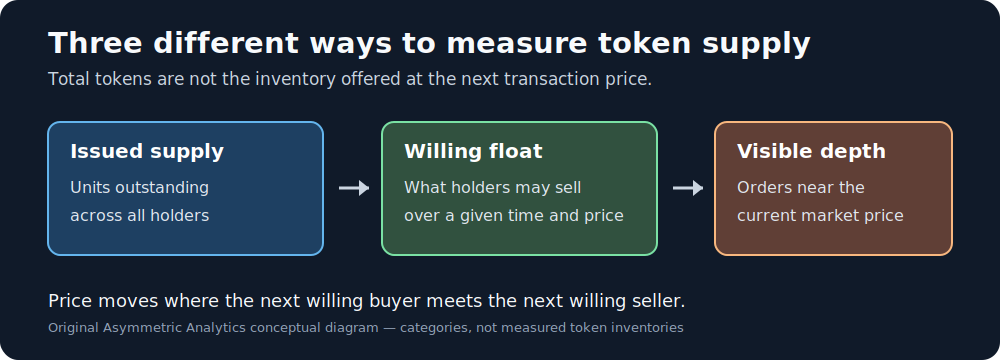
Imagine a market in which one million tokens exist. Of those, 900,000 are held by people with no intention of selling at today's price. The other 100,000 are available from sellers willing to transact now. If an institutional buyer seeks 50,000 tokens, it is not competing for one million; it is competing for the supply actually offered at successive prices.
This is an illustration, not an estimate of any cryptocurrency's inventory. It explains why circulating supply—a conventional count of issued, non-locked tokens—is not identical to tradable float, the portion owners are realistically prepared to sell over a given period and price range.
Market depth is the quantity buyers and sellers display near prevailing prices, often measured through order books. Thin depth can amplify price changes. It can amplify declines as well as advances.
The often-overlooked variable is time. A token might be unavailable for immediate sale but available tomorrow, next week, or after a fund redemption. The supply schedule is not a fixed wall. It is a collection of owner decisions and contractual constraints.
That is why a price shock requires three things together: persistent net demand, constrained sell-side liquidity, and insufficient replenishment from holders willing to sell into higher prices. One isolated whale-wallet chart cannot establish all three.
Detailed investigation
### XRP accumulation: What wallet balances can—and cannot—reveal
An often-repeated claim places an additional 1.54 billion XRP in large-holder wallets. A change in the balances of labeled addresses, even when accurately measured, cannot establish how many new investors bought XRP. It records blockchain balances; economic ownership requires more evidence.
The public claim does not identify the underlying wallet cohort, beneficial owners, acquisition prices or a reconciliation of net purchases against custody movements. That prevents a conclusion that an institution bought 1.54 billion XRP or that an equal number of tokens left tradable supply.
Consider four quite different events that can produce similar-looking charts:
1. A buyer acquires XRP on the open market and transfers it to an independently controlled wallet. 2. An exchange consolidates customer assets into a new cold-storage address. 3. A fund custodian transfers an existing position between legally distinct holding accounts. 4. An analyst's wallet-label database changes which addresses belong to a tracked cohort.
Only the first unambiguously adds a new buyer; even there, we need to identify the seller and the source of funds. The others may change visibility or legal custody without changing the economic exposure.
The correct investigative method follows actual blockchain movements and address labels, then reconciles them with independent fund holdings, exchange reserve methodologies and attributable ownership disclosures. Where the identity cannot be known, it should remain unknown.
Bitcoin: scarcity is programmed, market liquidity is not
Bitcoin's terminal issuance limit is often used as shorthand for scarcity. It is a meaningful protocol feature: new supply follows an issuance schedule rather than the discretion of a corporate issuer. But a limited total number of units does not set their future price. Demand can fall; early buyers can sell; collateralized owners can be liquidated.
There is more direct evidence for large-holder accumulation in Bitcoin than the unverified XRP claim currently provides. In an original research report dated October 13, 2026, CryptoQuant described a rise in balances for its tracked whale cohort excluding exchanges and mining pools. It estimated that those balances had reached 3.03 million BTC and reported a change toward accumulation relative to earlier months.
That research is useful but not infallible. It depends on the provider's address classifications and its definition of a whale. It is a dated observation, not a live reading of today's entire market. Its companion lending data also suggest an important complication: some large holders borrow against Bitcoin. Leverage may allow them to retain the asset during favorable conditions, but it can turn holders into involuntary sellers when collateral values fall.
A holder who does not sell is not necessarily a holder who cannot sell.
Ether: staked is not the same as permanently locked
Ether's supply dynamics differ from Bitcoin's. Ethereum's protocol documentation explains that ETH supply changes through validator rewards, which issue new tokens, and base-fee burning, which removes tokens. Its net supply therefore varies with participation and network activity.
Staking can reduce the amount of ETH immediately sitting on exchanges, but Ethereum staking withdrawals allow validators to exit and retrieve funds under protocol rules and queues. Staking positions can also be represented by liquid staking instruments that circulate even when the underlying ETH is committed.
A count of staked ETH is not equivalent to a count of assets economically removed from tradable markets. Some holders are economically exposed to ETH through claims that themselves can be sold or borrowed against. A rigorous supply estimate must avoid counting those same economic units as multiple independent shortages.
XRP: Ripple's escrow is relevant, but it is only one variable
XRP's market structure has its own constraints. Ripple publishes a quarterly holdings disclosure that distinguishes XRP in its available wallets from XRP placed in on-ledger escrow. As of June 30, 2026, Ripple reported approximately 37.656 billion XRP held in total, including 32.6 billion XRP in escrow.
These are issuer-reported figures for a particular date, not a claim about the precise amount offered for sale today. Escrowed XRP cannot be accessed until the applicable release conditions are met. Release schedules, re-locking and subsequent distributions matter to available supply, but it would be inaccurate to treat every escrow release as an immediate sale or every re-escrow as new demand.
Nor is network use mechanically proportional to token appreciation. A payment asset can turn over rapidly: the same units may settle many transfers, depending on market makers, inventories, timing and the network design. Proving price sensitivity requires comparing demand for held inventory with transaction throughput and the liquidity required to support it.
We should be just as ready to report exchange inflows and concentration risk as accumulation.
ETFs: the overlooked reverse gear
A spot crypto exchange-traded product makes it easier to obtain market exposure through a brokerage account. Depending on the product's legal structure, new share creation and redemption can lead to purchases, sales or in-kind transfers of underlying crypto assets.
The SEC's July 2025 decision allowing in-kind creations and redemptions for crypto exchange-traded products illustrates the mechanics: authorized participants can deliver or receive crypto assets as part of the fund's share-creation and redemption process.
What matters to tradable float is the net change in economic holdings, not simply a fund's dollar-denominated assets under management. A fund's asset value can rise without a single net inflow when the token's price goes up. Likewise, gross creations or transfers cannot be added indiscriminately to whale-wallet movements; the same underlying tokens may appear in multiple datasets.
If growing funds retain units for long periods, they may absorb inventory. If investors redeem during stress, the same mechanism can accelerate the release of inventory. Institutionalization introduces a new form of demand, not a guarantee of permanent scarcity.
An instructive detour: what large landlords tell us—and what they do not
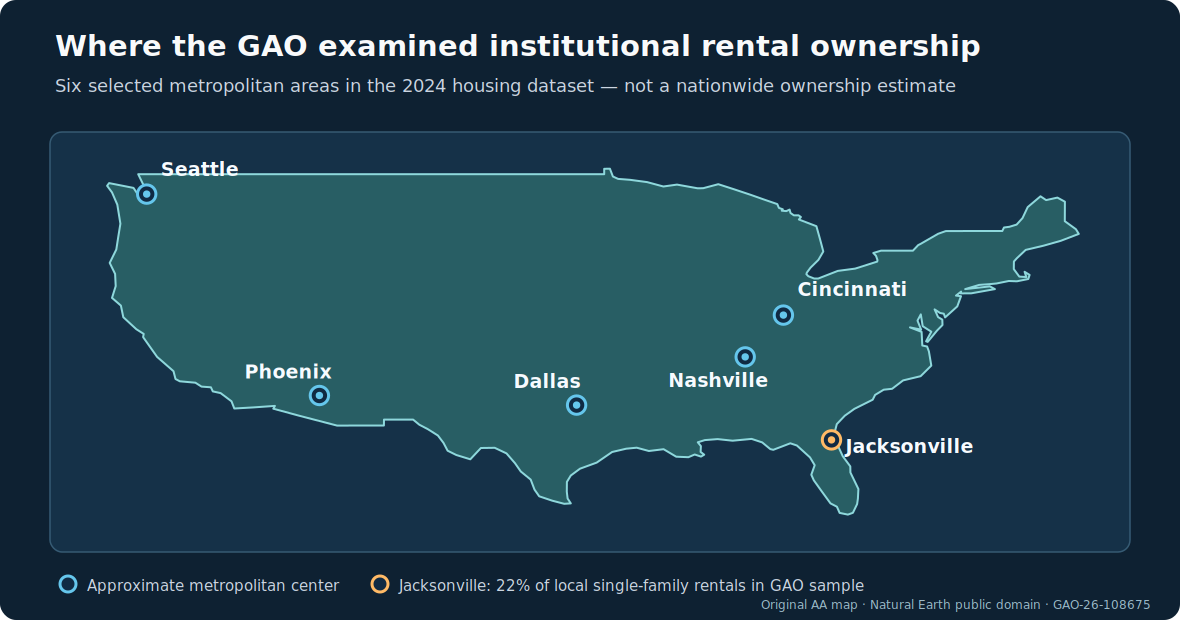
After the financial crisis, investors with access to capital bought foreclosed houses and assembled rental portfolios. In a March 2026 study , the U.S. Government Accountability Office found institutional investors owned roughly 1–3% of all single-family homes across six selected metropolitan areas in 2024, but as much as 22% of single-family rental homes in Jacksonville.
The important distinction is the denominator. A modest share of the entire housing stock can be a large share of the narrow market in which renters or buyers compete. The six-city study is not a nationwide ownership estimate.
The analogy breaks down quickly: houses cannot be sent globally between market makers in seconds, and two identical tokens are interchangeable in a way houses are not. Yet the lesson survives: the fraction actually available in a particular market is often more relevant to the next price than the total stock.
Market capitalization is not the cash required to move a market
Market capitalization is the quoted price multiplied by a defined supply count. It is a valuation convention. It is not a bank account holding that sum, and it does not mean that an equivalent dollar inflow is required to produce a particular quoted price.
Suppose the last token changes hands at twice the previous price while very few units trade. An estimate of market capitalization would also approximately double, even though the value of newly committed cash might be small. But this works in both directions: attempts to liquidate a significant share of the supply could move the clearing price much lower.
This is why extremely high price scenarios should be shown as conditional liquidity/valuation experiments, not disguised forecasts. An analyst must specify outstanding supply, order-book and over-the-counter liquidity, holder selling behavior, leverage, market-maker constraints and the period over which the price is supposed to persist.
Three plausible outcomes
The durable-absorption case. Long-duration ownership and fund demand grow while readily available exchange inventory and willing sellers contract. Incremental buying runs through increasingly thin offers. Price movements become more sensitive to flows. This case becomes stronger only if the same pattern survives corrections, redemptions and custody migrations.
The rotation case. Institutions, ETFs and large wallets trade among one another. Some balances leave exchanges and others return. Prices respond to changing macro risk appetite, but there is no secular shortage of saleable units. In this case, dramatic transfers tell us more about market organization than aggregate new investment.
The reversal case. Demand falters while leveraged holders face falling collateral values and fund investors redeem. Market depth vanishes on the bid rather than the ask. Previously concentrated ownership magnifies the drawdown. The bearish version of a supply shock deserves as much attention as the bullish version.
What we're watching
The decisive evidence will be a panel, not a headline: consistent net exchange balances by known venue; fund units and underlying-token holdings rather than only dollar AUM; time-stamped and labeled large-wallet cohorts with internal moves filtered out; realized sell-side market depth; derivatives open interest, financing rates and liquidation flows; Ripple's quarterly available/escrowed holdings; Ethereum's validator entry and exit queues; and Bitcoin's large-holder movements under transparent classification rules.
We would strengthen the absorption thesis if independently reconciled institutional inventories increase while spot sell-side liquidity declines for a sustained period, and the relationship remains observable through volatile weeks. We would weaken it if the apparent accumulation can be attributed to custody migrations, ETF redemptions, rising exchange availability, growing leverage without true spot demand, or readily replenished order books.
The financial-market consequence is not simply that “whales buy first.” It is that who holds an asset, why they hold it, and under what circumstances they become sellers can matter more to price formation than the number printed on its supply chart.
Primary evidence and provenance
Ripple: Facts about XRP and XRP holdings — Ripple's June 30, 2026 quarterly holdings disclosure.
U.S. SEC: In-kind creations and redemptions for crypto ETPs — regulation, July 29, 2025.
Ethereum.org: ETH supply and staking withdrawals — protocol documentation, viewed October 2026.
U.S. GAO: Institutional investor ownership of rental homes — original federal research, March 24, 2026.
CryptoQuant: Whales Are Back — original analysis dated October 13, 2026, using the provider's address classifications.