Democracy in the Age of AI: Who Controls the Information Layer?
By Asymmetric Analytics
Analysis
When a citizen asks where to vote, an AI assistant can give a direct answer instead of sending that person through a maze of websites. That is useful. When the same citizen asks what a policy proposal means, which sources are trustworthy, or why an election result is being disputed, the assistant is doing something more difficult: it is interpreting a contested public world.
The transition from search engines to conversational assistants is therefore more than a change in user interface. It may change how public information is selected, summarized, corrected and trusted.
The most important distinction is between the original authority that holds an official fact and the platform that presents that fact to a citizen. Those roles can cooperate, but they should not be confused.
1. Election information now travels through a new network
The 2026 U.S. midterms offer a practical case study. On October 14, Anthropic announced that Claude planned to incorporate state-specific voting information supplied through Democracy Works, including registration requirements, polling places and other election logistics. Anthropic also discussed safeguards for political conversations and the display of election-night results.
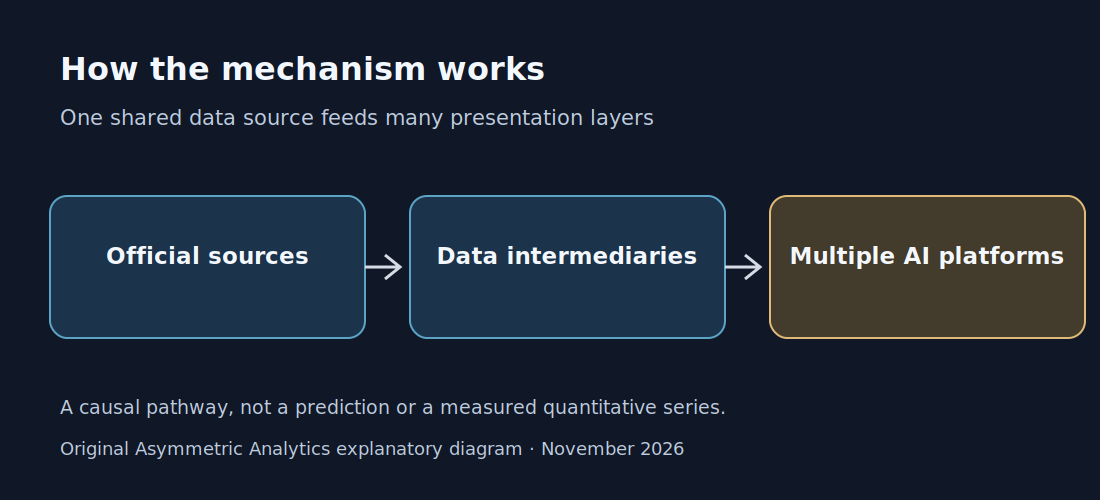
OpenAI's October 20 update described a live U.S. Democracy Works integration for registration, deadlines and polling places, with Associated Press election-night vote counts. Other consumer-facing providers have pursued similar arrangements.
Democracy Works documented its Google partnership , including Search's AI features and the then-planned Gemini access, and its work with TikTok . A shared infrastructure for reliable logistics can place accurate procedural information in more places than an official election website alone can reach.
That is a genuine public benefit. Voters need accurate hours, registration rules and locations regardless of which application they prefer.
The interesting consequence is concentration at a new layer of the information system: multiple platforms can depend on the same data intermediary even while presenting radically different conversational experiences.
2. A verified fact can become a misleading answer
Suppose the election office publishes a correct voting deadline. An intermediary captures it accurately. An AI assistant retrieves the right record and still explains it badly, omits an exception or fails to notice that the user is asking about a different jurisdiction.
No one needs to manipulate the underlying source for the user to receive a misleading answer.
The same issue becomes more complex when the topic is a candidate's position, a ballot initiative, an economic policy or a disputed public claim. These require more than retrieving one field from an official database. They require framing, selection of sources, characterization of uncertainty and sensitivity to context.
The Democracy Works Elections API documentation makes a valuable architectural point: it gathers information from government sources and some third-party systems, and provides canonical links that readers can use to inspect the origin of an answer. That provenance is a strength. It also reveals that saying every data field comes directly from one government office would be an oversimplification.
An accurate system should let the user move backward through the chain: answer, source record, election office and authoritative correction. A confident answer without an accessible trail creates unnecessary dependence on the assistant.
3. The difference between information and influence
There are at least three layers of decisions in an AI response.
The first concerns facts: what are the official registration deadline, officeholder, certified result or enacted policy? These questions can often be answered by well-maintained authoritative sources.
The second concerns interpretation: what does an economic proposal entail, what is the strongest argument on each side, and which claims can be tested? These questions require transparent reasoning and well-chosen evidence.
The third concerns presentation: what gets summarized first, what receives emphasis, which omissions seem important, and whether a system answers consistently when users change political labels or assumptions.
These layers should be tested separately. A platform may be excellent at providing election locations yet weak at representing competing policy arguments. Another may appear evenhanded in paired questionnaire tests but be inconsistent in longer conversations involving ambiguous or fast-changing events.
The existence of a safeguard is not proof that every output is accurate. Equally, discovering a biased or erroneous output is not proof that a company is deliberately manipulating an election.
4. What the bias research does and does not show
Political fairness cannot be fully reduced to a single score. A model may treat mirrored prompts symmetrically while relying on a narrow selection of sources. It may answer direct ideological questionnaires differently from realistic user questions. And it may perform differently across countries, languages, and policy subjects.
Anthropic's October 2026 description of its safeguards contains company-defined measures of political evenhandedness and abuse. Such evaluations are evidence about a specified test, not independent certification of every conversation.
Researchers have also examined broader questions. The peer-reviewed IssueBench study evaluated 2.49 million realistic prompts covering 212 political issues and ten language models. It found persistent issue biases across models and closer alignment with Democratic rather than Republican voter opinion on a subset of issues; this does not justify classifying all their answers or current versions as uniformly partisan. Such work is useful precisely because a model's political behavior can depend on the issues selected, the prompting method and the population used for comparison. It would be a mistake to turn a subset finding into a universal label for all AI systems.
An independent Princeton analysis dated October 8 compared the platforms' documented policies before the October 14 and October 20 announcements discussed above. It should therefore not be treated as an audit of those later implementations. Policy descriptions provide a starting point for accountability; evaluating actual user outcomes requires a different body of evidence.
Our appropriate standard is empirical: identify specific questions, compare responses with official sources, test equivalent formulations across viewpoints, repeat after corrections, and publish methods that others can reproduce.
5. Concentration can improve quality—and amplify mistakes
A common source provider can improve consistency. Instead of each platform constructing a different database of tens of thousands of local election rules, multiple providers can draw from maintained records and reuse authoritative links. This reduces duplication and makes corrections more manageable.
It also introduces the possibility of common-mode failure. An outdated source entry or wrongly mapped location can be propagated by many otherwise independent interfaces. A system that cannot explain the provenance of its result may make the problem harder for users to identify.
The economic incentives are similarly double-edged. Partnerships with authoritative data providers support trust and reduce liability, but the platforms owning the user interface can capture attention, behavioral feedback and the opportunity to become the default gateway for civic information.
The data provider is not necessarily an ideological gatekeeper. The platform that summarizes, ranks or refuses information can nevertheless influence which interpretations a user encounters. Neither observation requires alleging intentional partisan misconduct.
6. Where citizen control should remain
The final authority over election administration remains with election officials and lawful processes, not with a chatbot. Certified results are not determined by what an assistant says. A model can help a citizen find official information, but should not become a substitute for checking an election office when a deadline or eligibility rule is consequential.
Citizens also benefit from the ability to compare multiple explanations, inspect original documents and challenge errors. A responsible information system should make that work easier, not reward unwarranted confidence.
As public discussion moves into conversational interfaces, transparency about sources and corrections may become as important as search ranking once was.
7. What the 2026 election makes possible to audit
Now that the November 3 election has taken place, audits can compare the platforms' promised services with the answers users actually received: how quickly each platform reflected corrected election records, whether location questions were resolved accurately, how provisional results were distinguished from certified totals, and whether source links remained visible when answers were summarized.
We should also evaluate policy explanations using balanced, issue-specific benchmarks and publicly disclosed scoring criteria. The purpose is not to choose a political viewpoint. It is to test whether citizens can get reliable factual information and understand genuine disagreements.
The wider implication extends beyond elections. The same architecture increasingly mediates healthcare information, investment research, law, scientific debate and current affairs. A platform that earns trust in simple factual queries may be trusted in complicated interpretive ones, whether or not it has earned that broader confidence.
What would change our view
1. Correction latency: In sampled election-office corrections, do multiple platforms update within a documented measurement window, or propagate the same stale entry? 2. Source provenance: What share of sampled voter-logistics answers include a working link to the authoritative official record, and how often is the jurisdiction correctly identified? 3. Interpretive consistency: Do pre-registered mirrored political questions show systematic omission or emphasis differences when evaluated against a balanced evidence rubric? Rapid correction, traceable sources and reproducible cross-viewpoint accuracy weaken the concern; common errors or persistent selective omission strengthen it.
Primary evidence
Anthropic, Preparing for the 2026 US midterms .
OpenAI, Election information and safeguards in 2026 .
Democracy Works, Elections API and provenance .
Democracy Works, 2026 Google partnership .
Democracy Works, TikTok Elections Center partnership .
ELSI trail
Election administration, Democracy Works, Anthropic, OpenAI, Google, TikTok, data provenance, AI model evaluation, information intermediation and correction latency are related but not interchangeable. Official source-of-record authority is fundamentally different from an AI assistant's interpretation. A company's description of its safeguards is not independent evidence that those safeguards always work.