The Economics of Asymmetric Warfare: Can Small Attacks Produce Global Consequences?
By Asymmetric Analytics
Analysis
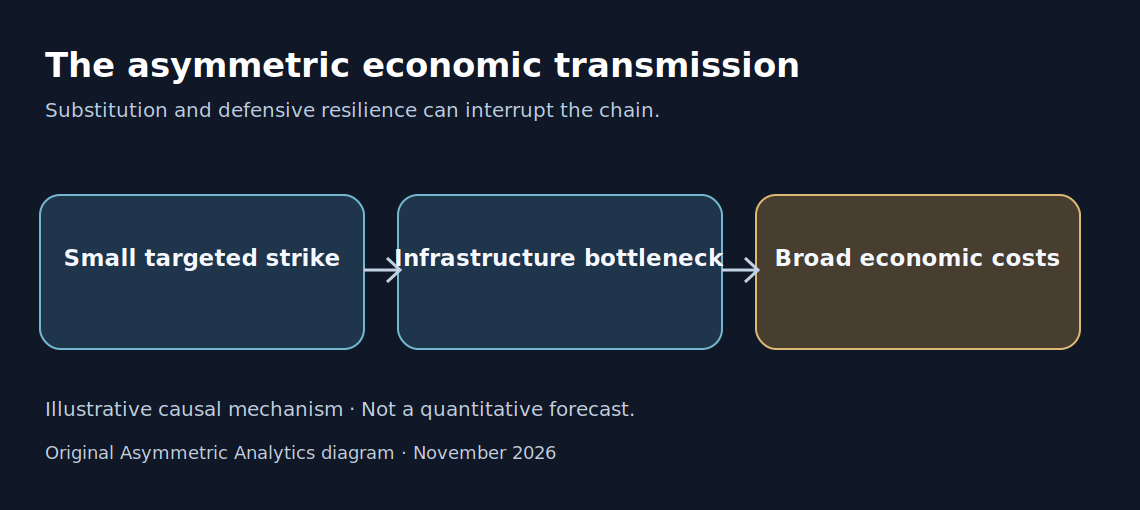
The cost of a weapon tells us remarkably little about the damage it may impose on the opposing economy. A relatively inexpensive drone can disable equipment that requires specialized engineers, imported components and long lead times to replace. A threat to tankers may alter insurance and routing decisions even if most vessels remain afloat. A small number of attacks on a vulnerable supply chain can force an adversary to spend far more on protection than the attackers spend on disruption.
The same logic is relevant to the 2026 Middle Eastern fighting documented in the IEA report: a conventionally stronger military can still confront economic costs when shipping, fuel or infrastructure becomes unreliable.
The compelling question is not whether a small weapon can damage a large object. It is whether low-cost attacks can change the strategic calculation of a richer, militarily stronger opponent.
1. War can be cheap to initiate and expensive to absorb
Military comparisons often place a drone or missile on one side of an equation and an interceptor or defended asset on the other. These comparisons matter but require discipline. A quoted unit price is not a full operating cost; a defensive response may protect many lives and assets; and an attacker needs a functioning supply chain and access to targets.
The economic asymmetry is therefore not a universal law that cheap weapons always win. It is a question about relative replacement rates, exposure and the cost of keeping an economic system working.
Industrial facilities are vulnerable in different ways. Some can restart quickly after minor damage. Others contain specialized processing units, compressors, transformers or controls whose replacements are produced by only a few manufacturers. Their fragility depends less on headline asset value than on whether an entire production network needs that one component to function.
A compressor that costs less than a refinery may halt production worth far more than its replacement price. Its strategic value comes from its position in the network.
2. Oil markets show how disruption travels
The IEA's October 2026 Oil Market Report gives the mechanism a factual anchor. It reports that global diesel exports in September were 700,000 barrels per day lower than a year earlier. Reduced exports from Russia and the Middle East were only partly offset by other regions.
That disruption did not occur because the world suddenly forgot how to refine oil. The IEA attributes the decline chiefly to curtailed Russian and Middle Eastern exports that other sources could only partly offset. War, transport risk and limits on refining flexibility can then magnify the consequences; this broader network effect is our interpretation.
The same report describes severe strains in diesel inventories, transportation costs and fuel prices. These are direct economic consequences, not proof that every contributor to the disruption acted under one coordinated strategy.
Diesel is especially consequential because it powers transport and agriculture, while crude oil must be processed before it can substitute for finished products. An oil producer can have plenty of crude and still struggle to supply the particular refined products its customers require.
3. The maritime leverage of chokepoints
The U.S. Energy Information Administration's World Oil Transit Chokepoints explains why a narrow maritime passage can have consequences far beyond its geography. The Strait of Hormuz links Gulf production to global markets; other passages connect the Red Sea, Mediterranean and Indian Ocean shipping systems.
The attacker may not need a formal blockade to alter commercial behavior. Higher perceived risk can increase insurance costs, security expenditures and transit times. Ships can reroute, but alternative routes are not always equivalent in distance, capacity, terminal access or vessel compatibility.
This does not guarantee success. Diversion pipelines, alternative ports, inventory buffers, defensive escorts and changes in demand can reduce the leverage of a threatened route.
The central economic issue is the elasticity of substitution: how easily can markets replace the capacity that has become unreliable, and at what price?
The UNCTAD Review of Maritime Transport provides broader context for the interaction of shipping networks, freight rates and trade disruption.
4. The cost of defense is not necessarily a loss
It is tempting to compare the cost of one attacking drone with that of one interceptor and declare that the attacker has already won. That reasoning ignores the value of what the defense protects.
If a costly interceptor saves a densely populated city or a critical industrial site, the expenditure may be economically justified many times over. Conversely, repeatedly using the most expensive possible defensive response against inexpensive expendable threats can strain inventories and finances.
The decisive measures are the protected value, the rate of attack, the ability to replenish defensive equipment, the operational success of each side and the opportunity cost of resources diverted elsewhere.
A defense that adapts with electronic warfare, cheaper counter-drone systems, dispersal and passive protection can change the cost exchange dramatically. A strike strategy that looks effective in its first weeks may produce declining returns after the opponent adapts.
5. Industrial replacement is the deeper measure of power
A military may possess extraordinary offensive capacity yet remain dependent on a narrow industrial supply base for replacement ammunition, drones, electronics and propulsion components.
Conversely, a smaller opponent can struggle to replenish its own weapons and skilled operators. No cost asymmetry lasts automatically. The contest becomes one of production rates, available inputs, financing and adaptation.
The case of drone warfare shows why the factory and the battlefield are increasingly inseparable. A side that can improve cheap systems, produce them in volume and learn from field failures may exert substantial pressure without matching the opponent's most expensive weapons.
This connects directly to the economic value of civilian factories, specialized components, energy infrastructure and the ability to move people and products across borders.
6. Food and fertilizers extend the reach of energy warfare
Natural gas can serve as both energy and chemical feedstock. Oil derivatives support agricultural transport and mechanization. War-related disruption in these inputs can raise the cost of fertilizer, crop production and food distribution.
The IEA's 2026 gas-security review highlights the role of physical availability and internationally traded cargoes. The FAO Food Price Index is useful for tracing commodity-price changes, though it cannot establish the motive behind a military strike.
There is a lag between input costs and consumer consequences. Farmers can adjust application rates, importers can switch suppliers and retailers can temporarily absorb costs. These adaptations make forecasts uncertain but do not eliminate the underlying dependence on fuel, fertilizer and freight.
A war fought in one region can thus become an economic shock in several others without the countries bearing those costs becoming direct military belligerents.
7. The strategic meaning of endurance
Imagine an adversary damages a refinery. If output is restored rapidly, the economic loss may be limited. If one imported part takes months to replace, the same strike can have a much larger effect. If a bypass pipeline absorbs the missing supply, the attack may fail to create lasting leverage even though the physical damage is real.
This is why an economic war cannot be assessed from dramatic footage alone. It requires measuring lost throughput, actual shipping movements, repair times, inventory changes, insurance premiums, substitute capacity and the durability of price impacts.
The attacker also pays an opportunity cost: weapons used against infrastructure are not available for other missions, and attacks that antagonize neutral countries may produce new coalitions against the attacker.
Economic coercion is a competition in endurance rather than a guarantee that the weak can always defeat the strong.
8. Three possible outcomes
Scenario 1 — Temporary disruption. Targeted attacks damage exposed facilities, but reserves, rerouting and repair restore throughput. Prices spike and then normalize.
Scenario 2 — Persistent economic pressure. Frequent attacks exceed the pace of repair and protection. Shipping becomes more expensive, inventories decline and governments must sustain costly defensive commitments.
Scenario 3 — Defensive adaptation. Cheap interception, passive resilience, redundancy and diversified supply chains lower the cost of protection. The attacker loses leverage even without the underlying conflict ending.
These outcomes can vary by sector and evolve over time.
What would change our view
1. Throughput and recovery: After documented attacks, how quickly do affected refineries, terminals and transport routes return to normal operation? 2. Cost exchange: Does the real cost of protecting economically valuable assets rise faster than attackers' costs, after including the value preserved by defense? 3. Substitution: Do alternative supply routes and facilities measurably reduce lost output and market price premiums over successive months? 4. Strategic concessions: Is there documented evidence that economic costs, rather than battlefield outcomes or unrelated politics, are changing an opponent's negotiating position?
The asymmetric-coercion thesis weakens where disruptions recover quickly and defensive costs become manageable. It strengthens where small, repeated attacks cause sustained, independently measured industrial losses.
Primary evidence
IEA, Oil Market Report — October 2026 .
IEA, Global Gas Security Review 2026 .
EIA, World Oil Transit Chokepoints .
ELSI trail
Asymmetric warfare, industrial chokepoints, refinery throughput, diesel, maritime freight, insurance, fertilizer and national fiscal capacity form an economic chain. The effect of an attack and the intent behind it must remain separately evidenced.