Europe's Energy–Debt Trap: When an Oil Shock Becomes a Fiscal Test
By Asymmetric Analytics
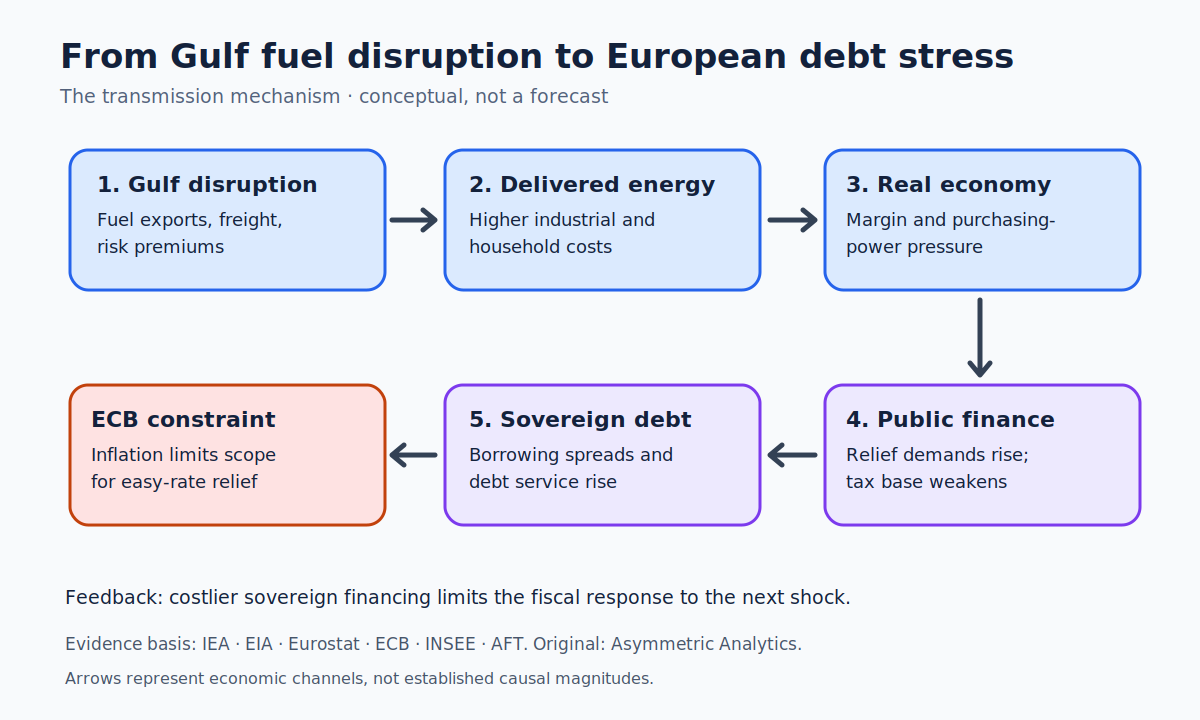
The real danger is the feedback loop
Europe's energy crisis is feeding directly into its sovereign-debt problem. Higher fuel costs are weakening industry and households while expensive government borrowing limits the response. Each pressure can intensify the other.
The latest Middle East disruption is raising the delivered cost of fuel, freight and industrial inputs at the same time that European governments are facing expensive borrowing, weak industrial output and political resistance to fiscal restraint. A costly-energy economy needs investment and relief. A strained sovereign balance sheet cannot provide them freely. Central banks, meanwhile, must protect purchasing power against inflation.
The same shock is weakening Europe's economy and its governments' capacity to stabilize it. That feedback loop—not the daily fluctuation in oil prices—is the central financial risk.
First, understand the barrels that never arrived
The International Energy Agency's October 14 assessment captures the apparent contradiction. Gulf crude exports recovered to 13.9 million barrels per day in September, over three-quarters of prewar volume. But Middle East refined-product shipments reached just 1.9 million barrels per day, compared with 4.7 million before the war. Global observed oil inventories were 509 million barrels below end-February levels.
The market is finding ways to move raw crude without restoring the full supply chain that turns it into diesel, jet fuel and heating fuels. The routes that remain are dearer. The EIA's October outlook reports record tanker rates in September, driven in part by higher insurance costs, and longer routes around conflict zones that tie up ships. Both pressures raise the delivered price of crude to refiners.
This distinction matters enormously to an industrial economy. Businesses do not operate on the abstract international price of a barrel. They buy electricity, process heat, diesel and transport services at specific places and times. The available grade of oil, refining margins, ship capacity and insurance risk all influence their final costs.
Second, the inflation shock consumes policy flexibility
Eurostat reported annual euro-area inflation of 3.8% in September 2026, compared with 3.2% in August. The energy component alone contributed 1.71 percentage points to the September annual rate. That means energy is already a major observable component of the current inflation problem, rather than a speculative future threat.
At the same time, Eurostat recorded that euro-area industrial output fell 0.5% in August, after a revised 0.3% fall in July, and was 1.1% lower than a year earlier. The decline adds to pressure on manufacturers already facing higher input costs.
A conventional slowdown invites lower interest rates and fiscal support. An imported energy shock is different. Lower rates cannot manufacture missing diesel or eliminate war-risk insurance premiums. And lower rates may weaken the currency or allow some cost increases to spread, making the inflation challenge more difficult.
The ECB raised its deposit rate to 2.50% in September . The bank is responding to persistent inflation even as the supply shock slows growth. Its policy dilemma is increasingly severe.
Third, sovereign finance runs on another clock
France illustrates the fiscal constraint with unusual clarity. INSEE reported general-government debt of €3,595.5 billion, equivalent to 119.0% of GDP, at the end of the second quarter of 2026.
Agence France Trésor's budget figures project a €339.7 billion total State financing requirement in 2027 and €72.9 billion in State debt service. Much of the financing requirement involves replacing maturing debt. As lower-rate bonds roll off, France must refinance at today's higher rates, steadily increasing its interest burden. Expensive new issuance raises future interest expense and competes with other spending. Meanwhile, energy-related support—household assistance, industrial subsidies, strategic infrastructure and defense—becomes politically harder to postpone.
The state can refinance tomorrow, but markets discount tomorrow's burden today. That is the second clock of the energy–debt trap.
Fourth, when the bond market starts amplifying the shock
Sovereign bonds are not merely government IOUs. Banks, insurers, investment funds and pension institutions hold and finance them. A fast rise in yields lowers the market price of existing fixed-rate bonds. Funds using leverage can face additional collateral calls and may sell into a declining market, making the price adjustment steeper.
The IMF's October 2026 Global Financial Stability Report identifies sovereign-yield shocks and leverage as routes through which bond-market stress can spread across the financial system. A sharp repricing can force leveraged institutions to raise collateral or sell assets, amplifying the original move.
The ECB has tools. Its Transmission Protection Instrument permits secondary-market sovereign purchases when disorderly market conditions threaten monetary-policy transmission, subject to criteria. The TPI can address disorderly markets; it cannot erase a government's fiscal obligations. Europe needs both functioning financial markets and credible public finances.
This distinction explains why falling U.S. government yields and rising French risk premiums need not be contradictory. Investors may seek highly liquid safe-haven bonds while demanding more compensation for a particular sovereign's deteriorating fiscal outlook.
Europe's three possible paths
Adaptation. Gulf exports and refining recover, diesel and freight premia fall, and inflation eases before higher borrowing costs impose material damage. The EIA's October forecast anticipates lower oil prices as trade routes and inventories normalize. European firms regain breathing room and fiscal strains remain manageable.
Prolonged stagnation. Fuel remains costly, but markets stay orderly. Real wages and industrial margins absorb the adjustment over time. Central banks have limited room to ease, governments ration fiscal support, and economic growth is weak. Years of weak growth may prove more damaging than a brief market panic, particularly if high energy bills reduce industrial investment.
Financial escalation. A new physical disruption depletes stocks further; borrowing spreads widen abruptly; leveraged holders liquidate assets; and policy disputes delay a credible response. Even if aggregate oil shipments remain substantial, the combined cost of fuel, credit and uncertainty creates a self-reinforcing downturn.
The decisive indicators are fuel shipments, inventory levels, inflation, sovereign borrowing costs and the functioning of credit markets.
The indicators that will decide the outcome
Our working thesis would weaken if refined-product exports recover sustainably, global oil inventories stabilize, diesel and tanker premiums retreat, euro-area energy inflation falls, and French sovereign spreads narrow while financing auctions continue normally.
One counter-signal has already appeared. The IEA's October assessment says European diesel refining margins fell from about $100 a barrel to about $60 by early October. That retreat does not restore missing fuel or depleted inventories, but it shows that one part of the price shock can ease before the broader disruption is resolved.
It would strengthen if low diesel availability persists into the winter, France faces materially more expensive issuance, corporate margins contract alongside production, and strained sovereign spreads extend beyond France. Those developments would signal a deepening financial squeeze.
The energy shock begins as a physical shortage, spreads into national balance sheets and can ultimately become a market-liquidity problem. That is why the Gulf and European sovereign-debt markets belong in the same investigation.
What the market may be missing
Europe's greatest exposure is not simply that it imports expensive energy. It is that the energy shock arrives when debt service, political fragmentation and inflation leave less room to pay for adaptation.
The world may eventually move enough oil around the Gulf to ease the immediate shortage. The question for Europe is whether the industrial and fiscal damage accumulated along the way can be repaired quickly enough to prevent a longer period of weak growth and financial fragility.
That is the energy–debt trap: a temporary disruption can create costs whose financing lasts much longer than the disruption itself.
Sources and research provenance
Primary sources:
IEA, Oil Market Report, October 14, 2026 — exports, inventories, demand and fuel availability.
U.S. EIA, Short-Term Energy Outlook, October 6, 2026 — disrupted pipelines, delivered energy costs and recovery forecast.
Eurostat, September euro-area inflation, released October 16 — 3.8% inflation and energy component.
Eurostat, August industrial production, released October 15 — month-over-month industrial output.
INSEE, Q2 2026 Maastricht debt, September 29 — French general-government debt.
Agence France Trésor, 2027 State financing and debt service — budgets/issuance versus government-wide debt distinction.
ECB, September monetary-policy decision and Transmission Protection Instrument — rates and policy limits.
IMF, October 2026 Global Financial Stability Report — stability risk framing and resilient markets.