The Factory Becomes the Weapon: Civilian Industry and the New Drone-Arms Race
By Asymmetric Analytics
Analysis
America once measured its wartime industrial advantage by the speed at which automobile factories could turn out vehicles, aircraft components, and weapons. The modern version may look less cinematic. It could be a battery production line that originally expected to sell cells into electric vehicles, then becomes qualified to manufacture batteries for military drones.
That sounds like a small industrial detail. In a war of attrition, it is anything but small. Aircraft inventories and missile magazines matter, but so do the mundane factories that feed the machines at the edge of the battlefield. A drone with an exquisite camera but no battery is not a weapon system. A contract that promises millions of cells but delivers none is not an industrial reserve.
The central question is whether the United States can turn civilian industrial depth into a durable defense advantage—or whether the celebrated conversion announcements will remain relatively small experiments.
1. A $75 million lesson in how to read industrial claims
On September 23, 2026, Amprius Technologies entered a defense agreement to establish high-volume domestic production of advanced silicon-anode lithium-ion cells intended for smaller unmanned aerial systems. The original SEC disclosure sets a government ceiling of up to $75 million over a base period extending into September 2028.
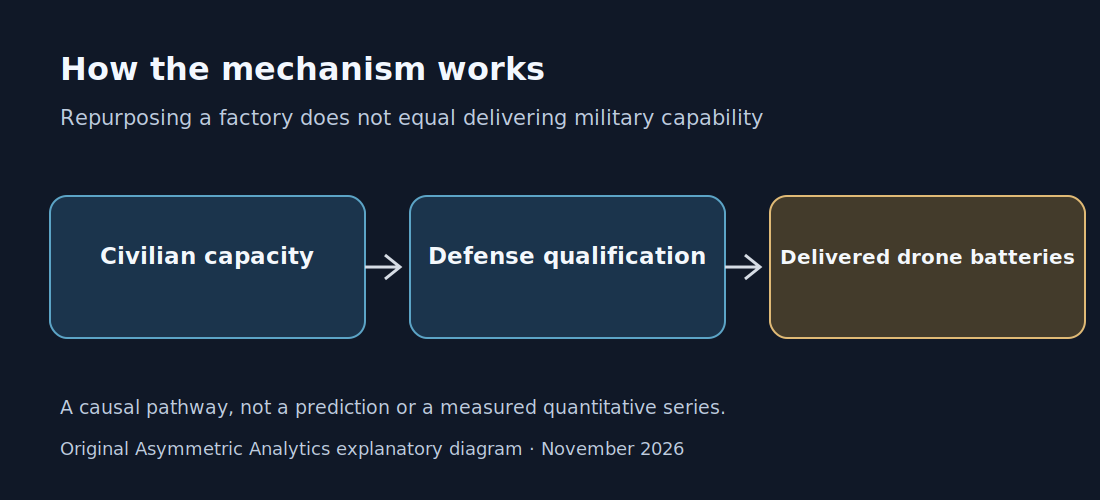
That is not the same thing as an immediate $75 million cash payment. The filing describes fixed-price work, deliverables, government acceptance, and milestone-based payments. About $22 million was initially obligated to fund the base period. The distinction between award ceiling, obligation, cash received, qualified line, and delivered batteries is the whole analytical story.
In a September 28 announcement , Amprius said the plan involved adapting an existing U.S.-based battery line operated by a major South Korean manufacturer. The industrial attraction is clear: using established equipment, engineers, workers and supplier relationships may avoid some costs and delays of building a wholly new facility.
The company describes a goal of up to twelve million cells annually, not twelve million drones. Even if that future cell output is achieved, an aircraft may require multiple cells, production yield and qualification consume capacity, and the full projected output is a future objective rather than current production.
2. Why civilian manufacturing matters more than it used to
The drone revolution has changed the arithmetic of procurement. A military with a limited number of exquisite aircraft can destroy powerful targets, yet cheap autonomous or remotely piloted systems can also impose continuous demands on air defenses, logistics routes, and electronic warfare. The relevant question becomes how many useful systems can be replaced after they are destroyed, not simply how many were acquired before the fighting began.
Factories designed for civilian products can sometimes provide a head start. Battery lines already understand cell chemistry, testing, thermal control and manufacturing yield. Commercial electronics suppliers know how to make components in large volumes. Machine shops accustomed to automotive quality systems may be capable of producing precision assemblies.
But transferability is not automatic. Defense procurement may require different specifications, traceability, cybersecurity safeguards, origin controls and safety qualification. A factory capable of producing millions of civilian units may need months of engineering to make a comparatively small number of military-qualified units.
That is why the milestone structure of the Amprius contract matters. The government is not merely buying batteries. It is paying to establish a production capability that could later serve many procurement decisions. This resembles an option on industrial capacity, not a guaranteed stream of wartime output.
3. China's supply-chain position complicates American rearmament
Domestic final assembly is valuable, but does not guarantee domestic control of upstream inputs. Lithium processing, battery materials, rare-earth magnets, electronic components, motors and specialized production equipment form long multinational chains.
A battery assembled in the United States can still be vulnerable to material price spikes, export restrictions, foreign supplier bottlenecks, or a shortage of specialized manufacturing equipment. Likewise, converting a plant does not create the trained workforce, qualified alternatives, and inventories needed to survive a prolonged disruption.
The IEA's Global EV Outlook 2026 battery chapter finds that China accounted for over 80% of global battery manufacturing capacity in 2025, with cathode and anode supply chains similarly concentrated. That is a documented industrial constraint, not an assumption that every drone battery uses the same chemistry. Civilian demand created much of the technological learning and production scale that defense programs now hope to borrow. The civilian electric-vehicle industry and the military drone industry may therefore compete for some inputs while also supporting one another's manufacturing knowledge.
There is a geopolitical paradox here. A country may increase the number of military systems assembled domestically while remaining dependent on foreign processing facilities for the parts that make those systems possible. Reindustrialization has to be evaluated at the level of the entire bill of materials, not merely a factory's address.
4. What a true conversion program would look like
We should measure four distinct achievements. The first is investment committed to an existing line. The second is the line's demonstrated qualification and operational capacity. The third is repeatable deliveries that survive quality audits and actual field use. The fourth is sustained orders large enough to keep the capability economically viable after its initial subsidy.
Each step answers a different question. Conversion funding can reduce commercial risk for the plant's owners. A qualified line proves the engineering works. Repeat deliveries demonstrate that yield, labor, materials and logistics operate together. Sustained demand tests whether the military wants enough of the product to keep the factory open.
If the program proves successful, similar conversions could offer a bridge between idle or underutilized manufacturing capacity and defense requirements. If it fails, the principal result might be the expense of retooling a product line to serve a small government customer.
A skeptical investor should ask whether the project meaningfully improves the manufacturer's order book and operating cash flows, rather than merely accepting the headline ceiling as revenue. A skeptical defense planner should ask how many qualified cells arrive on schedule and how easily production can be redirected when needs change.
5. The comparison with the Arsenal of Democracy
During World War II, American industrial power rested on enormous mobilization, standardized output and national priorities that reshaped large portions of civilian production. A single modern battery grant is not comparable in scale. Today's defense manufacturing exists inside a different economy with intricate international inputs and highly specialized electronic components.
The meaningful comparison is the mechanism, not the magnitude. Production capacity is a form of strategic power. A military that can replace inexpensive drones rapidly, keep components flowing, and adapt manufacturing faster than an opponent gains a powerful advantage even without producing the world's most sophisticated individual weapons.
Yet there is an opposing mechanism. Civilian factories may have more profitable customers and different capital needs. Governments may announce conversion programs without providing the predictable demand that makes permanent capacity viable. The defense side may also over-specify products, slow qualification, or change requirements faster than manufacturers can follow.
In other words, the industrial advantage comes from organized learning and dependable purchasing, not patriotic press releases.
6. Markets and the fiscal bill
This transformation has a financial side. For Amprius, the key observations are actual obligations, recognized revenue, working capital, cell qualification and yields. For broader manufacturers, the question is whether defense programs provide incremental demand or simply shift a costly manufacturing line from one uncertain customer to another.
A sustained transition could benefit specialized equipment suppliers, battery developers and qualified materials producers. It could also raise competition for constrained inputs and increase public procurement costs. The sector-level implications therefore depend on delivered output and margins, not on a universally bullish assumption about drone stocks.
Public spending also faces opportunity costs. Money spent qualifying and subsidizing defense capacity cannot be spent twice on other infrastructure. The correct test is whether the resilience purchased is worth the investment relative to alternate designs, inventories, or suppliers.
Claims about new manufacturing programs should always be compared with actual procurement performance, not only the executive description of what is planned.
7. The next industrial mobilization is a network
The factory is the visible part. Underneath it are cell chemistry, raw materials, industrial power, production equipment, qualified technicians, acceptance testing, freight and military demand. The future advantage belongs to the nation that can coordinate these pieces without becoming so bureaucratic that nothing arrives.
That is what makes the battery-conversion experiment worthy of serious attention. It does not prove the return of the Arsenal of Democracy. It reveals what a modern arsenal would have to build.
What would change our view
1. By September 2028: Have accepted contract milestones resulted in a qualified, operating battery line and documented deliveries? 2. After initial qualification: Are there follow-on customer orders and audited production yields, rather than only announcements of future capacity? 3. Across other conversion projects: Can production maintain reliable access to critical inputs and reasonable unit costs without indefinite subsidies? The thesis weakens when milestone acceptance stalls, deliveries do not materialize or dependence on a single upstream supplier remains unresolved.
Primary evidence
Amprius SEC agreement, September 23, 2026 .
Amprius award and manufacturing announcement, September 28, 2026 .
International Energy Agency, Global EV Outlook 2026 battery chapter .
ELSI trail
Civilian industrial capacity, defense procurement, lithium-ion cells, manufacturing conversion, industrial supply-chain concentration, military drone attrition, and fiscal capacity are related through the conditions that determine whether a planned factory becomes a reliable supply source. Those relationships should be reconciled against existing canonical ELSI identities rather than being treated as a single interchangeable concept.