The Great Divergence
By Asymmetric Analytics
Analysis
The world is approaching an extraordinary era of technological abundance. But the countries that prosper tomorrow may not be the ones that accumulated the most wealth yesterday.
A generation of new technology is being built around artificial intelligence, robotics, ubiquitous computing and increasingly automated industry. The economics of knowledge, labor, electricity and productive capital could change radically. A society that learns quickly can use these tools to become far more productive. A society that cannot adjust may find itself growing poorer relative to the rest of the world even as global wealth explodes.
This is the great divergence: not simply East against West, or democracy against authoritarianism, but societies that build the foundations of tomorrow's economy versus societies unable to escape the constraints of yesterday's decisions.
Europe provides a revealing test. It spent decades assembling one of the world's great industrial systems, then confronted an extraordinary chain of energy, security and regulatory challenges. Its political institutions must now decide whether to reverse costly arrangements or defend them as competitors invest in the infrastructure of artificial intelligence.
America and China are not without their own problems. They are, however, building enormous computing and industrial capabilities while the strategic map of Eurasia shifts around them.
The consequences will be visible not just in GDP tables but in where factories open, where engineers work, where energy is generated, where new businesses emerge — and where capital earns its return.
Brief
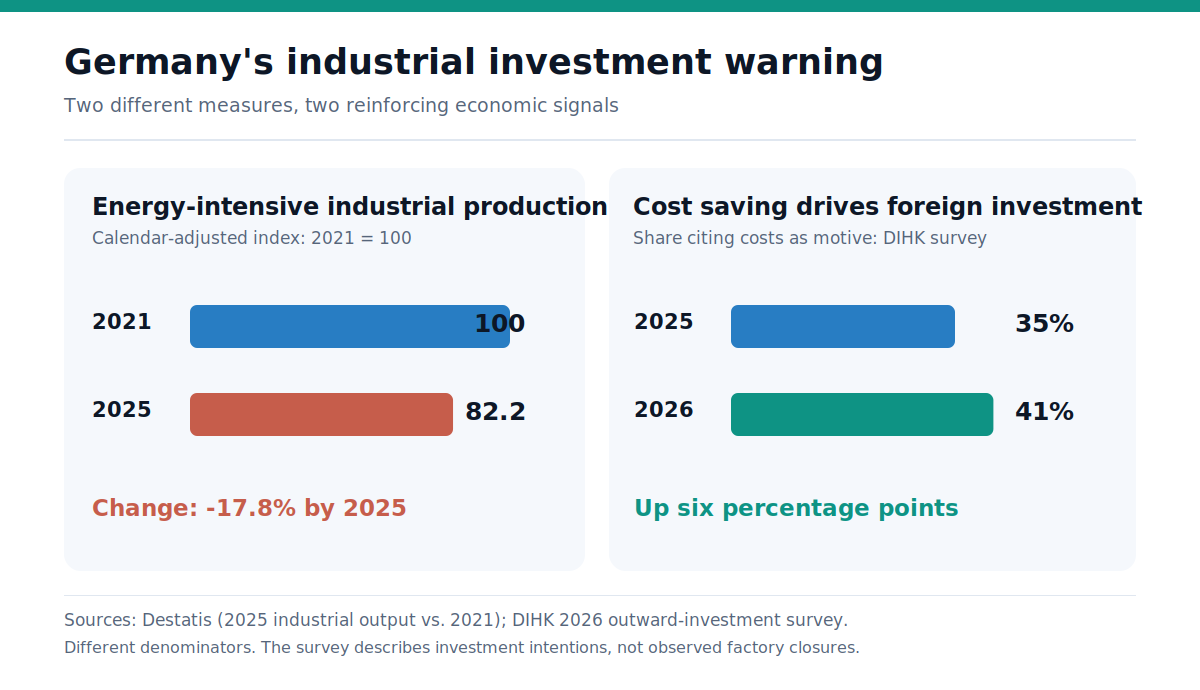
Germany's energy-intensive industrial output in 2025 stood 17.8% below its 2021 level, according to the Federal Statistical Office . The German Chamber of Commerce found that 41% of surveyed industrial firms planning investment abroad cited cost savings in 2026, up from 35% a year earlier.
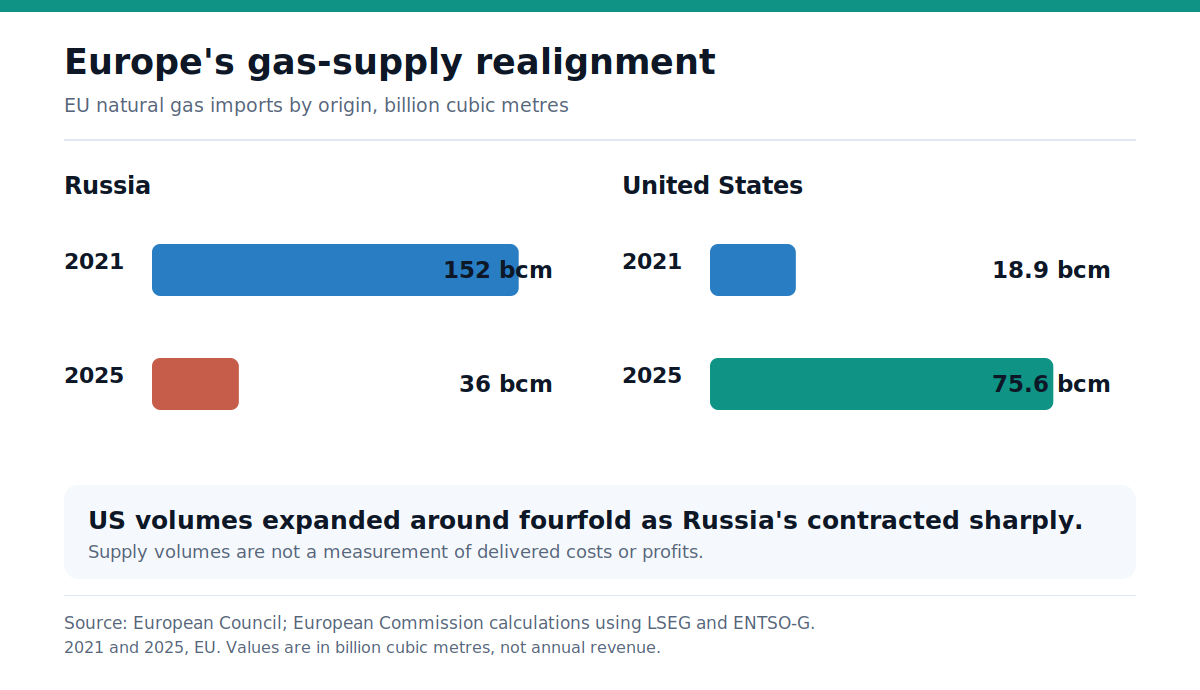
At the same time, the European Council's gas data show Russian deliveries falling from about 152 billion cubic metres in 2021 to 36 billion in 2025 while US volumes increased from 18.9 to 75.6 billion. Energy diversification reduced one geopolitical dependency but imposed new infrastructure costs and exposure to the global LNG market.
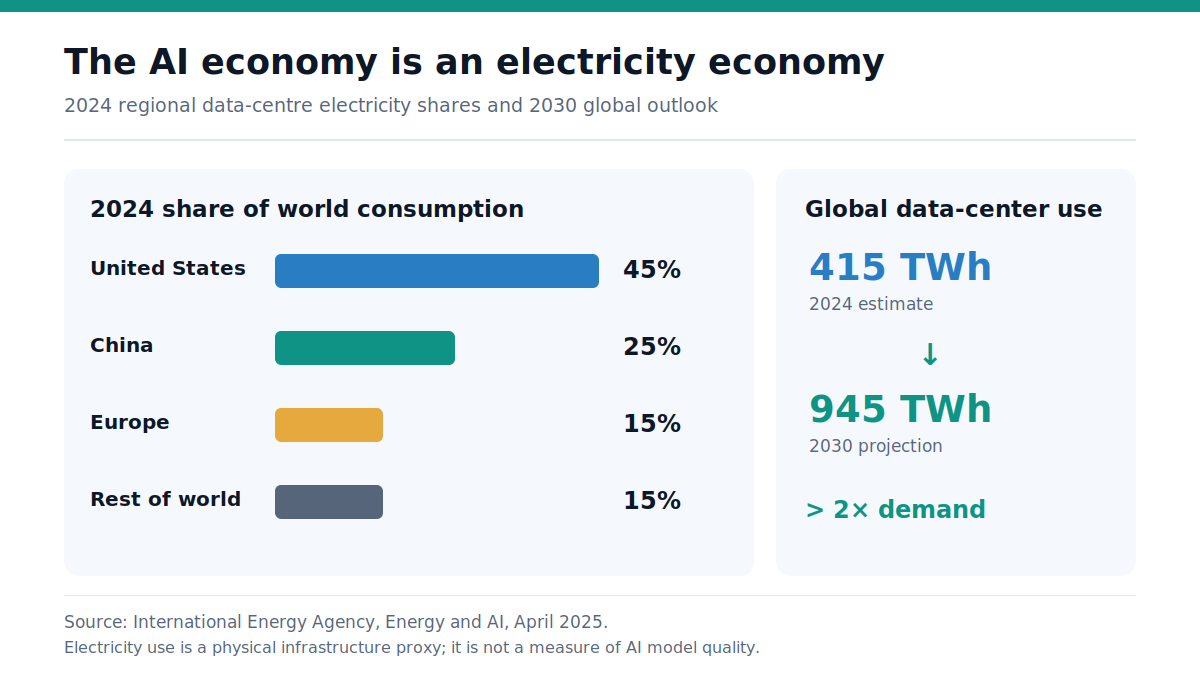
The next global growth engine needs electricity. The International Energy Agency estimates data centres consumed 415 TWh in 2024 and projects approximately 945 TWh by 2030. The US and China accounted for 45% and 25% of global 2024 data-centre electricity consumption; Europe accounted for 15%. These figures measure electricity use, not a league table of AI capability, but they show the physical scale of the race.
Our thesis: the greatest investment opportunities may arise not where wealth is currently most concentrated, but where energy, capital, technology, productive capacity and institutional adaptability reinforce one another.
Standard: The costly difference between being rich and remaining competitive
A country's inherited wealth is a stock; competitiveness is a continuing process. Factories must earn an adequate return on their next investment. Engineers need affordable power and viable customers. Entrepreneurs must be able to build faster than the market changes. Political systems must be capable of abandoning yesterday's answers when the underlying economics turn against them.
The European energy problem is cumulative. A decision to shut reliable generating capacity increases the difficulty of managing supply. A costly energy shock undermines chemical and metal production. Lower expected industrial returns redirect the next factory, and then the next generation of skilled employment, overseas. Tax revenues and political confidence come under pressure. New regulation or subsidies can soften particular symptoms but may leave the original investment disadvantage intact.
This is not a claim that renewable power is inherently expensive or that all European economies are alike. Solar and wind can be extremely competitive generation sources. China itself is deploying renewable electricity at extraordinary speed. The issue is system design and sequencing: what dependable power, transmission, storage and permitting exist when industrial demand needs them, and what happens when competing sources of firm energy are withdrawn too soon?
A second problem arrives just as the first becomes harder to fix. AI's infrastructure cycle needs land, equipment, technicians and extraordinary amounts of reliable electricity. Countries with abundant energy and rapid construction have an advantage; those already struggling to retain existing industry must now compete to attract a new generation of capital-intensive facilities.
Detailed investigation
### 1. Europe: The compounding cost of stupidity
The headline is intentionally provocative. The underlying economic question is simple: what happens when policies intended to solve one problem accumulate costs that make the next problem harder to solve?
European governments accelerated renewable deployment in pursuit of cleaner energy and greater energy security. But important parts of the transition moved faster than storage, networks, dispatchable backup and industrial adaptation could reliably accommodate. Germany then closed its final three nuclear reactors on April 15, 2023, as confirmed by its own economic ministry . France, by contrast, retained a large nuclear fleet. Treating the continent as if it had made one identical decision obscures the most revealing comparisons.
The 2022 Russia–Ukraine war introduced a profound geopolitical shock to a system that had long depended on Russian pipeline gas. Russia reduced major deliveries before the September 2022 Nord Stream explosions. The explosions then sabotaged physical pipeline infrastructure, making restoration harder. European sanctions, commercial responses and subsequent EU legislation restricting Russian fossil fuels further separated the two markets. These are distinct events and choices, and responsibility for the sabotage remains a matter of legal dispute. What matters economically is the accumulated loss of a major historical supply relationship.
The EU pursued replacement supplies, conservation and infrastructure investment, including LNG terminals. American suppliers captured a far larger share of the market. According to the European Council , US gas imports to the EU grew roughly fourfold between 2021 and 2025. The US supplied nearly 58% of the EU's LNG imports in 2025. Diversification reduced exposure to Moscow but created substantial new commercial reliance on Atlantic LNG.
And another shock arrived. In October 2026, Reuters reported that Qatar extended LNG delivery suspensions to Italy's Edison and Asian customers through year-end amid disruptions linked to the Iran war. Europe had not eliminated energy geopolitics; it had changed which routes and suppliers mattered.
Industrial energy prices expose the problem. The European Commission reported that in 2021–2023 EU industrial electricity prices were roughly two to three times US levels, and industrial gas three to six times US levels. Those are historical ratios, not measurements of October 2026 spot contracts. They explain why chemicals, petrochemicals, fertilizers, steel and other energy-intensive businesses face a powerful location decision.
A nation cannot legislate its way around the economics of a furnace, cracker or steel mill. It can mitigate costs, subsidize investment or improve productivity. But if the next plant earns a better return elsewhere, the next plant may be built elsewhere.
### 2. When factories leave, entire ecosystems can follow
Germany offers measurable warning signals. Its Federal Statistical Office reported that energy-intensive industrial production was down 17.8% in 2025 versus 2021. Output in industry excluding energy and construction fell another 1.3% in 2025 versus 2024. This is not the same as every European industry contracting, but the concentration of weakness matters: basic chemicals, heavy manufacturing and machinery support extensive downstream employment.
Corporate decisions show the direction of investment. A DIHK survey of about 1,700 German industrial firms found that 43% planned foreign investment in 2026. Among firms citing motives for outward investment, 41% named cost savings, versus 35% in 2025. It is a survey of plans, not a census of factories already relocated. Nevertheless, intentions matter because future capacity is built from today's capital commitments.
Consider BASF. The German chemicals group inaugurated an approximately €8.7 billion complex in Zhanjiang, China, in March 2026, according to the company's own announcement . That project began years earlier and is designed largely to serve Chinese demand; it cannot honestly be attributed entirely to a recent German energy shock. But it illustrates the scale at which a European industrial company can invest in the productive infrastructure of another economy.
The danger is more than a lower factory count. Industrial activity creates clusters of specialized suppliers, technicians, training institutions, logistics providers, equipment makers and researchers. When investment shifts, those connections can weaken. A future government may offer incentives to bring a factory back, but it must also rebuild the network around it.
Europe could retain powerful brands, scientific institutions and sophisticated design while a rising share of the physical production behind them occurs abroad. Tourism, culture and luxury goods could remain substantial strengths. Yet a continent celebrated for its history would face a more difficult question: how much of the next industrial era will it actually produce?
### 3. Regulation as an economic feedback loop
The European Commission itself acknowledges the cost of administrative complexity under regulation . Its simplification agenda targets a 25% reduction in administrative burdens across businesses and 35% for smaller firms, with €37.5 billion of projected annual savings by 2029.
Those numbers are revealing. They are an admission from Europe's own institutions that compliance absorbs resources that could otherwise support productive activity. It does not follow that every regulation is wasteful: product safety, property rights, environmental protection and fair competition all serve real purposes. The investment question is how much additional cost, delay and uncertainty each obligation introduces — and whether its benefits justify that burden.
The self-reinforcing trap is that lost competitiveness can trigger still more industrial-policy intervention . Higher costs lead to weaker investment. Weaker investment invites subsidies, reporting schemes, special exemptions and planning frameworks. Each new layer may address one symptom while adding another administrative burden. The system becomes increasingly occupied managing consequences of its own rules.
There is also a political problem. Reversing a policy can be harder than adopting it because powerful constituencies, budgets and institutional reputations become attached to the original decision. Governments may be economically capable of change and politically incapable of delivering it. Under those conditions, relative decline need not be inevitable in the laws of physics; it can become the most plausible result of institutional inertia.
### 4. Europe wants AI leadership — and regulates its arrival
The EU's AI Act imposes restrictions on specified uses, model documentation, transparency obligations and more demanding rules for certain high-risk applications. The Council's implementation timeline shows that most applicable rules began in August 2026, while some high-risk requirements were delayed to December 2027 and August 2028 through simplification legislation.
The protections address genuine issues. But regulation is not free. Legal review, classification of systems, documentation, conformity assessment and continuing compliance all consume time and capital. Larger incumbents may absorb those fixed costs more easily than small entrants. This could reduce competition, slow diffusion or favor established firms — mechanisms that deserve measurement rather than assumption.
Europe recognizes the other side of the equation. The Commission's AI Continent plan describes an initiative to mobilize €200 billion in AI investment, including €20 billion for proposed gigafactories and a network of AI factories. The challenge is executing those investments quickly enough, with competitive electricity, available sites, skilled people and buyers willing to adopt the technology.
Europe may be trying to govern the AI economy before it has built a competitive share of the AI economy. Whether it succeeds depends as much on the speed of deployment and productivity gains as on the sophistication of the rules.
### 5. America, China and the changing economic map
The US–China AI competition is not simply about whose chatbot produces better prose. It is about models, chips, manufacturing equipment, power networks, data centers, robots, supply chains and access to raw materials.
The United States has unusual strengths in frontier research, private capital, large technology platforms, software and domestic energy resources. Its 2025 national security strategy also elevates American strategic preeminence in the Western Hemisphere. Strategic ambition, however, is not the same as established control of the Americas.
China has enormous manufacturing capacity and is accelerating technology and electricity investment. Its partnership with Russia offers significant energy and materials connections across Eurasia, though their interests are not identical and neither state controls the entire landmass. India, Turkey, Japan, European states and other powers retain independent agency.
Energy is not a simple choice between fossil fuels and renewables. China's rapid deployment illustrates the opposite of that false dichotomy: the decisive question is how much reliable, affordable power a system can supply at industrial scale. The 2026 Ember global electricity review reports that China accounted for more than half of global solar generation growth in 2025 and continued deploying vast amounts of electricity infrastructure.
These distinctions matter. Europe cannot regain competitiveness merely by copying an American or Chinese political model. But it can learn from the urgency with which competitors build, connect power, finance industry and scale new technologies.
### 6. AI changes the historical equation
The International Energy Agency estimates global data-center electricity use will more than double from 415 TWh in 2024 to about 945 TWh in 2030. The United States represented 45% of 2024 use, China 25% and Europe 15%. The figures are a physical footprint, not an exact measure of computing productivity or AI supremacy, but they expose the growing importance of generation, grids and cooling.
Yet the extraordinary story is not the cost of the infrastructure; it is what that infrastructure might enable. AI and robotics may reduce the price of knowledge work, accelerate discovery, improve industrial control, automate logistics and permit smaller organizations to accomplish what previously required far larger workforces.
At the optimistic limit, that could create enough real output to inspire ideas such as universal basic income or universal high income. Such outcomes are not automatic. Abundance in production does not answer how ownership, wages, public revenue, purchasing power and access to essential goods will evolve. Nor does it guarantee that every country adopts the gains at the same pace.
That is the central paradox: the world could become dramatically richer while individual societies fall behind. The distribution of gains across nations may depend on how quickly they can build infrastructure, adopt tools and change institutions that were designed for another economy.
### 7. The countercase: Europe still has choices
Europe is not a museum, and its future is not already written. It contains exceptional research institutions, advanced manufacturers, major trading networks and globally recognized companies. France's nuclear capacity, the Nordics' electricity systems, Europe's engineering capabilities and the continent's enormous integrated market create important counterexamples to any single story of collapse.
Renewable generation can reduce dependence on imported fuels over time. Regulatory simplification can release resources. Electrification and industrial efficiency may lower some costs. The EU is explicitly attempting to accelerate AI capacity and reform some obligations. The question is whether those measures are large, rapid and durable enough to reverse investment incentives.
The case against our thesis is strongest if European electricity prices converge with competitors, the trend in energy-intensive production reverses, companies increase domestic capital formation, and new AI businesses begin scaling at globally competitive speed. These are measurable conditions, not rhetorical reassurances.
Follow the capital
Where is capital still being allocated according to yesterday's economic assumptions — and where are tomorrow's opportunities being underestimated?
First, examine energy abundance: gas infrastructure, nuclear generation, transmission, storage, grid equipment, power management and advanced electricity systems. The decisive metric is delivered, reliable power at an investable price, not any one technology's ideological appeal.
Second, examine AI's physical economy: chips, servers, cooling, networking, industrial automation and the companies that translate cheap computation into valuable outcomes. Immense capital expenditure is not proof of immense returns, but neither is temporary negative free cash flow evidence that the underlying infrastructure has no value.
Third, examine industrial migration. Every factory built abroad has a supplier network, power requirement, logistics footprint, financing chain and ecosystem of possible beneficiaries. The winners may be equipment firms, destination economies, utilities and manufacturers rather than the famous brands whose logos remain European.
Fourth, examine the emerging financial system : tokenized collateral, international settlement networks and digital-dollar infrastructure that may reduce friction as capital reallocates across borders. Value created by a network does not automatically accrue to every associated token or shareholder.
Investment history rewards neither complacency nor a simple bet on whoever announces the largest spending figure. We should test how much value new infrastructure creates, who retains the economics and whether assets are priced for a world that is already disappearing.
What would change our view
The European industrial-contraction thesis weakens if energy-intensive German production sustainably recovers, European industrial energy-price spreads narrow materially, outward-investment cost pressure falls, and EU AI deployment produces visible productivity and capital-formation gains.
The American and Chinese infrastructure theses weaken if computing demand disappoints, new capacity proves uneconomic, power shortages prevent construction, or geopolitical restrictions destroy more value than domestic investment creates.
The abundance thesis weakens if AI capabilities improve without producing broadly measurable output or lower prices; it strengthens if adoption increases productivity and real purchasing power across industries and households.
The world is moving
The future will not necessarily belong to the nations with the largest economies, the greatest accumulated wealth or the most powerful institutions today.
Some countries will recognize the transformation underway and reorganize their energy, industries and institutions around it. Others may devote their resources to defending arrangements built for a world that no longer exists.
The coming era could create wealth on a scale that makes today's infrastructure spending look modest. But that wealth will not necessarily appear where the last century's prosperity accumulated.
The future belongs to those who see it coming — and act accordingly.
Places in this story




United States, China, Russia
Made with Natural Earth