The Great-Power Bargain: Is Ukraine the Opening Bid in a Reordered World?
By Asymmetric Analytics
Analysis
When the leaders of the United States, Russia and China discuss world affairs, it is tempting to imagine three leaders sitting around a table and dividing a map. Ukraine might become a bargaining item, Taiwan another, and energy sanctions or access to markets the financial terms of a larger deal.
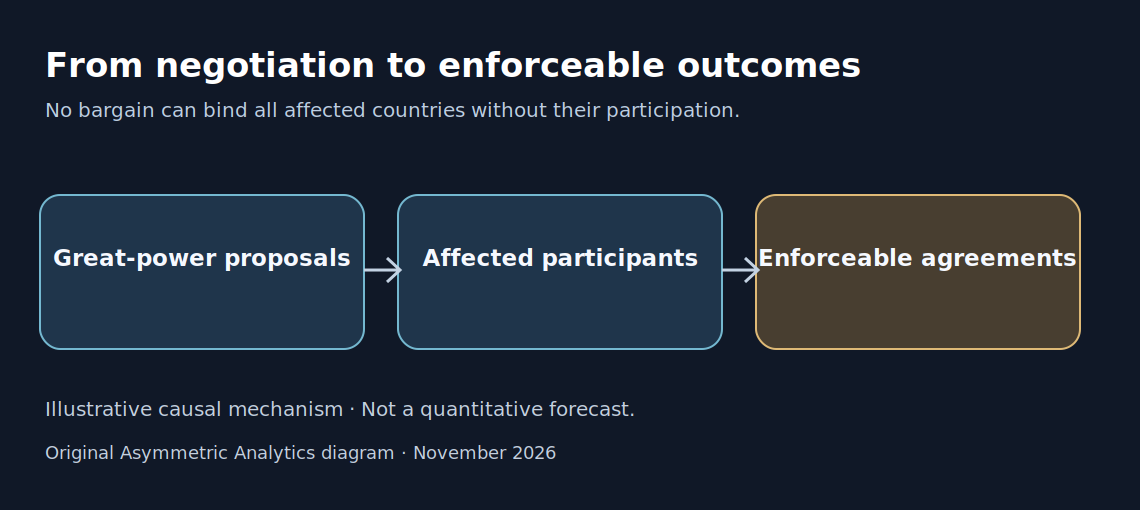
Great powers have often attempted to shape the security environment through negotiation. But this picture omits the most important obstacle: the other governments and populations affected have interests and the capacity to resist or complicate an arrangement imposed upon them.
The international system is not a simple board game in which three players own every piece.
The more serious question is whether a series of regional conflicts and economic pressures is creating incentives for Washington, Moscow and Beijing to negotiate across issues that would previously have been treated separately.
That is a possibility worth investigating. It is not evidence that a trilateral summit has been agreed, that Ukraine is already being exchanged for Taiwan, or that any global settlement is imminent.
1. Negotiation begins where military leverage meets economic cost
A state that has achieved its immediate military objectives may want to consolidate gains. A state unable to achieve a decisive battlefield victory may seek a negotiated outcome that preserves enough security and domestic legitimacy. A state facing expensive overseas commitments may want an agreement that reduces the cost of sustaining them.
The economic incentives can be as significant as the military ones. Wars consume industrial output, weaken trade routes, redirect investment and require debt financing. A ceasefire can reduce immediate costs but leave sanctions, damaged infrastructure and disputes over territory unresolved.
These conditions create opportunities for bargaining. Yet the parties do not necessarily value each issue in the same way. An arrangement that reduces American expenses may be unacceptable to Ukraine. A measure Russia considers a security guarantee may be viewed by European states as a threat. Beijing may see benefits in stable trade without accepting another country's preferred military arrangement.
The presence of overlapping incentives does not automatically produce a mutually acceptable contract.
2. Ukraine cannot be negotiated out of existence
The United Nations Charter identifies sovereign equality and the prohibition of force against another state's territorial integrity as foundational principles. Those principles do not guarantee that every state can protect itself successfully, but they explain why an agreement between powerful outsiders is not equivalent to lawful consent by the state whose territory is at issue.
A potential negotiation about Ukraine must distinguish what different participants can actually promise. Washington can change U.S. assistance, sanctions and diplomatic recognition policies. Moscow can negotiate matters it controls and accept obligations for its own forces. European governments have separate powers concerning aid, sanctions, trade and future security architecture.
Ukraine itself controls its government's consent and its willingness or ability to implement and sustain an agreement. No foreign leader can simply guarantee the durability of a settlement rejected by the people and institutions expected to live under it.
That is why the participant list matters as much as the agenda.
3. Taiwan is not a transferable bargaining chip
The temptation to connect Ukraine and Taiwan arises because Russia and China are major military and diplomatic powers and because the United States has major interests in both regions.
We have identified no official proposal or agreement documenting an explicit Ukraine-for-Taiwan exchange. The two questions have different historical, legal, military and domestic-political contexts.
Even if leaders explore understandings about regional restraint, their commitments cannot eliminate Taiwan's domestic politics, the policies of regional partners or the consequences of military escalation.
Nor are Russia and China identical strategic actors. Their energy, trade, technology, finance and security interests overlap in some areas and differ in others. An arrangement desirable to one may increase the other's dependence or reduce future leverage.
A credible investigation should distinguish public diplomatic statements, formal proposals and enacted policies from dramatic theories about what leaders might secretly intend.
4. Europe's influence depends on what it can deliver
European governments may be excluded from particular negotiation formats and still influence the result through sanctions, financial assistance, weapons production, refugee policy, trade access and long-term reconstruction financing.
But there is a difference between possessing influence and determining the terms of a negotiation. A government that contributes substantial resources but has little direct role in negotiations may discover that its preferred outcome is harder to obtain.
For Europe, independent military capability and fiscal room can change bargaining power. Political declarations do not substitute for the ability to sustain commitments or to provide meaningful alternatives when talks fail.
The Council of the European Union's sanctions documentation is one measure of the EU's policy instruments. Sanctions can impose costs and alter incentives, though they do not guarantee a particular battlefield or diplomatic outcome.
The larger lesson is that negotiating influence comes from credible commitments and alternatives, not merely the number of seats at a table.
5. Energy and mineral supply chains are bargaining instruments
Oil, natural gas, refined fuels, critical minerals and semiconductors connect states whose military interests may otherwise conflict. Economic relationships can create leverage, but can also make coercion expensive for the actor applying it.
An exporter may threaten supply restrictions but sacrifice revenue. An importer may impose sanctions but accept higher input prices. A company may reroute production, creating long-term industrial consequences even after a temporary political dispute ends.
This is why sanctions and trade measures should be examined as economic mechanisms. The meaningful questions are how rapidly importers can substitute suppliers, how financing and insurance adjust, whether domestic production can replace lost inputs and whether the targeted government changes behavior.
A large country is not immune to these constraints simply because its military or currency is powerful.
6. The dollar's role is more complicated than a currency headline
International finance adds another layer to great-power bargaining.
The IMF COFER series measures the currencies held in official foreign-exchange reserves. It does not measure every trade invoice or payment. The Swift Global Currency Tracker describes a particular set of financial messaging activity, not all global trade settlement.
These are separate indicators. A country may diversify some central-bank reserves while still using dollars in commodity contracts, bank deposits and international debt. A new payment network may reduce reliance on a particular messaging infrastructure without displacing dollar-denominated financial claims.
The distinction is important because technologies offering alternative settlement can make cross-border transactions more efficient while reinforcing demand for stable dollar-denominated instruments.
A political dispute about access to Western financial systems can create incentives to diversify payment rails, but it does not automatically create a viable replacement for the dollar's liquid asset markets, legal institutions and global network effects.
7. Digital infrastructure matters, but proof-of-concept is not adoption
The International Chamber of Commerce Digital Standards Initiative works to improve the interoperability and legal recognition of electronic trade documents. These efforts address genuine administrative friction in trade finance.
The BIS archive for Project mBridge documents cross-border wholesale CBDC experimentation that reached an MVP stage in 2024. The BIS handed the project to participating central banks in October 2024 and now lists its own project as concluded; this is not a claim that the BIS still operates the platform. They do not establish that one private digital asset or particular blockchain has become the global settlement standard.
A future system may combine conventional bank money, stablecoins, tokenized deposits and interoperable ledgers. Which infrastructure succeeds will depend on governance, liquidity, legal finality, compliance and actual transaction volumes.
Whether future payment technology creates value for a particular private token is a separate investment question, not established by central-bank experiments.
8. Three possible diplomatic paths
Scenario 1 — Narrow regional agreements. Washington, Moscow and other participants pursue specific arrangements concerning Ukraine, sanctions or security assurances. There is no comprehensive world-order bargain. Other disputes continue.
Scenario 2 — Managed competition. Great powers find limited mechanisms to avoid accidental escalation and stabilize selected trade or military relationships while remaining rivals. Regional partners retain independent agendas.
Scenario 3 — Failed grand bargaining. Attempts to link too many unrelated interests make agreement politically impossible. Each state returns to unilateral or coalition-based strategies, possibly raising costs and uncertainty.
No path requires assuming that three leaders have secretly agreed on the future of every smaller country.
9. The economic signals behind diplomatic theater
Markets often react to the possibility of a summit before negotiators have produced an enforceable agreement. Oil prices can move on perceived supply risk; defense contractors may respond to procurement expectations; sovereign yields can reflect changes in spending assumptions; currencies react to liquidity and risk.
Some reactions prove temporary. Others lead firms to redirect irreversible capital investment.
The important distinction is between a negotiating headline and a change in the real options available to businesses and governments. An announced political understanding has economic significance when it alters actual restrictions, shipments, investment, access or military deployments.
That makes implementation more important than symbolism.
What would change our view
1. Summit evidence: Are named participants, an official agenda and agreed negotiating mandates publicly confirmed, rather than inferred from commentary or exploratory contacts? 2. Consent and implementation: Do affected states and institutions formally accept relevant terms, and are there observable mechanisms for enforcement? 3. Cross-domain linkage: Do formal agreements explicitly exchange security, sanctions, trade or financial concessions across regions, or are negotiations mostly independent? 4. Market effects: Do changed oil flows, investment decisions, sanctions implementation and cross-border payment volumes persist after the diplomatic announcements? 5. Alternative behavior: Do European and Asian partners build independent policy options that constrain a proposed great-power arrangement?
The thesis of a single comprehensive bargain weakens when negotiations remain narrow, affected states resist and implementation is absent. It strengthens only with documented cross-domain commitments and measurable compliance.
Primary evidence
United Nations Charter, Chapter I .
Council of the European Union, Sanctions against Russia .
IMF, COFER September 2026 data brief .
Swift Global Currency Tracker .
ELSI trail
Great-power competition, Ukraine, Taiwan, NATO, economic sanctions, official reserve currencies, trade invoicing, digital settlement and energy trade represent connected but legally and economically separate relationships. A proposed bargain is not the same thing as a binding agreement or a verified real-world transaction.