Hormuz Without a Blockade: The Economics of Making Oil Movement Expensive
By Asymmetric Analytics
Analysis
We tend to imagine control of the Strait of Hormuz as a binary question: is it open or closed? In an actual maritime crisis, the more consequential question may be how reliably—and at what price—ships can deliver the oil.
A route can remain physically passable while becoming commercially punishing. It can also remain highly dangerous while exporters improvise ways to move substantial volumes. These are not contradictory outcomes. They are two measurements of the same adapting system.
Two tanker strikes recorded by UK Maritime Trade Operations illustrate the distinction. The authority recorded an unknown-projectile strike near Al Faw, Iraq, on October 20 and a separate tanker strike and extinguished onboard fire near Bukha, Oman, on October 21. Crews were reported safe. Neither warning attributes responsibility or reports that Gulf exports stopped.
These notices establish incidents, not the identity of the attackers or a measured oil shortage. The question for markets is not simply how many tankers were hit. It is whether repeated danger is changing the marginal cost, duration and reliability of delivered energy.
The one-minute reading
The Strait of Hormuz does not have to close to become economically damaging. Tankers can keep moving while attacks, delays, higher war-risk insurance and tighter shipping capacity raise the cost of getting oil to refineries.
Two October 20–21 tanker incidents reported by UK Maritime Trade Operations establish continuing maritime risk, not responsibility for the attacks or the size of any insurance premium. The IEA's October assessment also shows a recovering crude-export system alongside much weaker refined-product exports. That contrast is what markets should measure.
The central question is whether energy arrives when and where it is needed, at a sustainable delivered cost. The strongest challenge to our thesis is adaptation: protected passages, alternative terminals and lower future insurance premiums may reduce the pressure even without full political resolution.
The five-minute analysis
A physical-flow headline counts barrels loaded or passing through a chokepoint. The buyer faces another calculation: freight, insurance, transit time, financing, destination and refining capability. The two figures can move in different directions.
The IEA reports that Gulf crude exports partially recovered in September, while refined fuels and LPG remained well below earlier levels. It also describes inventory erosion and sharply elevated freight and refining costs. Those measured imbalances are more informative than treating every attack as a blockade.
The financial consequences may take three paths. Higher landed fuel costs can reinforce inflation; lost industrial margins can suppress growth; and inventories plus longer voyages can consume working capital. None guarantees a particular direction for bond yields, gold or the dollar. If shipping premiums and transit times normalize while cargo deliveries remain strong, the economic-coercion thesis weakens materially.
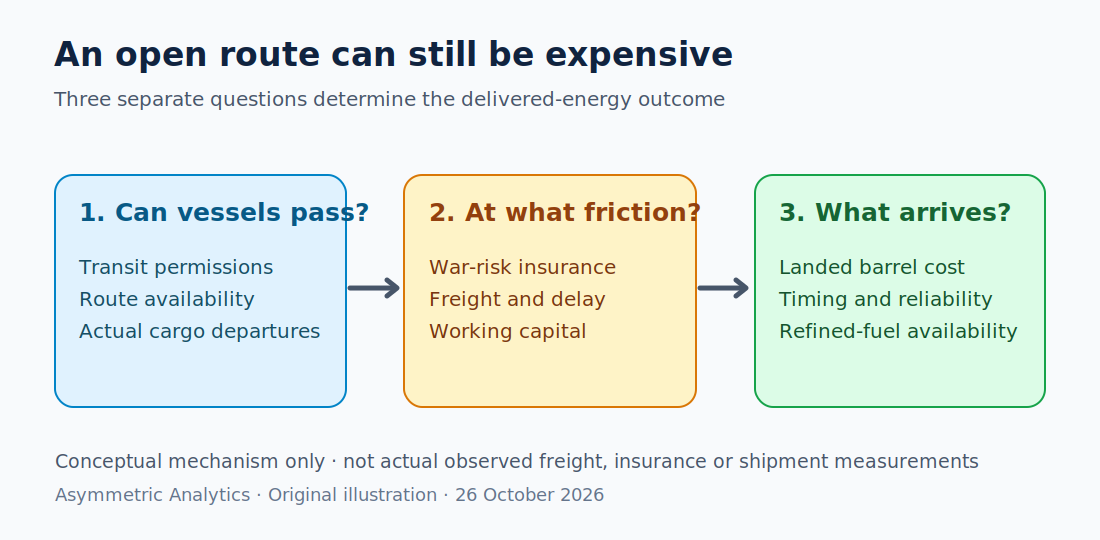
Security is a cost imposed on every future voyage
Consider the chain from an oil field to an importing refinery. Production is one step. The barrel must enter storage, be loaded, move aboard an available tanker, cross the relevant maritime route, be discharged and finally reach a refinery able to process its grade.
An attacker does not have to disable every link in this chain to impose costs on the entire system. A credible threat can change decisions before another projectile is fired. Shipowners weigh crew safety; insurers reprice war risk; charterers negotiate rates and delays; governments consider escorts; refiners increase their desired inventory buffers.
These are economic responses to perceived probabilities, not proof that a particular named actor conducted every incident. Attribution remains a separate evidentiary question.
The U.S. Maritime Administration's Gulf advisory describes threats to commercial shipping, including strikes and navigation-system problems. The UKMTO warning register provides incident-level reports. Neither is itself a complete record of realized global freight premiums. That measurement requires shipping-market evidence.
Our working hypothesis is that an unstable but usable route can transfer costs to nearly every participating vessel. Whether the resulting price is economically unsustainable is an empirical question, not a premise.
The paradox of substantial exports during repeated attacks
Evidence of physical resilience complicates any simple blockade narrative. Exporters can reroute some shipments through pipelines, use alternative terminals, arrange protected passages or change how cargoes are handed from vessel to vessel. Each method has geographic and operational constraints. None should be counted as new oil production merely because the cargo changes hands.
This is where original shipping-flow evidence becomes indispensable. Kpler produces proprietary maritime and commodity tracking datasets; its developer catalog describes the kinds of measures available. A weekly export estimate repeated by a newspaper cannot establish the comparable shipment series unless the underlying region, dates, method and revisions are known. The analysis here does not depend on an unverified proprietary weekly figure.
In particular, a single strong export week cannot establish that every part of the Gulf network is back to normal. The comparison needs a common region, a common time period and consistent treatment of crude versus condensate, transfers at sea, tanker destinations, delayed deliveries and late revisions.
Even if exports are near pre-crisis levels for a week, it is possible that freight costs, travel time and the amount of oil tied up in transit have risen. Conversely, if protected shipments become regular and premiums normalize, resilience could actually defeat the pressure strategy. Both cases must be tested.
A barrel shipped is not the same as a barrel delivered
That difference matters most for buyers. The world has more than one oil balance: upstream output, crude cargoes shipped, landed crude available to refiners and the finished fuels available to consumers.
The IEA's October Oil Market Report distinguishes the condition of crude supply and inventories from difficulties in refined-product markets. The financial stress from interrupted diesel supply can differ from the stress from a crude shortfall, even if an export headline appears reassuring.
A tanker spending additional days on a longer or safer route also temporarily ties up shipping capacity and cargo. For the importer, the relevant unit of analysis is not simply daily production but the landed barrel at the right place, time and price.
Here, too, we should be precise. A strike reported in Omani waters does not prove a shortage of Asian diesel. Its potential consequence runs through subsequent shipping behavior, availability and refining balances; those intermediate changes need independent observation.
Why an attacker's objective and an exporter's adaptation can both be rational
For a defender, maintaining exports can be preferable to surrendering a lucrative route even when the marginal cost rises. Governments may absorb security expenses because the alternative is larger lost revenue, domestic disruption or strategic dependence.
For a coercive actor, repeated uncertainty can be attractive precisely because it is less expensive than sustaining a perfect closure. A limited number of incidents may force many uneventful voyages to pay for protection and insurance.
But this logic does not prove an Iranian strategic plan in any particular strike. UKMTO does not identify attackers in the two October 20–21 projectile reports. Statements by Iran or other parties must be separated from independently verified ship damage, behavior and market effects.
Nor should we assume all insurance costs are passed into crude prices at once. Freight contracts, voyage length, charter availability, grades, term-delivery arrangements and refinery inventory can distribute the burden differently across producers, shipowners and consumers.
Where the risk reaches financial markets
There are at least three plausible channels, which need not reinforce one another.
The inflation channel: higher landed fuel and transport costs can raise input prices, narrow margins and complicate central-bank decisions. Diesel costs matter to trucking, agriculture, construction and mining as well as household transportation.
The growth channel: expensive energy can also destroy demand and profitability. Under this scenario, weaker industrial activity could eventually offset an oil price spike. Bond yields may reflect weaker growth rather than only inflation.
The balance-sheet channel: governments, refiners and shipping firms may have to hold more working capital, financing and buffer inventory. That ties the cost of maritime insecurity to interest expense and liquidity—not merely to the Brent futures quote.
The result is not a predetermined surge in the dollar, gold, oil, stocks or digital assets. Market outcomes depend on monetary policy, real yields, currency funding, timing and whether the dominant shock is inflationary, recessionary or geopolitical.
Three possible futures, and what would falsify each
Managed insecurity. Incidents continue, but shippers adapt; throughput stays substantial, while insurance and delivery costs settle above the old baseline. This weakens if premiums and travel delays rapidly normalize despite continued threats.
Progressive attrition. Repeated incidents exhaust spare shipping, rerouting, inventories or security capacity, causing persistent delays and measurable declines in delivered crude and products. This weakens if the supposed bottlenecks are not reflected in shipping availability or port receipts.
De-escalation and recovery. Credible security or diplomatic changes restore ordinary commercial traffic, shorten voyages and lower the cost of delivered energy. This weakens if advisories improve but war-risk premiums, port activity and actual deliveries do not.
Each scenario calls for dated, source-identified measurements, not narrative conviction. We would test them using the original UKMTO and JMIC threat assessments; actual vessel arrivals, deviations and voyage lengths; first-party Kpler flows if legally accessible; the IMF PortWatch shipping series; energy-market figures from the IEA and EIA ; plus verifiable rates from shipping operators and underwriters.
What markets may be missing
The familiar headline is that an attack threatens to close Hormuz. The less familiar possibility is that the corridor can keep functioning and still become a persistent tax on world commerce.
Yet we should resist overstating the claim. The ability of a global supply network to adapt is not a small footnote. It is a central part of the story and may be the strongest reason the economic pressure fails.
The test is therefore not a dramatic photograph, an anonymous claim of destroyed tankers or even a single week of export volume. It is the sustained difference between the amount of energy that reaches customers and the resources required to get it there.
In a contest between coercion and adaptation, that is the ledger that ultimately matters.