When Machines No Longer Need Our Labor: Who Owns the Abundance?
By Asymmetric Analytics
Analysis
The industrial age made human labor extraordinarily productive. A worker with a machine could produce far more than a worker with bare hands. The computer age extended that leverage into offices and communications. Artificial intelligence promises a further step: software and robots that perform increasingly complicated tasks with less direct human supervision.
That possibility is exhilarating. It is also economically unsettling. Modern prosperity is distributed largely through wages, business profits, asset ownership and public services. What happens when the system produces substantially more but needs fewer hours of human labor to do it?
The question is not whether machines will replace every worker. They will not. The question is whether the connection between participation in production and a claim on its rewards becomes less reliable.
1. Exposure is not the same as unemployment
The International Labour Organization's May 2025 refined exposure index found that roughly one quarter of global employment falls in occupations with some generative-AI exposure. Only 3.3% lies in the highest exposure category. The ILO emphasizes that transformation of occupations is more likely than complete job elimination, because most jobs contain tasks needing human input.
The IMF's February 2026 remarks place potentially affected employment closer to 40% globally and 60% in advanced economies. These figures use a different lens: they include roles that may be complemented as well as disrupted by AI. They are not competing forecasts that 25%, 40% or 60% of workers will become unemployed.
This distinction changes the policy question. A person whose routine work is automated may use AI to handle more customers or higher-value tasks. A company may expand output instead of reducing headcount. Entirely new services may appear. Equally, a firm can use productivity gains to reduce labor expense while maintaining the same volume of production.
The outcome depends on demand, competitive pressure, labor mobility, institutions and ownership. Technology creates options; economics determines which options are chosen.
2. Ownership decides who receives the first dividend
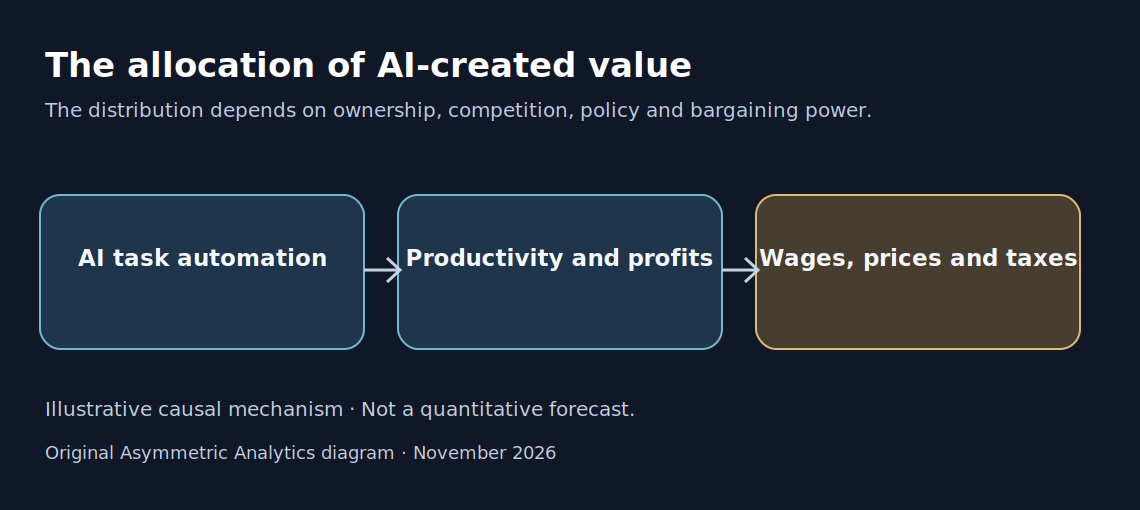
When a machine replaces hours of work, the immediate financial benefit usually accrues to the organization deploying it: the same service can be provided at lower cost, or more services can be sold with similar staffing. That gain can then be passed to customers through competition, to workers through higher wages, to shareholders through profits, or to governments through taxation.
The order matters.
If a technology is widely available and competitors can adopt it cheaply, much of the benefit may be competed away into lower prices. Consumers receive greater purchasing power, including those who own no technology company shares. If scarce compute, proprietary data, power connections or intellectual property limit competition, more of the benefit can remain with the owners of those bottlenecks.
A world of abundance is therefore not automatically a world of equal abundance. Production and distribution are separate economic problems.
The IMF's 2024 Staff Discussion Note on AI and work discusses the risk that advanced economies capture more benefits while occupations and incomes adjust unevenly. The question for investors and policymakers is whether earnings power accrues to a small number of owners or spreads through businesses, labor markets and lower prices.
3. The purchasing-power paradox
Workers are also customers. If an economy becomes excellent at producing goods but increasingly weak at distributing purchasing power, firms may encounter demand constraints even while productive capacity expands.
This does not imply inevitable economic collapse. Lower prices themselves increase real income, and new activities can absorb labor that existing activities no longer require. That historical adjustment has mattered enormously through agricultural and industrial mechanization.
But AI may change both the speed and the range of affected work. Digital products can scale unusually quickly, and the adaptation burden may fall on people whose specialized skills lose value before they can acquire new ones. When the transition is rapid, a long-run improvement in welfare can coexist with a painful near-term distribution problem.
The OECD's research on AI and work identifies employer adoption, job quality, wages, skills and worker participation as central measurement questions. Those outcomes are more informative than counting demonstrations in which a model passes an exam or performs a narrow office task.
4. The tax base may move before public institutions do
Governments fund services through taxes tied to wages, consumption, capital income, property and corporate profits. If a larger portion of national income flows through profits rather than wages, the mix of reliable tax bases can shift.
This can be favorable if overall productivity and income grow fast enough. A larger economy can support greater revenue even at unchanged statutory tax rates. But it may also expose problems in fiscal systems that rely heavily on payroll taxation while profits are internationally mobile or sheltered by complex arrangements.
An indiscriminate tax on automation could reduce useful investment. Relying entirely on existing labor taxes may become increasingly mismatched to how value is produced. The challenge is designing broad, predictable tax systems that capture some of the gains without punishing innovation or encouraging wasteful labor retention.
We should watch the distribution of taxable profits, wage shares, employment participation and real household consumption, rather than assuming any specific universal tax solution is inevitable.
5. Universal basic income and universal high income are different promises
A universal basic income provides a recurring minimum transfer, generally without a work requirement. The financing challenge is not just the size of an individual payment but the enormous number of recipients, interactions with existing benefits, tax changes and inflationary pressure if demand outruns available goods.
Universal high income is a much more ambitious aspiration. It presumes that very large productivity gains can support widely distributed material affluence. But that does not specify a distribution mechanism. A society cannot reach high income merely by renaming a small transfer.
Several possible channels exist: cheaper essential goods, public ownership or sovereign investment funds, broader private asset participation, wage gains in complementary occupations, and direct social transfers. Each has different consequences for incentives and political institutions.
A sustainable design must distinguish the real output available to consume from the financial claims people hold. Money transfers without corresponding productive capacity can shift prices rather than increase real living standards.
6. Three paths toward 2035
Scenario 1 — Broad diffusion. AI becomes inexpensive, competitive firms expand, essential services cost less and new complementary jobs emerge. Consumers receive much of the benefit even without direct machine ownership. Labor adapts through turnover and training rather than permanent mass exclusion.
Scenario 2 — Ownership concentration. Scarce models, compute capacity, energy and distribution channels capture a disproportionate share of AI-generated profits. Output grows rapidly, but wage growth and worker bargaining power lag. Political pressure for transfers and competition policy increases.
Scenario 3 — Slow adjustment. Technical capability outruns organizational adoption. Companies struggle with integration, energy, security and regulation; measured productivity rises more slowly than model benchmarks suggest. The social adjustment is uneven but does not resemble sudden labor obsolescence.
These are mechanisms to monitor, not assigned probabilities.
7. What would distinguish them?
Real-world employment, hours worked and wage distributions offer one set of signals. Corporate margins, market concentration and the division of national income between labor and capital offer another. Productivity, measured consumer prices and new-firm entry show whether gains are spreading.
The most important single number may be real median household purchasing power relative to output per worker. If production per worker rises sharply but the median household experiences little improvement, the distribution question is not theoretical.
If those measures rise together, the pessimistic concentration scenario becomes harder to sustain.
What would change our view
1. ILO/OECD employment evidence: Do high-exposure occupations experience sustained net job losses or mainly task reorganization as AI deployment spreads? 2. National accounts: Does the labor share of income fall over multiple years while real productivity accelerates, or do wages and consumer welfare keep pace? 3. Ownership and competition: Do new entrants, declining service prices and broader asset participation disperse economic gains, or do profits become more concentrated? 4. Fiscal sustainability: Can governments maintain services with stable, broad tax bases without materially depressing investment?
The thesis that ownership becomes the binding constraint weakens if productivity gains consistently pass into real wages and lower prices. It strengthens if gains remain concentrated while median living standards stagnate.
Primary evidence
ILO, Generative AI and Jobs: Refined Global Exposure Index .
IMF, Leveraging Artificial Intelligence and Enhancing Countries' Preparedness, February 2026 .
ELSI trail
Artificial intelligence, occupational task exposure, labor income, capital ownership, consumer prices, national productivity, universal basic income and universal high income each describe distinct parts of the transition. The causal connection runs through actual deployment, competition and institutions—not a prediction that human beings will become economically irrelevant.