The Next War May Begin at Home: Why Western Governments Are Preparing Their Own Infrastructure to Fail
By Asymmetric Analytics
Analysis
For much of the last seventy-five years, Americans watched wars unfold on television. Korea, Vietnam, the Gulf War, Afghanistan, Iraq: the fighting was distant, even when the consequences reached every household through taxes, inflation, and the terrible cost borne by military families. Two oceans made the continental United States a difficult place for a conventional enemy army to reach.
That geographic advantage remains formidable. But the modern economy has built a different kind of bridge across the oceans. Electricity controllers, logistics networks, hospital equipment, payment systems, and refrigeration units can now be operated remotely. So can vulnerable parts of the infrastructure on which military bases depend.
An adversary does not have to defeat the U.S. Navy to change the temperature inside an inadequately secured freezer. And it does not have to defeat the U.S. Air Force to force a city to deal with a compromised industrial controller.
The most consequential change in modern warfare may be that the battlefield and the home front no longer need to be in the same geographical location.
1. The warnings are real. The clock starts at home.
On 22 October 2026, Britain's Cabinet Office launched its Be Ready household campaign . Families are encouraged to prepare for roughly three days of interrupted electricity, water, telephone and internet service. This is not a sudden instruction to evacuate. The Cabinet Office explicitly says the updated campaign builds on household guidance available since May 2024 and emphasizes emergencies such as severe weather. The official three-day checklist includes simple supplies and ways to help neighbors.
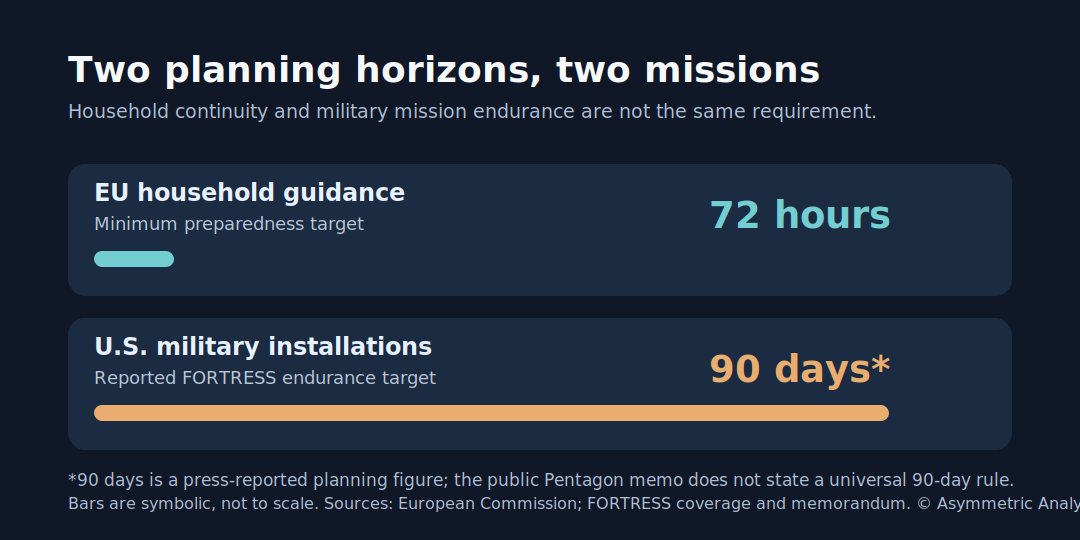
The European Commission's Preparedness Union Strategy , published in March 2025, goes further than ordinary disaster advice. It proposes a minimum 72-hour civilian self-sufficiency target alongside strategic stockpiling, public-private cooperation, civil-military planning, and an all-hazards approach that explicitly includes geopolitical conflict and cyber threats.
NATO makes the military connection plain. Its September 2026 resilience requirements set out allied commitments to plan for continuity of electricity, food, water, transportation, communications, healthcare, and government authority during sustained crisis or conflict. Civilian support to military operations is part of the same doctrine.
These programs were not all conceived in one week. Some date back years, and storms remain a major reason for keeping emergency supplies. What has changed is the unmistakable integration of civilian preparedness with military resilience.
2. Why the Pentagon wants military bases to become islands
FORTRESS America, announced by Defense Secretary Pete Hegseth in September 2026, is intended to make major American military installations substantially less dependent on external utilities and supply chains. Its five pillars are energy independence; industrial and supply-chain resilience; strategic reserves; installation hardening and cybersecurity; and space and electromagnetic-spectrum resilience. The five pillars are also described in CSIS's October 2026 analysis .
The ambition is understandable. An aircraft cannot fly without fuel, a command center cannot operate without power, and an equipment depot becomes less useful if the parts suppliers or transportation networks outside its perimeter are immobilized.
The publicly reported FORTRESS planning details include a 90-day target for maintaining essential operations independently at major installations. That number comes from reporting on internal Pentagon documents; the publicly described September memorandum does not establish a universal completed 90-day requirement for every base. The distinction matters because the difference between announcing resilience and building it is measured in years, money, engineering, and actual backup capacity.
The Pentagon is effectively seeking something like an island inside the national economy: an installation with enough autonomous power, water, supplies, communications and protection to keep operating while surrounding systems experience a serious outage.
But what happens outside the fence? Base employees, contractors, truck drivers, local hospitals and suppliers all live in the civilian economy. A military installation can become more resilient without making the wider community invulnerable. That asymmetry will become increasingly important if a conflict stresses both military and civilian systems at once.
3. The grocery freezers are the warning nobody expected
In late October, Reuters reported that the Pentagon was investigating suspicious August failures at commissaries on at least six U.S. military bases. At one Arizona installation, officials described a freezer entering a defrost cycle and heating its food overnight. Military investigators considered a possible cyberattack and contacted authorities investigating similar European incidents. They had not publicly established a culprit.
After October refrigeration disruptions in France, Europe saw another cross-border wave. Reuters reported that attackers manipulated refrigeration controls at numerous supermarkets, causing temperatures to rise and products to spoil. Reuters reported a renewed cross-border wave on 2 November , followed by urgent disconnection and remediation of vulnerable equipment. The 3 November report documented attempts by retailers and vendors to contain exposure.
On 4 November, Reuters reported cold-storage control incidents that occurred on 2 November at three regional blood-service facilities . Employees transferred blood to unaffected equipment, and officials reported no harm to blood stocks.
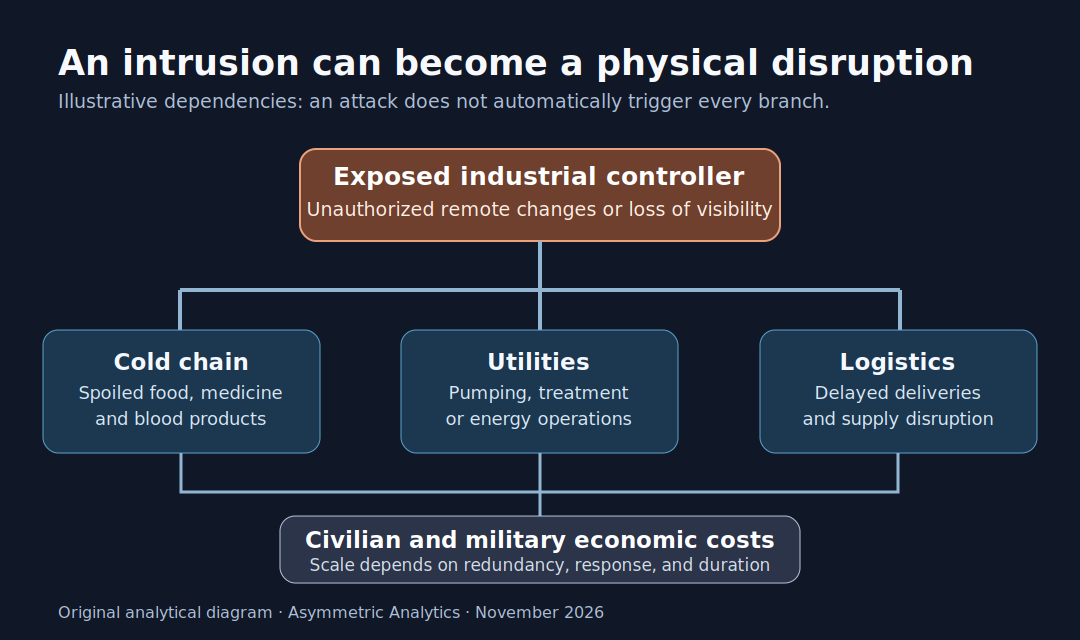
There is an essential fact here: the attacks have demonstrated disruption at particular sites, not the collapse of a national food supply. Investigators have not established that every incident is linked or attributable to a single state. Reuters' technical examination pointed instead to a recurring structural vulnerability: remotely managed industrial equipment can remain internet-accessible with weak security or outdated software.
That is what makes the story strategically important. A low-profile system may be economically consequential precisely because its owners never thought of it as a battlefield.
4. The industrial controller is the new front line
Modern industrial installations rely on programmable logic controllers and other operational technology to translate digital instructions into physical actions. A controller may regulate temperatures, a motor, a pump or another process. These are different systems with different safeguards, but they share the feature that a command can change what physical equipment does.
For an attacker, the strategic prize is no longer limited to stealing files. Manipulating a physical process can spoil perishable inventory, interrupt production, consume repair crews, halt distribution or undermine confidence in essential services.
This is not a hypothetical capability assigned to Iran because of politics. In the government's April 2026 joint advisory , U.S. agencies documented Iranian-affiliated cyber actors targeting internet-connected programmable logic controllers in American water, energy and government facilities. The agencies' July update described observed operational disruptions and financial losses. The technical advisory is AA26-097A .
That advisory documents Iranian-affiliated operators conducting disruptive attacks against U.S. industrial systems. It does not prove they conducted the European refrigeration attacks. Treating those two propositions as interchangeable would turn a valuable investigation into a misleading accusation.
5. Four adversaries, four sets of incentives
Iran, North Korea, Russia and China all belong in the investigative frame, but not because every attack should be attributed to one of them.
Iran has the clearest specifically documented precedent in the current U.S. industrial-control advisories. During escalating hostilities, the incentive to impose costs without matching American conventional firepower is obvious. The important question is whether any forensic evidence from recent events actually matches the operators identified in those advisories.
North Korea has demonstrated sophisticated financial cyber intrusion and theft. The FBI's 31 October attribution of the Binance cryptocurrency theft is a striking contemporary example. That establishes an ability to compromise digital systems and obtain large financial rewards; it does not independently demonstrate control of American energy infrastructure. Cybercriminal opportunity and strategic sabotage are distinct objectives.
Russia has years of experience with disruptive operations and has an interest in demonstrating that European governments cannot always shield civilian life from the consequences of confrontation. China, meanwhile, has capabilities and potential incentives associated with a future major-power crisis; pre-positioning concerns make defensive preparedness rational even absent an imminent attack.
We should not ignore other possibilities: criminal groups, proxy operators, ideologically motivated individuals, unrelated attacks against the same equipment, or the exploitation of widely shared vulnerabilities. Attribution requires technical evidence, not merely a list of geopolitical grievances.
A deeper question follows: is the attacker trying to destroy something now, or learning how to cause larger disruptions later? Small operational incidents may expose weak defenses and response times. They may equally be uncoordinated opportunistic exploitation. The common technical signatures, affected equipment, infrastructure used by attackers, and incident timing are what can distinguish those possibilities.
6. Asymmetric warfare reaches the economic core
The conventional measure of military strength counts aircraft, ships, personnel, missiles and industrial output. The asymmetric measure asks a different question: what is the least expensive way to impose an unacceptable strategic cost?
A country may be able to defeat an enemy military in direct battle while still absorbing major losses from disrupted ports, damaged energy networks, unavailable industrial components, or unreliable civilian communications. Those costs can influence operations and political choices without an enemy ever occupying territory.
For decades, the logistical burden of projecting force across an ocean worked heavily in America's favor. A cyber operation can cross an ocean without moving an army. But it still depends on accessible systems, exploitable vulnerabilities, attackers who can evade detection, and defenses that fail. Cyberwarfare is not magic; it can be stopped, isolated, recovered from and sometimes attributed.
The distinction is particularly important with electromagnetic pulse scenarios. A nuclear EMP and a targeted industrial cyberattack are not interchangeable. A nuclear detonation would represent an extraordinary escalation with very different military and political implications. The cases documented here demonstrate narrower cyber-physical threats; they do not prove a nation can be switched off in one action.
The next war may arrive at home through fuel prices or logistics before it arrives through a missile. It may begin with isolated industrial outages, a constrained shipping lane or compromised payment infrastructure. The economic attack surface is far broader than a battlefield map.
7. The crucial asymmetry may be inside our own country
Imagine a regional infrastructure crisis. A military base successfully isolates its power system and keeps flight operations running. Nearby residents struggle with fuel availability, unreliable payment terminals, disrupted water treatment or local hospital backup limits. Civilian supply trucks find damaged roads or fuel constraints; the same workers responsible for keeping military systems functioning have families affected by the outage.
The base has gained resilience. The country has not necessarily gained the same amount.
This is why NATO treats civilian food, water, transportation and communications as part of military preparedness. Defense does not end at the perimeter fence. The civilian economy is the logistics network behind the armed forces.
The British three-day advice and the reported American 90-day military objective are not directly comparable survival standards: they describe different missions and timescales. Yet their convergence reveals a common strategic idea. Every system that can carry on without immediate outside assistance reduces one point of failure during a crisis.
That principle can work at household, city, industrial and military levels. It also creates a more useful public conversation than treating every emergency checklist as evidence of a secret countdown to war.
8. What we should be watching now
The next meaningful signals are operational. Do investigations establish a common technical link between European and American refrigeration events? Do governments publish attributed findings, indictment details or shared forensic indicators? Are additional industrial controllers compromised in unrelated sectors? Does the Pentagon convert the FORTRESS program into funded, measured milestones with independent endurance tests? Can allied governments demonstrate actual restoration exercises, not just household brochures?
Three paths are worth following. In the first, the recent refrigeration incidents prove to be a cluster of opportunistic exploitation against similar equipment; defenders update systems and contain the threat. In the second, investigators identify a sustained campaign testing industrial access in several countries; the strategic threat becomes more serious even without large-scale damage. In the third, a wider geopolitical conflict creates simultaneous pressures on infrastructure, fuel and logistics, making military resilience and civilian preparedness central to national strategy.
The strategic conclusion is not that a particular war begins tomorrow. It is that the ability to impose economic damage on a rival's home front no longer requires winning a conventional battle first. Governments are preparing because that capability is already part of the security landscape.
What would change our view
We would revise this analysis if detailed investigation showed the European refrigeration events were purely unrelated equipment malfunctions, if forensics established a common campaign with a very different motive, if independent national resilience tests showed civilian restoration and military operations remain robust under sustained disruption, or if the Pentagon's planning documents established a substantially narrower FORTRESS mission than the public descriptions suggest. Conversely, a well-supported cross-border attribution, verified attacks in additional industrial sectors, or evidence of coordinated disruptions would strengthen the argument that economic infrastructure is becoming a deliberate theater of conflict.
Primary evidence and reporting
UK Cabinet Office, Be Ready campaign announcement, 22 October 2026 .
UK Be Ready preparedness checklist .
European Commission, Preparedness Union Strategy, 26 March 2025 .
NATO, 2026 Resilience Baseline Requirements, 15 September 2026 .
CISA technical advisory AA26-097A .
CISA joint advisory on Iranian-affiliated attacks, April 2026 and July 2026 update .
CSIS, Hegseth's FORTRESS America initiatives, 20 October 2026 .
The War Zone, FORTRESS America and 90-day planning report, 26 October 2026 .
Reuters, Pentagon refrigeration investigations, 29 October 2026 .
Reuters, European refrigeration disruptions, 2 November 2026 and 3 November follow-up .
Reuters, French blood-service refrigeration, 4 November 2026 and refrigeration vulnerability examination .
ELSI trail
The shared mechanism behind these stories is resilience under dependency. Be Ready represents the household level; NATO's civil-preparedness requirements connect households, infrastructure operators and military logistics; FORTRESS America addresses military installations; industrial control systems explain how digital access can change physical processes; and cold-chain incidents reveal the economic cost of relatively small equipment disruptions. The same framework helps readers compare operational evidence with the much larger disruptions governments are preparing to prevent.