Three Revolutions, One Economic System: War, AI, and the Strain on Sovereign Finance
By Asymmetric Analytics
Analysis
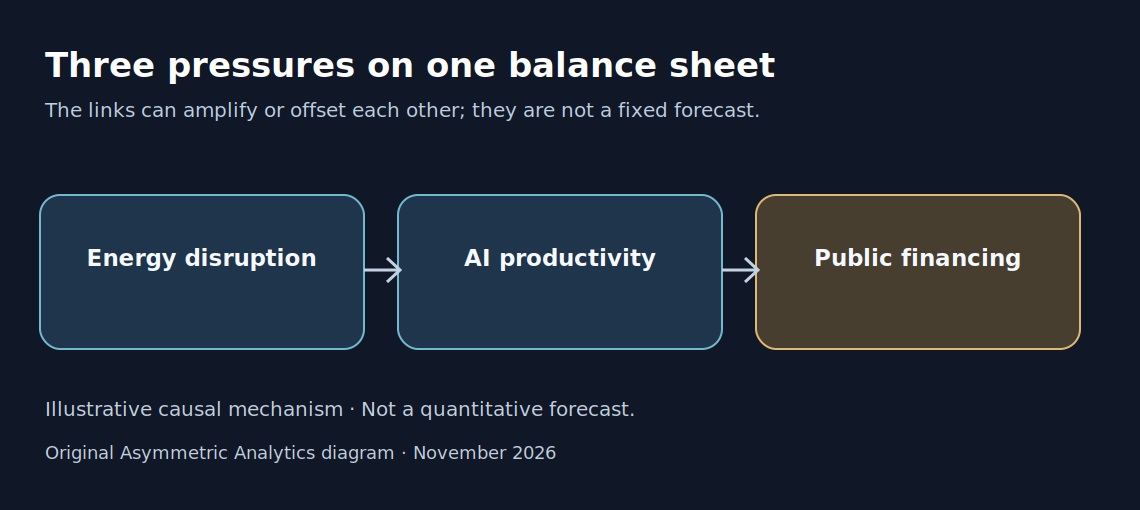
The global economy is experiencing three transitions that are usually discussed as though they live in separate rooms. One is military: low-cost drones, attacks on energy infrastructure and the use of economic damage as leverage. Another is technological: artificial intelligence making some human tasks cheaper and expanding the productivity of organizations that can use it. The third is financial: governments with large existing debts competing to fund defense, energy, infrastructure, social programs and interest expense.
These stories belong together because they ultimately compete for the same scarce resources—capital, energy, skilled labor and political attention.
War can raise costs just as AI offers the possibility of reducing them. AI infrastructure can require enormous investment just as governments increase borrowing. More productive societies may find the fiscal burden easier to bear, while unequal distribution of the benefits can create new claims on the public budget.
The outcome is not necessarily collapse. These shocks can reinforce one another, or they can partly cancel one another. That interaction is the market blind spot.
1. A supply shock that reaches far beyond the battlefield
The IEA's October 2026 Oil Market Report records a world contending with war-related disruptions to oil products and shipping. It reported global diesel exports in September approximately 700,000 barrels per day below the same period a year earlier.
This is important because diesel is an input to agriculture, mining, trucking, freight and many industrial processes. Higher prices function partly like a tax on businesses and households: they raise the cost of reaching the same level of economic activity.
There are multiple possible responses. A firm can raise prices, reduce margins, invest in efficiency, change suppliers or cut production. Consumers can reduce discretionary spending. Governments can offer relief, but that relief must be financed through taxation, borrowing or reallocating existing expenditures.
An energy shock is therefore simultaneously an industrial, inflationary and fiscal event. The damage does not stop at a port or refinery.
2. AI changes the productive frontier
Artificial intelligence offers a very different kind of force. Rather than taking capacity away, it can enable firms and workers to accomplish more with existing resources.
In February 2026 remarks, the IMF Managing Director described the possibility of a significant productivity acceleration while warning that the benefits depend on infrastructure, skills and institutional readiness.
The ILO's refined occupational exposure index estimates one in four workers has at least some exposure to generative AI, while noting that most occupations are more likely to be transformed than entirely eliminated.
These are not forecasts of universal unemployment. They describe a large and uneven reorganization of tasks, work and potential income.
The immediate fiscal implication is ambiguous. A more productive economy can generate more taxable income and more goods at lower unit costs. But automation that concentrates profits while disrupting wages can shift both the tax base and demands for redistribution.
An economy can become richer in aggregate while particular households and industries experience insecurity. That divergence may be central to the politics of financing the transition.
3. Sovereign balance sheets are the meeting point
The IMF's October 2026 Fiscal Monitor briefing warned that public debt, higher interest rates and persistent spending pressures are increasing fiscal vulnerability.
Governments must now consider several competing commitments. Military inventories require replenishment. Energy networks need investment. AI adoption can demand power-grid expansion and education. Aging populations require medical and pension spending. Interest must be paid on accumulated debt before the same revenues can finance new priorities.
The word constraint matters. A sovereign government can issue debt or money in ways a household cannot, but it does not escape the real resource costs of what it purchases. The price of capital, the credibility of fiscal institutions and the availability of labor and materials still influence outcomes.
Borrowing can be appropriate when it funds investments that raise future productivity. Persistent borrowing to cover operating shortfalls without a corresponding growth response poses a different challenge.
The distinction between productive investment and current consumption is therefore more meaningful than simply treating all government spending as either a stimulus or a waste.
4. Why higher productivity does not automatically solve debt
Suppose AI raises real output faster than expected. If tax receipts grow as a result, the same nominal debt can become easier to service relative to national income. But the benefit depends on the distribution of profits, the tax system, interest rates and the cost of implementing new infrastructure.
If better productivity also raises the expected return on private capital, investors may demand higher real yields on government bonds. That could offset part of the debt-service benefit, particularly when debt matures and must be refinanced.
The public real-yield series for inflation-indexed U.S. Treasuries provides one observable indicator of changing financing conditions. It cannot alone determine why yields move. Stronger real growth, inflation expectations, fiscal risk and monetary policy can produce overlapping effects.
The important question for governments is whether the growth dividend arrives quickly enough, and broadly enough, to finance obligations incurred in the meantime.
This is particularly challenging when infrastructure projects have long construction periods and uncertain returns.
5. The double squeeze on private investment
A manufacturer may confront higher energy prices and borrowing costs at the same time. A technology company may expect large future AI-related demand but face expensive capital and delayed grid connections. A government may want to subsidize industrial resilience just as debt-service expenses rise.
These constraints can compound. More expensive energy lowers expected returns, while higher discount rates reduce the present value of future cash flows. Firms may postpone otherwise useful projects, which reduces the future productive capacity needed to finance public commitments.
Yet there are countervailing mechanisms. New technology can reduce waste, make supply chains more resilient, improve logistics, and permit companies to maintain output with fewer scarce inputs. Better allocation of capital can do more than a large spending program whose benefits arrive too late.
The relationship between war and AI investment may thus be both competitive and complementary. Defense requirements consume fiscal space but can accelerate demand for automation, robotics, power resilience and advanced manufacturing.
Whether that demand generates broad productivity or narrow windfalls must be measured rather than presumed.
6. The distribution question feeds back into politics
If AI raises output but gains flow primarily to a small number of owners, governments may face stronger demands to support displaced workers or fund public services. If AI makes products cheaper and improves real wages, pressures may diminish.
The difference shapes the credibility of long-run budgets. A population that experiences rising living standards may tolerate structural change and investment delays more readily than one that sees economic concentration without tangible benefits.
The welfare of the median household is therefore not a separate social footnote. It affects the political durability of the policies required to finance AI, energy security and defense.
An economy that is technically capable of creating abundance can still produce public distrust if the distribution system performs poorly.
7. Three paths through the next decade
Scenario 1 — Productivity offsets disruption. AI adoption raises broad output and business efficiency while energy supply adapts and governments prioritize capital spending with measurable returns. Fiscal ratios stabilize as growth improves.
Scenario 2 — Inflation and debt reinforce each other. Repeated supply disruptions, constrained energy and infrastructure capacity, and elevated borrowing costs suppress real investment. Governments borrow heavily to protect consumers and maintain defense commitments, making future adjustment harder.
Scenario 3 — Aggregate growth with social fragmentation. AI produces large corporate profits, but wages and the tax base adjust slowly. Economic output grows while political pressures for redistribution and public services increase, complicating the fiscal benefit.
These scenarios are not probabilities or dates for an impending crisis. Different economies can occupy different paths at the same time.
8. How markets would reveal the divergence
The most useful indicators span sectors. Energy inventories and fuel-price spreads measure physical constraints. Real yields and sovereign borrowing costs measure financial conditions. Corporate cash flow, investment and productivity measure whether AI spending is producing economic value. Wage growth and household consumption reveal how widely that value is distributed.
The BIS statistics portal provides international credit and debt indicators that can complement national fiscal records. None of these series alone proves a grand macroeconomic narrative. Their value lies in whether they move together in the causal sequence the thesis predicts.
A rise in oil prices may be temporary. A rise in bond yields may reflect healthy expected growth. A fall in technology shares may coexist with accelerating AI adoption. The analyst must distinguish each signal before combining them.
The central risk is allowing one dramatic observation to substitute for an entire model.
What would change our view
1. Energy resilience: Do IEA product stocks, refinery runs and maritime flows recover despite continued security pressure, reducing the supply component of inflation? 2. AI productivity: Does measured output per hour grow broadly, not just in a few leading companies, and does it lead to sustainable higher tax receipts? 3. Sovereign financing: Do debt-service ratios and real borrowing costs stabilize as growth improves, or rise despite higher nominal revenues? 4. Distribution: Do real median wages and household purchasing power advance alongside AI-generated profits? 5. Investment: Does capital spending in grids, defense and automation generate observable capacity rather than only higher construction and financing costs?
The thesis that these pressures necessarily compound weakens if energy adaptation, technological gains and fiscal discipline reinforce each other. It strengthens if production constraints, weak wage growth and debt-service costs worsen in a sustained sequence.
Primary evidence
IEA, Oil Market Report — October 2026 .
IMF, Fiscal Monitor briefing — October 2026 .
IMF, AI preparedness and productivity — February 2026 .
ILO, Global GenAI occupational exposure index .
ELSI trail
Military disruption, energy supply, AI productivity, labor-income distribution, sovereign borrowing, interest rates and private investment are connected through real resource constraints and the fiscal system. Treat directional relationships as testable claims rather than deterministic forecasts.