By Design? How War's Energy Targets Become a Global Cost-of-Living Shock
By Asymmetric Analytics
Analysis
A motorist filling a diesel tank thousands of miles from a battlefield may be paying part of the war's economic bill. So may a farmer choosing how much fertilizer to apply, a trucking company renegotiating its rates, and a family finding that food prices have risen again.
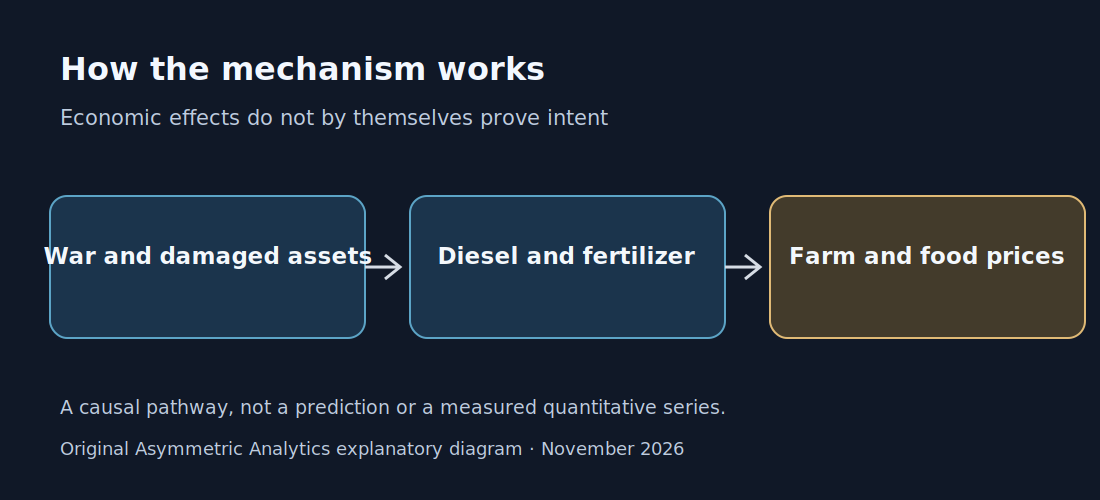
The connection is not mysterious. Energy makes ships move, fertilizer possible, factories operate and crops reach supermarkets. When warfare damages one part of that chain, the economic effects can travel much farther than a missile.
The more provocative question is whether those consequences are accidental. Are the people planning attacks merely accepting collateral economic damage, deliberately seeking leverage by causing hardship, or pursuing some wider coordinated strategy to impoverish civilian populations?
The answer requires examining specific decisions and their evidence, not treating every price increase as proof of a hidden master plan.
1. Diesel is the transmission belt of modern civilization
Oil prices attract headlines. Diesel deserves equal attention because heavy transport, agriculture, mining, construction and many industrial systems depend on it.
The International Energy Agency's October 2026 Oil Market Report describes severe diesel and gasoil tightness. Its estimates show global diesel exports in September around 700,000 barrels per day below a year earlier. The agency describes disruptions affecting Russian and Middle Eastern exports, depleted inventories, constrained refining and exceptionally high freight costs.
The transmission is straightforward. A refinery processes particular grades of crude into products. If a preferred crude supply is interrupted, a substitute can alter yields and production costs. If a refinery is damaged or becomes difficult to supply, regional product output falls. If tankers avoid a chokepoint, freight rates rise and replacement deliveries become slower or more expensive.
Diesel prices then transmit the shock into farm machinery, trucks, cargo transport, industrial equipment and backup power. Some customers can reduce consumption. Many essential users cannot stop operating without causing greater harm.
That difference between discretionary demand and essential demand makes diesel an especially powerful mechanism for turning a distant war into widespread inflation.
2. Fertilizer makes the consequences last longer
The second channel runs through ammonia, urea and sulfur-linked fertilizer products.
At the September 24, 2026 Rome Coalition ministerial meeting , FAO Director-General Qu Dongyu described how the Middle East conflict had disrupted energy and fertilizer markets. His remarks identified the Gulf as a major source of internationally traded urea, sulfur and ammonia, and reported substantial delays in fertilizer trade.
The economic effects are not limited to what fertilizer costs today. Farmers purchase inputs according to planting schedules and expected crop prices. A farmer may respond to higher fertilizer prices by applying less, changing crops or postponing other investments. The consequences for output can emerge months later, after current inventories and contracts have already masked part of the disruption.
Those reduced yields or changed crop mixes may then influence food supply, grain and feed costs, livestock economics and household prices. The chain has lags, substitutions and countervailing forces, so a rise in fertilizer prices does not mechanically produce a fixed increase in food prices.
This timing is critical. A shipping disruption that lasts several weeks may have a price effect far beyond those weeks if it arrives during a crucial procurement or planting window.
3. Why shipping chokepoints amplify limited military power
A country with a smaller navy or air force may still threaten shipping routes that matter to a much larger global economy. The Strait of Hormuz is a familiar example, but the general mechanism applies to pipelines, export terminals, ports, rail junctions, power substations and fertilizer plants.
The attacker does not necessarily need to halt all traffic. Raising the expected cost of movement can be sufficient. Shipowners may reroute, insurers reprice coverage, carriers demand higher margins, and buyers hold more inventory. Many of those behavioral changes persist even when the damage itself is localized.
The IEA's global gas-security analysis highlights how supply interruptions and competition for flexible cargoes can raise costs across distant markets. The nation suffering the immediate physical damage and the nation bearing a large share of the economic consequences need not be the same.
This is asymmetric economic warfare: relatively limited attacks on strategically important nodes may produce costs disproportionate to the hardware employed.
Yet a successful economic coercion campaign still depends on the target's ability to adapt. Emergency stocks, substitute pipelines, additional refining, rerouting, conservation and new suppliers can reduce leverage over time. The immediate shock and the durable strategic result are not identical.
4. Three different levels of intent
We should not collapse three explanations into one.
Collateral consequence. A military strikes an objective because of its direct operational value. Economic damage to civilians is foreseeable, but not the principal reason for the attack. For example, an oil facility may also supply fuel to military vehicles or generate revenue for a state.
Anticipated strategic pressure. A decision-maker knows an attack will restrict fuel or export earnings and treats that effect as a useful way to weaken an opponent. Civilian economic pain may be part of the calculation even when the public justification emphasizes military necessity.
Deliberate economic coercion. Economic disruption itself is an intended outcome: the attacker aims to raise fuel prices, disrupt food supplies or impose wider political costs, perhaps to change the other side's bargaining position.
An additional claim—an overarching coordinated global campaign to engineer starvation, inflation or population decline—requires a much stronger evidentiary burden. It cannot be inferred merely from predictable economic effects or the fact that several actors benefit from instability.
For an individual incident, we would need original strategy documents, orders, statements, patterns of target selection, timing, or reliably attributed operational evidence. Intent also may differ among the military commander, political leadership and allied organizations.
5. Incentives can differ even within one war
A country exporting oil may benefit financially from higher prices until production, shipping or market access is disrupted. An importer generally pays more. An armed group may regard rising transport costs as valuable leverage. An industrial competitor may capture market share while another country's factories confront high energy bills.
These incentives matter, but they do not prove coordination. Different actors can independently choose strategies that produce overlapping disruptions. One country may attack a refinery for military reasons while another threatens shipping to gain diplomatic leverage, and a third adapts industrial output in response.
The resulting inflation could resemble a coherent strategy even when it arose from decisions that were never jointly planned.
This is why the investigation must keep a timeline of actual strikes and publicly documented goals alongside independent commodity data. We should compare observed price movements with control factors such as inventories, weather, demand, currencies, trade policy and central-bank decisions.
6. The overlooked cost of uncertainty
An infrastructure asset need not be destroyed to become economically less useful. A refinery can be offline because staff cannot operate safely. A ship can stay in port because an insurer declines coverage. A fertilizer factory can reduce production because its gas supply is too unreliable.
These costs arise from the expectation of further disruption, not just past physical damage.
In financial terms, war raises the premium investors and operators demand to commit capital. In economic terms, it delays projects and reduces the supply available during periods of stress. In everyday life, it can translate into expensive fuel, higher food prices and reduced purchasing power.
The critical weakness for a more powerful nation may therefore not be the inability to defeat enemy forces. It may be the inability to prevent repeated small attacks from imposing lasting economic costs across a complex civilian economy.
7. What the data can tell us
The IEA provides energy balances, inventory changes, refinery runs and forecasts. The FAO's Food Price Index tracks international prices of food commodities; it does not measure every household's grocery bill. The World Bank commodity markets resources offer broader price comparisons. Together these allow analysts to trace real market movements rather than constructing a theory from selected gas-station photos.
But aggregate prices cannot prove why an individual military leader chose a target. Economics measures the effect; intent requires separate evidence. The distinction is important: measuring economic harm is not the same as demonstrating a commander's motive.
This distinction ultimately makes the story more compelling. We do not need to invent a hidden plan to see how modern warfare can punish the economic foundations of distant civilian societies.
8. The strategic prize is political endurance
Economic attacks test governments' ability to maintain domestic support, alliances, industrial production and financing while the military conflict continues.
A strong country can win engagements and still struggle with the cumulative costs of keeping trade routes open, defending dispersed infrastructure and replenishing defensive equipment. A weaker opponent may calculate that persistent losses to commerce will alter the stronger country's objectives faster than battles alter the balance of forces.
That calculation is not always correct. Sustained attacks can also harden resistance, trigger retaliation or cause an international coalition to adapt more quickly. But the strategic logic is clear: the economic consequences of war are no longer simply background conditions. They can be a central theater of conflict.
What would change our view
1. Documented target intent: Do official statements, orders or target patterns identify economic disruption as an objective rather than only an expected consequence? 2. Commodity transmission: Do IEA fuel inventories and FAO fertilizer and food series move with identified interruptions after accounting for demand, exchange rates and substitutes? 3. Adaptation: Do shipping volumes, refinery runs and input deliveries recover despite continued attacks, reducing coercive leverage? The thesis of deliberate economic coercion weakens when strikes consistently correspond to immediate military objectives and price effects are better explained by other factors. A claim of centrally coordinated global economic harm requires independent evidence of coordination.
Primary evidence
IEA, Oil Market Report — October 2026 .
FAO Director-General, fertilizer access and food security statement — September 24, 2026 .
ELSI trail
Diesel, refinery capacity, shipping risk, fertilizer feedstocks, food commodities, household inflation and sovereign fiscal pressure form a cross-domain pathway. These relationships are meaningful only when observed economic consequences remain distinct from hypotheses about military intent.