America's Gulf Partners Fear the Next Strike on Iran — and the Retaliation They May Inherit
By Asymmetric Analytics
Analysis
The crucial question in the Gulf is no longer just whether Washington can hit Iranian targets. It is whether countries hosting American forces can survive the retaliation that follows without losing the ports, energy systems and business confidence on which their prosperity depends.
On October 28, the UAE Ministry of Foreign Affairs called for political solutions, diplomatic coordination and renewed efforts to prevent escalation. At the November 1 IISS Manama Dialogue , diplomatic adviser Anwar Gargash joined a closing session devoted to global security. The diplomatic message lands after months of war, not in an atmosphere of hypothetical concern.
The concern has become more immediate. On November 3, Qatar's Foreign Ministry confirmed that its envoys had returned from discussions in Tehran and were exchanging proposals between Iran and the United States. It described a high level of Gulf coordination to avert renewed fighting, but announced no diplomatic breakthrough. The ministry also condemned an attack on the Qatari gas carrier Al Mayeda and warned that threats to navigation undermine negotiations. Gulf governments are trying to prevent a new strike-and-retaliation cycle while protecting infrastructure already exposed by the war.
Brief
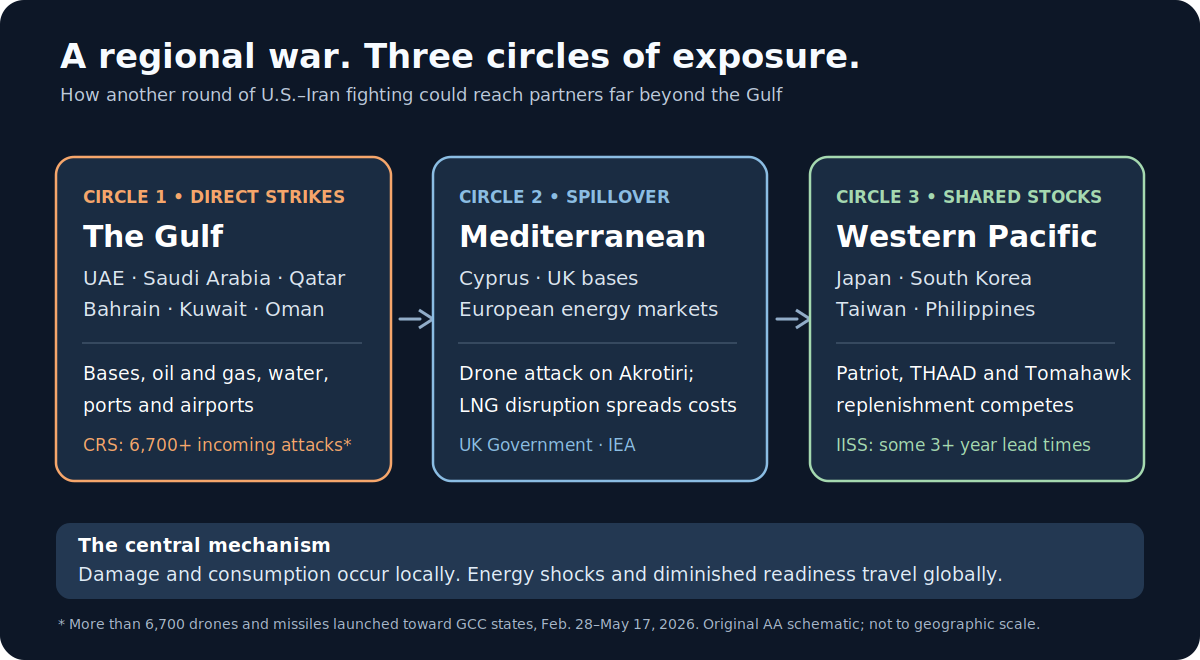
The Congressional Research Service recorded more than 6,700 Iranian drones and missiles launched at the six Gulf Cooperation Council states between February 28 and May 17. The targets extended beyond American bases to airports, energy installations and other civilian infrastructure. Much of the incoming fire was intercepted, but high interception rates cannot eliminate damage, economic disruption or the cost of defending every facility.
That presents Gulf governments with an uncomfortable choice. American forces remain important to their protection, but hosting those forces can also make their countries targets in a U.S.–Iran confrontation they did not choose.
For an ally, a security guarantee is valuable only if the protection it delivers exceeds the danger the relationship introduces.
Standard: What the Gulf is trying to protect
These are not simply oil-producing states. The Gulf is an interconnected network of LNG export terminals, desalination plants, airports, shipping hubs, finance centers, data infrastructure and enormous foreign investments. A damaged refinery affects fuel supply; a disrupted port affects global commerce; an unreliable airport weakens business travel and logistics.
The International Energy Agency reported that the Strait of Hormuz normally carried almost 20% of global LNG supply. Its de facto closure during the 2026 war shook prices in both Asia and Europe. Even countries untouched by missiles have therefore paid part of the economic cost.
The Gulf is not uniformly rejecting Washington. Governments still value the deterrent effect of American forces, and they face Iranian threats regardless of whether U.S. troops are present. Their problem is that protection and exposure can rise together.
Detailed: The danger does not stop at Hormuz
There is already a geographic precedent. On March 3, the British prime minister's office confirmed a drone attack on Britain's RAF Akrotiri base in Cyprus and announced additional defensive deployments. The attack brought the threat to the Eastern Mediterranean, far outside the six Gulf monarchies.
Another consequence is less visible. In an October assessment , the International Institute for Strategic Studies found that the Iran war had depleted U.S. missile stocks also needed for deterrence in the Western Pacific. Replenishment of some Patriot, THAAD and Tomahawk inventories could take three years or more. This does not mean those weapons are exhausted. It means available stocks, delivery schedules and industrial production become contested across theaters.
That is the wider lesson: renewed strikes could impose direct costs on Gulf partners, energy costs on Asian and European economies, and military readiness costs on partners facing China, Russia or North Korea.
A regional war can generate global vulnerabilities without becoming a global shooting war.
This is the escalation trap examined in our related analysis, 1914, 1939, 2026: The Dangerous Illusion That War Can Be Controlled . Washington can choose the opening attacks; it cannot choose every response by Iran, every defensive deployment by its allies, or every economic shock that follows. A campaign begun as a limited military operation can create commitments that are much harder to limit.
There is a countervailing possibility. A credible diplomatic settlement could reopen shipping, reduce repeated interceptor expenditure and restore confidence in the American security relationship. Stronger regional coordination could also improve the Gulf's defense rather than weaken it. Neither outcome is assured.
The critical indicators now are whether diplomacy produces a durable Hormuz arrangement; whether further attacks strike civilian energy, water or transport systems; whether Gulf governments adjust access to American bases; and whether U.S. weapons manufacturing can replenish systems faster than future conflicts consume them.
For Washington, the central question is not simply how much damage another strike would do to Iran. It is how much security the United States can preserve for its partners after the retaliation begins.
Places in this story








United States, Iran, Saudi Arabia, United Arab Emirates, Qatar, Bahrain, Kuwait, Oman
Made with Natural Earth