Iran Does Not Need to Defeat the US Navy to Make Hormuz Expensive
By Asymmetric Analytics
Analysis
“War is the continuation of politics by other means.” — Carl von Clausewitz, On War (common English rendering)
Iran's latest claims about burning tankers in the Strait of Hormuz raise a larger question than how many ships were damaged: can a country with a much smaller navy impose economic costs on the world's most powerful military and its trading partners?
On November 3, Anadolu, citing Tasnim's report of an IRGC Navy statement , reported Iran's claim that three tankers had hit naval mines. On November 4, Reuters reported another IRGC claim : four tankers were ablaze after alleged mine strikes, and the IRGC said it had detained two other vessels. Neither report identifies enough ship details to establish losses independently, and the public claims do not establish whether these groups of vessels overlap. The IRGC has asserted mine strikes; independent ship-identity and forensic confirmation is still missing.
Official maritime reporting supplies another part of the picture. UK Maritime Trade Operations lists Warning 195-26, in which a tanker company security officer reported two unknown projectiles striking the engine room near Limah, Oman, on November 3. Warning 194-26 relays an Indian government report that an Indian-crewed dhow was attacked outbound, with survivors rescued by the Omani Royal Navy. Warning 193-26 describes another reported projectile strike on November 2. UKMTO identifies no attacker in these notices. The ship identities are not established well enough to know whether any report overlaps an IRGC claim; none independently confirms a mine strike.
Brief
Iran does not have to win a fleet battle to disrupt an oil trade route. Ships need crews willing to sail, insurers willing to cover them, ports willing to receive them and buyers confident that cargo will arrive.
This is the potential economic leverage, whether or not the IRGC's latest ship-loss claims are established. When crossing Hormuz is perceived as dangerous, the price of delivering oil and liquefied natural gas can rise even if individual voyages are completed. Risk changes decisions about many more voyages than the ships directly attacked.
Standard: The waterway and the market
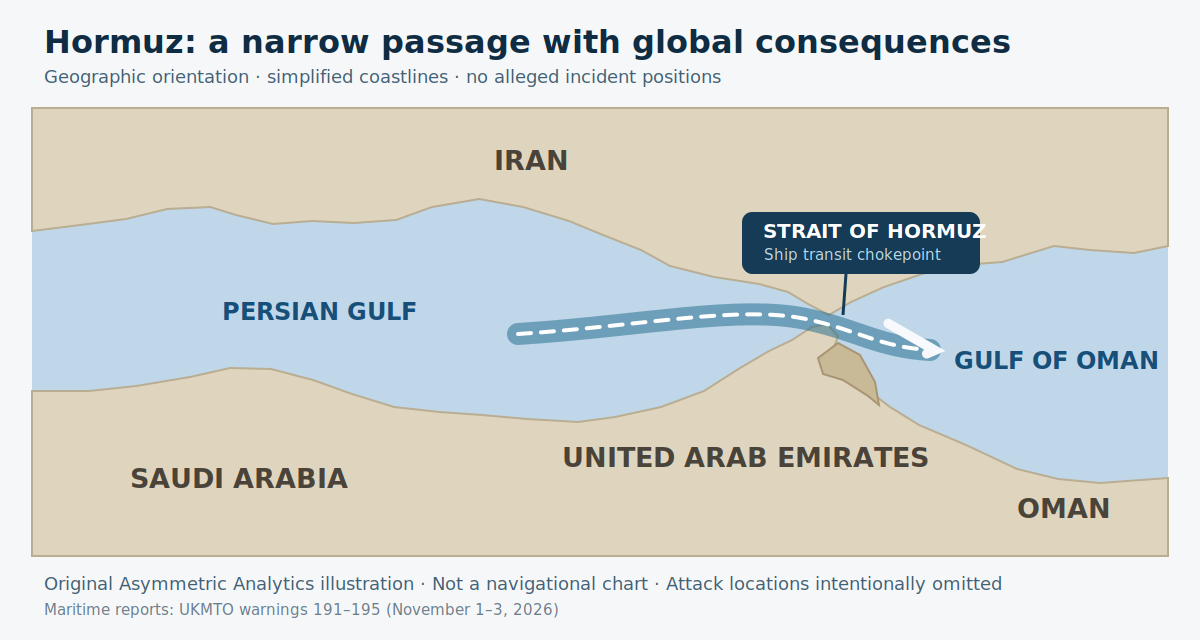
Hormuz connects the Persian Gulf to the Gulf of Oman and the open ocean. The surrounding export economy depends on a narrow maritime connection, and alternative pipelines can replace only part of its capacity.
In its August 12 Global Energy Security Data, Table 4 , the U.S. Energy Information Administration estimates total oil flows through Hormuz averaged 21.6 million barrels per day in the fourth quarter of 2025, 14.9 million in the first quarter of 2026 and 4.9 million in the second quarter. That is a decline of approximately 77% from the first to the last period. The decline spans the onset of the February 2026 war and broad disruption to shipping. EIA's flow table does not apportion causes; the decline cannot be assigned to mining risk alone or to the later November incidents. EIA warns that ships' tracking signals have been particularly unreliable since late February and its 2026 flow estimates are subject to revision.
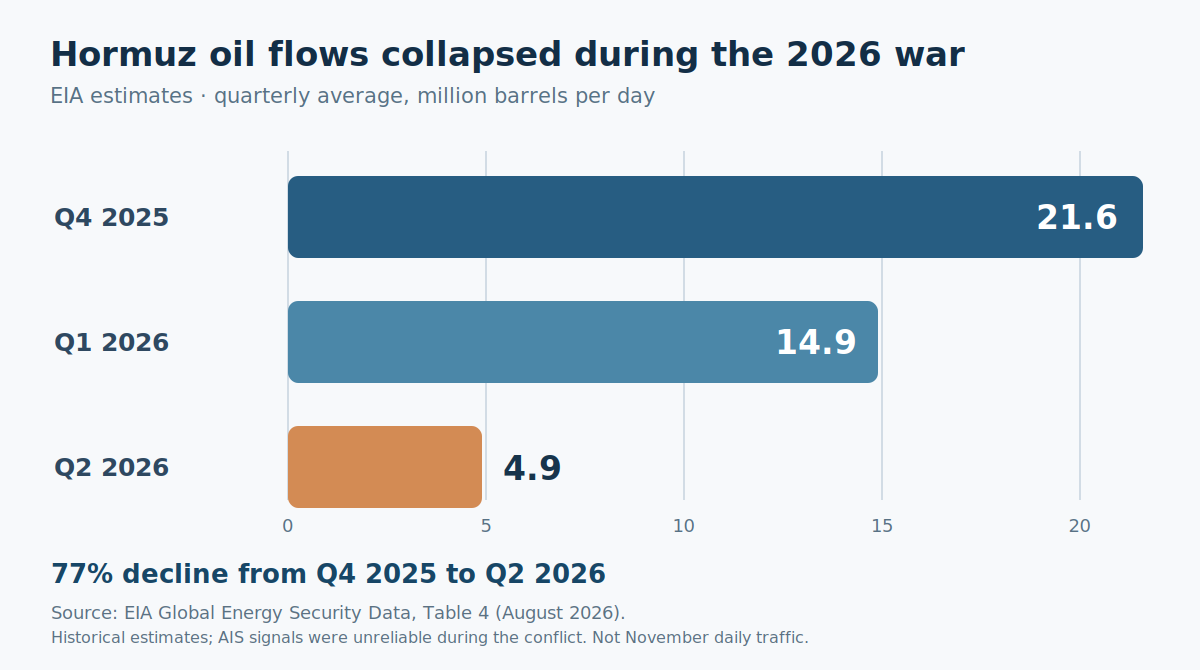
For Q4 2025 versus Q2 2026, the same EIA table estimates liquefied natural gas flows at 10.5 versus 0.8 billion cubic feet per day. LNG is natural gas cooled into a liquid so it can be carried by tanker. When an export route becomes unreliable, the disruption reaches power plants, factories and households in countries far from the fighting.
A war-risk premium is the additional insurance cost associated with conflict. These costs are already visible: in its March 30 assessment , the UN Conference on Trade and Development reported oil-tanker freight rates up more than 90% since late February, sharply higher war-risk insurance premiums and some insurers withdrawing Persian Gulf cover entirely. These are costs of the wider conflict—not a measured effect of the November allegations. UNCTAD also documents a pathway into fertilizer and food prices.
Detailed: Military dominance is not the same as economic control
The United States possesses overwhelming advantages in airpower, naval forces and long-range strike capability. It can inflict destruction on Iranian military infrastructure that Iran cannot match against the American homeland. Yet the economic contest is not symmetrical: Iran can threaten trade near its shores while many of the financial consequences are borne by its neighbors and distant importers.
The immediate pressure lands on shipping companies and Gulf exporters, then on import-dependent economies, notably in Asia. Europe feels the shock through competition for LNG cargoes and higher energy costs. The IEA's November 3 Global Gas Security Review says the EU is entering winter with gas stocks at their lowest level since 2013. A cold winter combined with continuing Gulf LNG disruption could draw storage below 10% by the end of March 2027 in the agency's stress simulation. That is an economic and supply-security warning, not a forecast that European households will lose heating.
The United States is less dependent on imported Gulf energy than many overseas buyers, but oil is priced in a global market. Higher fuel costs, inflation pressure, military spending and weaker allied economies can still transmit the shock home.
An Iranian policy of deliberately exploiting shipping risks, if pursued, would carry costs as well as potential leverage. Continuing disruption could harm Iran's own trade or strain ties with countries affected by higher energy prices. Pipeline bypasses, additional LNG supply, safer transit arrangements and diplomacy could all reduce the disruption. This is AA's strategic inference about bargaining incentives, not evidence that Iran deliberately caused any particular UKMTO incident.
In our related investigation of the illusion of controlled escalation , we examine how military action can generate second-order consequences its initiators do not control. Hormuz makes that danger concrete: the military balance and the economic balance can point in different directions.
What would change our view
The next decisive evidence will be identified ships and confirmed damage mechanisms; independently observed shipping volumes; actual freight and insurance prices; sustained deliveries to energy importers; and whether diplomacy produces a credible, lasting transit arrangement.
The distinction that matters is straightforward. An unverified claim that several tankers struck mines is not proof of those losses. But a maritime corridor can be economically impaired long before its physical capacity is destroyed—and the damage can extend far beyond the ships that were attacked.
Primary sources and reporting
UK Maritime Trade Operations, notices 193–195, November 2–3, 2026 .
U.S. Energy Information Administration, global energy chokepoints and Strait of Hormuz flow tables (estimates through Q2 2026).
International Energy Agency, Global Gas Security Review 2026, November 3 .
UNCTAD, March 30, freight costs, war-risk insurance and fertilizer disruption .
Anadolu, November 3, Iranian Guard claim of three tanker mine strikes .
Reuters, November 4, Iranian Guard claim of four tanker mine strikes (ship identities unverified).