America's Drone War Comes Home: Laser Weapons Now Guard Mar-a-Lago
By Asymmetric Analytics
Analysis
The American president is now being protected by a weapon that can reach an approaching drone at the speed of light.
Photographs from October 31 show a vehicle-mounted LOCUST counter-drone laser near Mar-a-Lago, alongside Avenger air-defense vehicles armed with Stinger missiles. The War Zone reported the laser's deployment on November 2; NORAD and U.S. Northern Command confirmed that they had sent ground-based air defenses and counter-unmanned-aircraft capabilities to the area at the Secret Service's request. Reporting identifies the mobile laser as a 20-kilowatt-class Army Multi-Purpose High Energy Laser.
That is an extraordinary milestone in its own right. But the more consequential development is what this technology might do to the economics of defense. For decades, the answer to an incoming aerial threat has often been another missile. Increasingly, the answer could be electricity.
Brief
The advantage sounds almost unfair: a missile must launch, accelerate, steer and travel. A laser beam crosses a kilometer in roughly 3.3 microseconds. Once a threat is detected and tracked, the defender does not need to wait for a projectile to fly an intercept course.
There is one crucial distinction. Hitting at the speed of light is not the same as destroying at the speed of light. The beam must remain concentrated long enough to heat or disable a vulnerable component. That can take seconds, depending on the weapon, distance, weather and target. Yet as output power and tracking precision improve, the time required to cause damage can shrink dramatically.
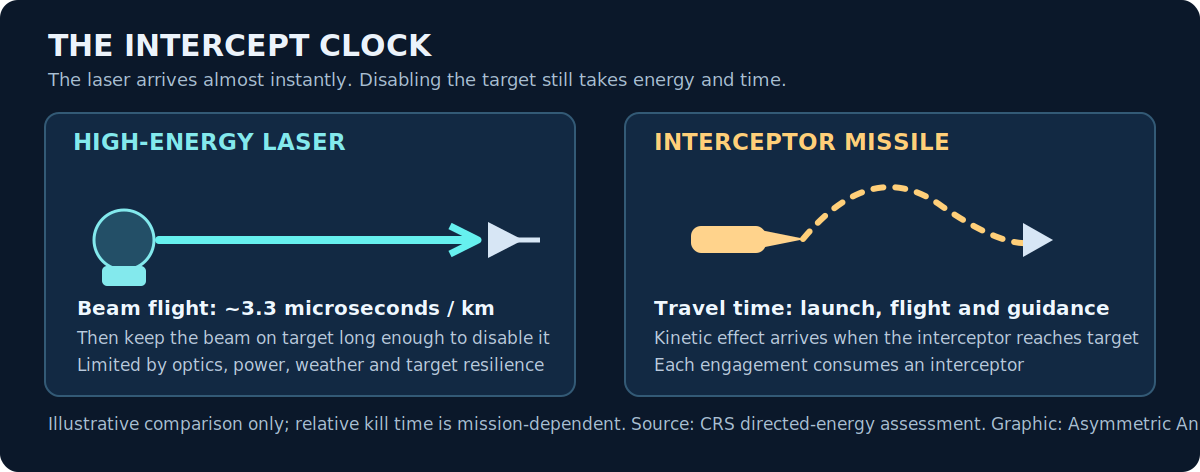
The practical significance is already visible. The laser and the Stingers are positioned together, but they solve different problems. The laser offers repeated engagements without consuming an interceptor missile. The missile offers another defensive option when range, weather, target hardness or geometry defeats the beam.
Standard
Consider the arithmetic of a cheap drone versus an expensive interceptor. A defender that repeatedly spends far more to destroy an attacker than the attacker spends to launch it faces a losing industrial equation. Even a perfect interception record can become unsustainable when ammunition stocks, factory output and resupply time are limited.
A laser reverses much of that equation. It consumes electricity and imposes maintenance, cooling and equipment costs, rather than expending a separate missile on every engagement. Power is not free, and the full system is not cheap. But its marginal firing cost can be remarkably low compared with a kinetic interceptor.
This is not merely a laboratory ambition. AeroVironment announced a $464.8 million U.S. Army award in September for the Enduring-High Energy Laser program. Its planned 30-kilowatt LOCUST X3 production systems are intended for repeated engagements against small and medium-sized unmanned aircraft. The manufacturer's specifications describe a broader 20–35-plus-kilowatt product class. The unit photographed in Palm Beach is identified in reporting as the earlier 20-kilowatt AMP-HEL configuration, not the new 30-kilowatt production model.
The causal chain is straightforward: inexpensive drones make missile interception economically unattractive → armies invest in directed energy → each defended site can conduct more engagements without exhausting a stockpile → the advantage shifts toward reliable electrical power, sensors, cooling, precision tracking and manufacturing capacity.
This is a direct extension of our Arsenal of Democracy investigation : the defense industry cannot assume that expensive, slow-to-replace interceptors will remain the best answer to mass-produced aerial threats.
Detailed
Could lasers eventually replace missiles, rather than merely help conserve them? Across meaningful portions of short-range air defense, yes. The question is no longer whether a laser can disable a flying target. It is how large, fast, resilient and numerous those targets can become before the defender must switch weapons.
A five-second exposure from a 20-kilowatt optical beam represents 100 kilojoules of emitted energy. A hypothetical one-megawatt beam emits the same energy in one-tenth of a second. That comparison is not a claim of equal destructive effect: atmospheric losses, beam spreading, moving aim points, target materials and thermal effects determine how much actually reaches the vulnerable spot. It illustrates why higher optical power could radically change the time available for an interception.
Congressional Research Service analysis identifies precisely this combination of promise and constraint. Lasers can track targets that maneuver too sharply for some missile interceptors, move energy almost instantaneously and redirect quickly. They also need line of sight; fog, rain, dust and turbulence weaken the beam; sustained heating can disturb the air through which it travels; and a single laser generally cannot disable many separate targets simultaneously.
A network changes the last problem. Multiple lasers, sensors and conventional interceptors could distribute a swarm across available firing systems. The result would not be a magical shield. It would be a defense that scales differently from today's missile-heavy approach.
The lesson extends beyond the president's residence. Ships, airfields, power stations, military bases and critical industrial facilities all face some version of the same imbalance: a small, cheap flying machine can threaten assets worth millions or billions. If reliable directed energy turns each defense engagement from a scarce munition into a renewable power-and-cooling problem, that imbalance begins to narrow.
Mar-a-Lago makes the transition tangible. The weapon is no longer merely being demonstrated at a distant test range. It has been assigned to protect one of the highest-profile sites in America. The technology remains layered with missiles today, but it may steadily displace them in missions where directed energy proves faster, cheaper and dependable enough.
What would change our view
The decisive tests are operational rather than promotional: repeated successful intercepts in difficult weather, at useful distances, against maneuvering targets and coordinated swarms; shorter measured engagement times as laser power increases; and demonstrated lower lifecycle cost per defended target. If those gains fail to materialize, or if atmospheric losses and power requirements overwhelm the benefits, conventional missiles will retain a much larger share of air defense.
Primary sources
The War Zone, LOCUST laser guarding Mar-a-Lago , November 2, 2026, including official NORAD and U.S. Northern Command statements.
ZeroHedge, directed-energy weapon deployed at Mar-a-Lago , November 3, 2026.
AeroVironment, $464.8 million E-HEL award , September 2, 2026.
AeroVironment, LOCUST X3 technical profile .
Congressional Research Service, Navy Shipboard Lasers: Background and Issues for Congress , January 12, 2026.