America Can Win the Battles. Can Iran Win the Economic War?
By Asymmetric Analytics
Analysis
“War is the continuation of politics by other means.” — Carl von Clausewitz (common modern rendering of On War, Book I)
In the familiar modern rendering of Clausewitz's argument, war continues the work of politics through violence. The historical English translation often uses “policy” instead of “politics.” Our reading is that military results must ultimately be judged against political objectives, not just equipment destroyed.
The war began on February 28, 2026, when the United States and Israel launched strikes on Iran . Tehran retaliated across the region. An April ceasefire and June memorandum did not hold; renewed hostilities followed in July, and by autumn the conflict had become a mixture of intermittent strikes, sanctions, a U.S. blockade of Iranian ports and Iranian threats to shipping. Both governments use military and economic pressure. The shipping and price data below measure the combined results of war, restrictions, commercial responses and supply losses—not Iran's actions alone.
The United States and Iran are fighting across two different balance sheets.
On one, America has a commanding conventional military advantage, augmented by Israel's military operations. Washington's stated objectives include degrading Iranian missiles and naval capabilities and preventing a nuclear weapon. On the other, Iran retains means to threaten Gulf commerce and seeks regime survival and relief from sanctions and blockades. A tanker's captain, a European chemical manufacturer and a Gulf finance minister can all pay a price for decisions taken elsewhere. CENTCOM's July announcement also makes clear that American naval power is restricting traffic to and from Iranian ports, even as Washington says non-Iranian transit should continue. Tehran's maritime threats and Washington's economic restrictions are not the same action, but both matter to the political bargain.
But the two balance sheets are connected. Iran's capacity for disruption can decay as its military infrastructure is damaged. The world can adapt by rerouting shipments, building inventories and substituting supplies. Iran itself pays for a prolonged war. The important question is therefore not whether Tehran can impose costs. It can. The question is whether it can impose costs faster than its leverage—and its own economy—erodes.
Brief: The three clocks of this war
The first clock is military. The United States can destroy and suppress Iranian capabilities at scale, while Iran seeks to retain enough missiles, drones, maritime threats and survivable military capacity to make escalation costly.
The second clock is economic. Ships need willing crews, insurance and commercially viable routes. Buyers need the right cargoes at the right ports at acceptable prices. Disruption radiates into Asia, Europe, food production and American fuel costs. The U.S. Energy Information Administration (EIA) estimated a 4.9 million-barrel-per-day average through Hormuz for Q2. Separately, the International Energy Agency (IEA) estimated 10.9 million barrels a day in September, which it described as 3.7 million above August. These are snapshots from different methodologies; the same IEA report documents a month-to-month improvement, without isolating the relative contributions of military, diplomatic or commercial changes.
The third clock is political. U.S. officials have described objectives concerning Iran's missile forces, naval threat and nuclear program. Iranian officials seek an end to attacks and sanctions, the lifting of the U.S. port blockade and release of frozen funds as part of a settlement. Gulf states want protection, predictable exports and investment confidence. Europe and Asia want energy at prices their firms and citizens can afford.
Who gets to declare the war over—and on what terms—depends on all three clocks.
Standard: The asymmetry is economic, not merely military
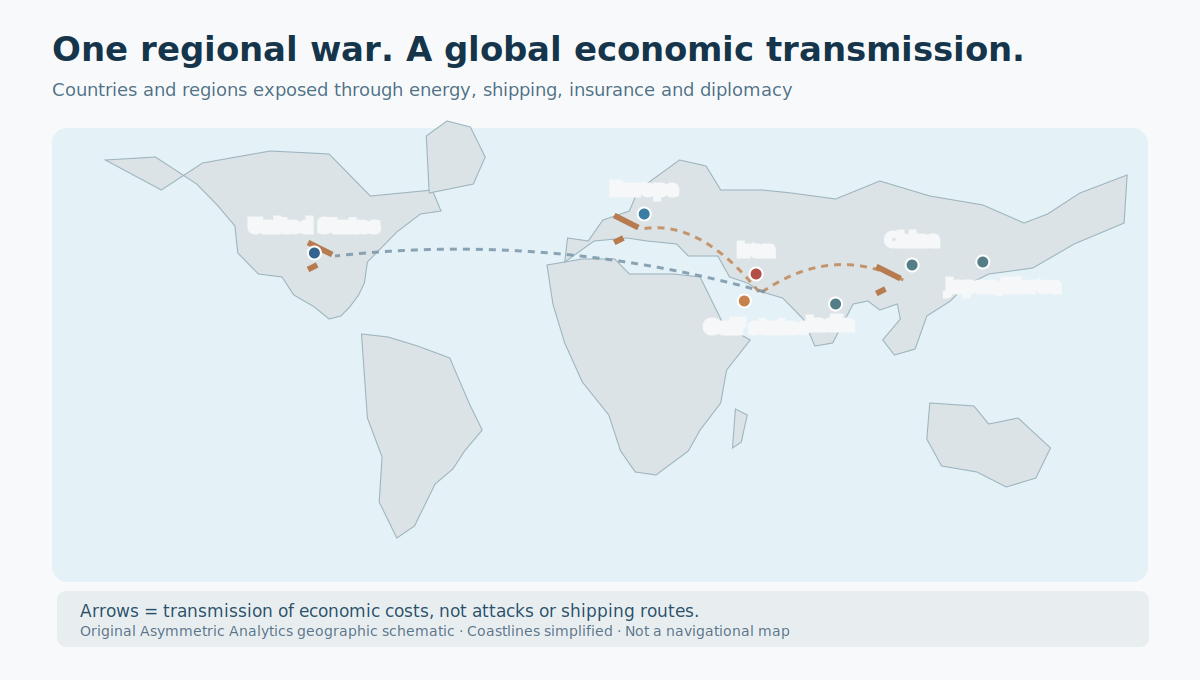
The public argument often divides the conflict into American firepower versus Iranian mines and missiles. That is too narrow. Israel is also a military party, and the United States uses blockade and sanctions as instruments of economic pressure. Iranian shipping restrictions, American port restrictions, strikes on infrastructure and the reactions of shipowners all contribute to the economic disruption.
A government can prevail in direct engagements and still face an unfavorable political bargain if the resulting economic burden becomes unacceptable to its allies. Conversely, an actor that imposes economic pain may find that the victim countries respond by reinforcing the stronger power's military coalition. Economic disruption is leverage only when it changes decisions in the desired direction.
We can see both mechanisms operating.
A June Congressional Research Service assessment , drawing on Gulf Research Center data, reported more than 6,700 Iranian missiles and drones directed at the six Gulf Cooperation Council states between February 28 and May 17. The report described disrupted airports, damage to infrastructure and pressure on commerce. American and allied defenses intercepted many threats, but protection is neither free nor perfect. Nor should people disappear behind cost figures: a UN humanitarian assessment documented severe civilian casualties, damaged homes and displacement inside Iran during the war's first weeks; Gulf populations have also suffered casualties and disruption.
That leaves Gulf governments with an uncomfortable dual dependency. Their security relationships with Washington help protect them from Iran, yet their bases, ports and economic exposure can pull them into a confrontation they did not direct. The relationship can offer both protection and added exposure. There is no single Gulf response: governments differ in geography, energy mix, politics, attack experience and confidence in outside guarantees.
Iran does not need Gulf governments to become its allies to create political pressure. A government seeking to reopen commerce may urge restraint and negotiations while still opposing Iranian military attacks. But damaging Gulf infrastructure can also deepen those countries' determination to cooperate militarily against Tehran. Iranian pressure on Gulf neighbors can create demands for negotiation or reinforce their security cooperation with Washington.
Detailed investigation
### 1. Why control of the sea is not the same as control of trade
A brief detour into shipping economics helps explain the problem. An ocean passage may be physically navigable and still fail the commercial test. A cargo moves only when a shipowner accepts the safety risk, an insurer covers the voyage, financing is available and the buyer expects timely delivery.
War-risk insurance is particularly revealing. In S&P Global's March 30 reporting , marine insurance executives said additional seven-day Persian Gulf war-risk premiums had reached around 2.5% of a ship's insured hull value earlier in March before easing toward 1% by late March. These are dated market observations, not current November quotes. They demonstrate how security conditions can reprice a whole class of voyages without destroying every vessel.
UK Maritime Trade Operations continues to report projectile and other maritime incidents. Reuters reported another tanker struck by two unidentified projectiles north of Qatar late on November 4, with the crew and damage status initially unknown. The source did not identify a perpetrator. On November 4, Reuters relayed an IRGC assertion that tankers had struck mines. Its claimed vessel losses are not independently established. See our separate AA News analysis for the incident chronology and distinction from unattributed UKMTO reports.
The commercial mechanism requires neither an infinite minefield nor a perfect naval blockade. Risk can impose delay, higher costs and uncertainty on thousands of decisions at sea and on land. But those consequences have to be measured in freight rates, insurance premiums, delivered volumes and arrival times—not simply counted in military communiqués.
The UN Trade and Development agency, UNCTAD , estimated in March that the strait normally carried about one-quarter of seaborne oil trade and roughly one-third of seaborne fertilizer trade. Fertilizers are themselves important imports for farmers; delays or price shocks can reach food-production costs in countries far from the naval conflict. That is separate from the Gulf's role in natural-gas and chemical feedstock markets.
### 2. The chart that complicates both sides' arguments
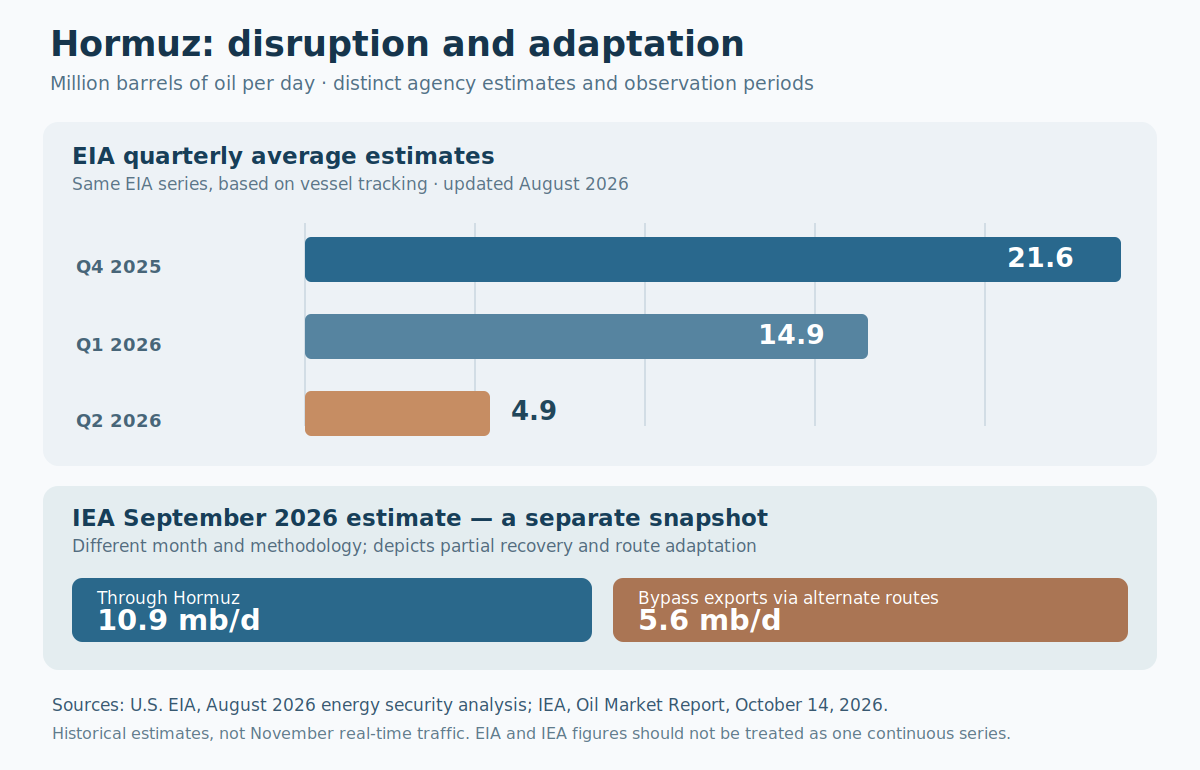
The EIA's August energy-security analysis, Table 4 estimated Hormuz oil flows at 21.6 million barrels a day in Q4 2025, 14.9 million in Q1 2026 and 4.9 million in Q2. Q1 included most of January and February before fighting began on February 28. Its tanker-tracking estimates are subject to revision, particularly when vessel-identification signals are unreliable in wartime.
The IEA's October Oil Market Report separately estimated 10.9 million barrels a day through Hormuz in September, an increase of 3.7 million from August. It also counted 5.6 million a day in bypass exports, up 970,000 barrels a day from August. These are different physical routes; they should not be spliced into the EIA's earlier quarterly series, which uses a separate method. The September changes demonstrate partial recovery across routes, without revealing how much resulted from defense, commercial adaptation, policy changes or improving conditions.
Recovery is also uneven across products. The IEA estimated that Gulf refined petroleum-product exports reached 1.9 million barrels a day in September versus 4.7 million before the war. Liquefied petroleum gas exports reached 670,000 barrels a day versus 1.5 million. Crude may move through a bypass pipeline, but that does not automatically replace the diesel, jet fuel or industrial feedstock normally shipped from a damaged or disrupted refinery.
This is an important constraint on both slogans. Iran cannot assume that keeping the strait risky will stop all trade. Washington cannot assume that restoring crude exports restores the larger energy system.
### 3. The Gulf states are directly exposed—and have their own political objectives
The six Gulf Cooperation Council countries do not experience this conflict as a distant strategic contest. Their budgets, tourism, airlines, refineries, gas terminals, export infrastructure and investment ambitions all depend on a reputation for stability.
For Qatar, LNG exports are central to national income. For the UAE, major logistics, finance and aviation businesses make regional confidence as important as oil. Saudi Arabia is both a giant energy exporter and a country attempting to build a broader economy beyond oil revenues. Oman must protect trade and maritime security while maintaining room for diplomacy.
In ordinary times, these investments create prosperity and diversify the economy. In wartime, they create additional reasons to avoid prolonged conflict.
The first political channel is therefore not necessarily direct Iranian persuasion. It is the reaction of the Gulf's own governments to lost trade, delayed investments and the risk of repeated attacks. A government might press Washington and Tehran for an agreement while continuing to depend on American military protection. Or it might conclude that the threat requires still closer cooperation with the United States.
Iran's bargaining strategy must contend with the possibility that intimidating a neighbor produces the opposite of the intended political result.
### 4. Asia absorbs the energy shock; Europe pays for scarcity
Asian buyers are heavily exposed to Gulf energy. An interruption can raise fuel prices, reduce industrial margins, increase electricity-generation costs and force some countries to substitute fuels.
Europe's vulnerability is different. It competes for flexible liquefied-natural-gas cargoes, and a higher Asian bid can affect European prices even when a particular shipment was never headed to Europe.
The IEA's November 3 Global Gas Security Review measures the supply loss and resulting prices across these interconnected markets. Gulf LNG loadings from Qatar and the UAE were more than 60 billion cubic metres below the year-earlier level from March through October. European benchmark hub gas prices averaged close to $20 per million British thermal units, nearly 70% higher year over year for those months. The corresponding Asian spot LNG average was about $21.50, nearly 80% higher.
Those figures describe a global price shock, not a complete halt in gas consumption. The IEA also observed demand reduction, including lower European industrial gas use and fuel-switching in Asia. That is how expensive energy does much of its damage: households and factories adjust before pipes necessarily run empty.
Will Europeans freeze this winter? We do not expect widespread household heating failures as the central outcome. Household customers and essential services have special protections in the EU's gas-security framework , and governments can respond through imports, storage withdrawals and reduced industrial demand. Nevertheless, the IEA says EU gas stocks entered the 2026–27 winter at their lowest level since 2013. Under a colder-than-average winter and continued Hormuz LNG disruption, its stress simulation puts EU storage below 10% by the end of March 2027. That would leave very little buffer for another cold spell or technical failure.
There is a difficult timing issue. Under the EU's phased Russian-gas restrictions , the prohibition covering qualifying long-term Russian LNG contracts takes effect January 1, 2027, in the middle of this winter. It reduces a politically sensitive supply channel unless replacement volumes are secured. EU Regulation 2026/261 also permits narrowly time-limited emergency suspension of certain prohibitions under statutory gas-crisis conditions. That is a safety valve, not a guarantee that replacement gas can arrive quickly.
For Europe, the economic danger is broader than the image of a cold apartment. More expensive energy can remove another margin from chemicals, metals, fertilizer and other energy-intensive industries. Governments can keep homes warm while still presiding over the loss of industrial capacity, tax receipts and economic competitiveness.
### 5. The United States pays in money, inflation and commitments
The United States has substantial domestic energy production and can sustain conventional military operations at scales beyond Iranian capacity. But it cannot isolate its economy from a global oil price or protect allies without spending resources.
The Congressional Budget Office estimated approximately $38 billion in incremental Department of Defense operating and equipment costs through August 1, 2026. That is neither an all-in cost nor a current estimate. CBO also projected that the conflict-related energy shock would leave the year-over-year U.S. personal consumption expenditures inflation rate in Q1 2027 about 0.5 percentage points above its pre-war forecast. The extra inflation is part of the economic cost, not evidence of a military defeat.
The longer a regional conflict lasts, the more policymakers must weigh direct military spending against other commitments, replenishment schedules, energy inflation and the cost of helping partners withstand retaliation. These are strategic tradeoffs, not evidence that America has lost the ability to fight.
One particular tension matters: Iran may be unable to prevent American attacks while still being able to make the consequences of those attacks economically unattractive to American partners. That leaves Washington with two tasks—military deterrence and the restoration of confidence in ordinary commerce.
### 6. Iran has its own economic clock
The case for Iranian leverage has an obvious weakness. Prolonged war damages the Iranian economy too. The Congressional Research Service's September assessment cited reported 84% year-over-year Iranian inflation in August and a record-low rial near 2.25 million per U.S. dollar in September. These are dated conditions, not current November readings, but they show severe domestic strain even as Iran retained means to threaten Gulf shipping.
The United States' declared naval blockade of traffic to and from Iranian ports , U.S. sanctions and allied strikes put economic and military pressure directly on Iran. Iranian attempts to constrain shipping can also raise costs for its neighbors and complicate relations with energy importers. A country may oppose American sanctions while also opposing Iranian maritime threats. These are reciprocal sources of economic pressure, with very different instruments and legal claims.
Adaptation compounds the problem. The IEA's Hormuz fact sheet identified Saudi and Emirati pipelines capable of bypassing part of the strait's normal crude trade. The October report's 5.6 million-barrel-per-day September bypass-export estimate is a different measure from the IEA's earlier 3.5–5.5 million barrels a day of potentially available spare pipeline capacity. Spare capacity is an incremental technical estimate; actual bypass exports include flows already using those routes and can change as operators alter logistics. September bypass exports rose 970,000 barrels per day from August, not by the entire 5.6 million. Protected transit, diversification of suppliers, alternate routes and demand adjustment can all weaken a coercive strategy over time.
The reverse remains possible. A new maritime incident, disruption in a different export corridor or a winter energy shock could increase political pressure faster than these adjustments take effect. This is why the contest is dynamic rather than a one-time comparison of military inventories.
### 7. Clausewitz's question: What political outcome is each side buying?
Reuters' November 3 report on Qatar-mediated negotiations illustrates the political level of the conflict. Tehran has demanded sanctions relief, an end to the American blockade of Iranian ports and release of frozen funds as conditions for a fuller reopening and settlement. Washington maintains stated concerns about missiles, regional attacks and the nuclear program. The strait was not physically empty—IEA estimated significant September traffic—but threatened passage is not the same as dependable commercial navigation. Qatar is trying to bridge these negotiating positions.
Washington's ability to strike Iranian infrastructure does not, by itself, specify the terms Tehran will accept. Iran's ability to disrupt commerce does not, by itself, establish that Washington will concede. Nor can either side assume that Gulf governments, European leaders or Asian importers will react to economic pain in exactly the manner intended.
There are at least three plausible pathways.
An imposed settlement: Military pressure degrades Iran's ability to sustain attacks, and more dependable shipping reduces the economic leverage Tehran can bring to negotiations.
A costly compromise: Iran retains enough disruption capacity to keep external costs politically significant, while American military and economic pressure convinces Tehran that continuing is worse than an agreement. Washington might accept phased sanctions relief, a modified port blockade or an agreed transit mechanism in exchange for credible Iranian restrictions and guarantees. That would represent a political concession shaped partly by economic pressure if negotiators explicitly connected the terms to restored trade. Each side could describe the outcome differently at home.
A prolonged contest: Intermittent maritime incidents, partial export recovery, recurring sanctions and failed negotiations produce an expensive equilibrium. Neither military dominance nor commercial disruption translates into a durable political resolution.
No single day's tanker incident, oil price or battlefield announcement tells us which outcome is unfolding. Sustained changes in the three sets of indicators—military capability, commercial conditions and negotiating terms—will give us a much clearer picture.
What would change our view
We would revise our assessment of Iranian leverage upward if reliable evidence showed rising delivered-energy costs, persistent commercial avoidance of Hormuz, deteriorating Gulf investment or increasingly explicit demands from partners for Washington to make concessions—while Iran retained the ability to sustain disruptive pressure.
We would revise it downward if attacks became less frequent, shipping and insurance costs normalized, crude and refined-product deliveries recovered together, bypass routes became more dependable, and Gulf governments deepened rather than loosened their security cooperation with the United States.
Most importantly, we would watch the negotiations. The strongest evidence that economic warfare was producing political results would be documented concessions that officials themselves link to restoring commerce, rather than our own inference from coincident events.
On our reading of Clausewitz, neither missiles fired nor tankers moved establishes political success. The struggle must ultimately be judged by the terms it produces.
America can win battles. Iran can impose costs. The lasting question is whose political objectives survive the contest between them.
Evidence and further reading
IEA, Oil Market Report, October 14, 2026 : September recovery, bypass exports, refined-fuel shortages and inventories.
EIA, Global Energy Security Data, August 2026 : quarterly Hormuz oil and LNG estimates through Q2 2026.
IEA, Global Gas Security Review, November 3, 2026 : LNG price and volume impacts; EU winter stress case.
Congressional Research Service, Arab Gulf States and Iran Conflict, June 3, 2026 : GCC attacks, defenses and alliance consequences.
Congressional Research Service, US Conflict with Iran, September 2026 : military conflict, US and Iranian aims, wartime blockade, domestic economic conditions and diplomacy.
Congressional Budget Office, Estimating the Cost of Combat Operations Against Iran, September 15, 2026 : incremental military costs through August 1 and inflation forecasts.
UNCTAD, Hormuz Shipping Disruption, March 10, 2026 : energy, fertilizer, trade and developing-economy exposure.
UKMTO, maritime incident register : distinct incident-level maritime reports and revisions.
U.S. Central Command, naval blockade resumption, July 13 : U.S. blockade limited to traffic serving Iranian ports.
UN OCHA, humanitarian conditions in Iran, March 17 : early-war civilian toll, disruption and displacement.
IEA, Strait of Hormuz and alternative routes : technical pipeline bypass context.
Council of the EU, Ending Russian Energy Imports : phased legal timetable and transitional contracts.
EU Regulation 2026/261 : emergency suspension provisions for qualifying gas crises.
S&P Global, Gulf War-Risk Insurance, March 30, 2026 : dated insurance market quotes.
Reuters, November 5, 2026 : newly reported incident north of Qatar.
Reuters, November 3, 2026 : reported negotiating positions.
Clausewitz, *On War*, Book I, Chapter 1 : classic argument on war and policy; the linked Graham English translation differs from the epigraph's familiar modern rendering.
Places in this story





United States, Iran, Saudi Arabia, United Arab Emirates, Qatar
Made with Natural Earth