France's Sovereign Debt Trap: When a Carry Trade Becomes a Financial-System Risk
By Asymmetric Analytics
Analysis
What We're Watching | Updated October 25, 2026
One-minute summary
We think the extraordinary movement in French government bonds is revealing a fault line between two kinds of risk. One moves in hours: investors who borrowed heavily to buy a supposedly dependable asset can be forced to sell it all at once. The other moves in years: a government that must continually refinance its obligations gradually pays more for the privilege of borrowing.
France has vulnerabilities in both places. INSEE records general-government debt at 119.0% of GDP. France's debt agency anticipates a €339.7 billion state financing requirement in 2027. Meanwhile, Reuters reported on October 22 that the ten-year yield premium over Germany reached 177.7 basis points, a level associated with the previous euro-area debt crisis.
On October 23, Moody's maintained France's Aa3 rating and negative outlook. The finance ministry called the decision support for its proposed 2027 deficit-reduction plan. The rating reprieve does not refinance the country's obligations or resolve the budget negotiations.
France continues to borrow successfully, and the long average maturity of its outstanding debt slows the impact of higher rates. But a leveraged market unwind can still worsen public financing if it spreads into auctions and bank credit. The question is whether those two clocks begin reinforcing one another.
Five-minute analysis: the two clocks of a debt crisis
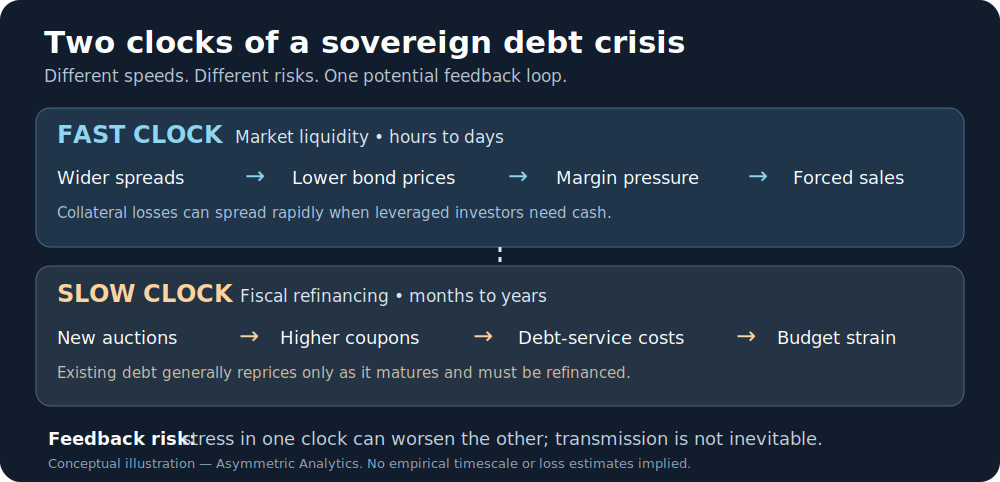
Picture two clocks running in the same room.
The first measures market liquidity. A bond dealer needs a buyer this afternoon. A hedge fund needs additional collateral before the next clearing cycle. A lender changes the terms on which it advances cash against government securities. None of those decisions waits for parliament to pass a budget.
The second measures fiscal solvency. A government issues bonds over years, retires old bonds as they mature, collects taxes and decides how to pay for interest, services and investment. Most of the existing debt does not acquire a new coupon because the ten-year market yield changes on Tuesday.
The danger comes when the clocks interact. Forced selling raises yields now. Higher yields on successive auctions raise future interest costs. A more burdensome budget worsens political and investor expectations, feeding back into yields.
This is a plausible mechanism. It is not yet proof that the full loop is operating.
What actually changed
A French government bond is an OAT: an Obligation assimilable du Trésor. Its yield is the return a buyer can expect from its price and future cash flows. When buyers require a higher yield, the price of a fixed-coupon bond falls.
According to Reuters' October 22 market report, the ten-year OAT–German Bund spread reached 177.7 basis points. That is the extra annualized yield investors demanded to hold French rather than German debt at that moment; one basis point is one-hundredth of one percentage point. The spread measures a difference in yields, not the probability of default.
That distinction matters because several causes can widen a spread: perceived fiscal weakness, inflation expectations, liquidity, hedge demand, position liquidation, and safe-haven buying of Bunds. Calling the entire change a sudden reassessment of default risk would be too simple.
The trading pressure has been amplified by concentrated positions. Bloomberg reported an October 2 unwind in crowded French asset-swap trades, while Reuters examined the role of hedge funds in European sovereign bond markets. Those accounts help explain a possible mechanism. The scale of private trading losses and the identity of any forced sellers have not been established by public position-level data.
The plumbing: how a safe asset becomes an unstable trade
A repo, short for repurchase agreement, lets an investor obtain short-term cash by selling securities with an agreement to repurchase them later. Economically, the securities act as collateral for financing.
A fund can buy OATs, fund a large proportion through repos and earn the difference between bond income and its financing costs. Those gains may look small, but leverage magnifies returns on the fund's own equity.
Consider an illustrative scenario, not a report of any real fund.
The fund buys €100 million in bonds and finances €90 million with repo borrowing.
It has only €10 million of its own equity supporting the investment.
Assume the market value of the bonds falls by 7%, while the €90 million financing liability has not changed.
Assets fall to €93 million; equity falls to €3 million. The fund has lost 70% of its original equity.
A rough duration approximation illustrates one route to a price fall: if a bond's modified duration is seven years, a one-percentage-point increase in yield implies approximately a 7% price decline, before convexity and other effects. Duration is the sensitivity of price to a yield move; it is not the bond's maturity.
The same structure also faces haircut risk. The haircut is the fraction of collateral value the repo lender refuses to advance. If a lender moves from financing 90% of a €100 million collateral position to only 85%, the borrower needs €5 million in additional funds even before accounting for market-price changes. In practice repricing, margin calls, collateral eligibility and financing tenor interact.
One more distinction: an asset-swap trade is not necessarily a simple outright leveraged OAT position. It combines the bond with an interest-rate swap and targets relative pricing. And an OAT–Bund relative-value book can be exposed to the French–German spread even if its net exposure to broad rate moves is small. The desk-level evidence must keep those mechanisms separate.
The possibility of a forced sale is what makes a government bond an unusually powerful source of market stress. The asset is supposed to be liquid and dependable; many institutions therefore use it as collateral. If lenders and borrowers simultaneously decide they want less of it, the problem is no longer confined to one trader's performance.
The slow clock: France's refinancing arithmetic
INSEE's September 29 release reports that French Maastricht public debt was €3,595.5 billion, or 119.0% of GDP, at the end of the second quarter. That is general-government debt, a broad statistical measure.
Agence France Trésor's plans concern the central state's cash financing. For 2027, the agency projects €339.7 billion of total state financing need, versus €311.7 billion in the updated 2026 plan, along with an estimated €72.9 billion budgetary debt interest charge. The medium- and long-term issuance plan is another measure—€340 billion net of buybacks—and should not be added to the financing requirement. Mixing these categories can make a crisis look larger than it is.
AFT's September 30 debt register reports that the average life of the French state's negotiable debt was 8 years and 158 days. That is a substantial buffer against instant refinancing shock. A ten-year market yield of 5% does not mean France begins paying 5% immediately on every euro of debt already outstanding.
But the buffer cuts both ways. Because old bonds mature gradually, a persistent increase in rates has time to accumulate through successive budgets. The key variable is not one volatile day's yield: it is the weighted borrowing cost of what France must issue and roll over across multiple years, compared with nominal GDP growth and the primary fiscal balance.
In conventional debt dynamics, the debt-to-GDP ratio tends to face upward pressure when the effective interest rate exceeds nominal growth unless offset by a sufficient primary surplus. That is a mathematical relationship, not a forecast of France's fate.
A critical counterpoint: people are still buying French debt
For this thesis to have credibility, it must include facts that push in the opposite direction.
On October 15, AFT issued €12.0 billion of medium-term OATs across four securities, each with bid-to-cover ratios from roughly 2.23 to 2.32. AFT reported continued demand at auction. Those ratios do not guarantee favorable future auctions or stable secondary liquidity. But they directly contradict the assertion that France is already shut out of markets.
There is another distinction worth teaching. Market liquidity means a bond can be sold promptly without a large price concession. Funding liquidity means its owner can borrow against it on reasonable terms. Sovereign market access means the state itself can sell newly issued bonds. Stress in one can affect the others, but they are not interchangeable.
That is why an alarming hedge-fund departure story should not be reported as a French sovereign default story.
Could the ECB stop a disorderly spiral?
The ECB has instruments designed to preserve the transmission of monetary policy. Its Transmission Protection Instrument (TPI), announced in July 2022, can permit purchases of qualifying public securities in response to unwarranted, disorderly market dynamics. Eligible sovereign issuers are assessed using fiscal and macroeconomic policy and sustainability criteria. France has been under the EU's excessive deficit procedure since July 2024; the Commission's official France case file confirms that its fiscal supervision remains active. That makes ECB support politically and legally more constrained than a simple promise to buy French bonds.
The central word is unwarranted.
If bond yields rise because investors rationally expect weaker public finances and inflation, the ECB cannot simply classify all that repricing as a market malfunction. Its intervention is a policy judgment subject to eligibility, proportionality and competing euro-area objectives. The instrument is not a blanket price floor for OAT holders.
At the same time, the existence of TPI changes the risk landscape from 2011. Market participants know that policymakers have an established instrument and institutional memory of fragmentation. An equilibrium in which investors expect eventual stabilization is possible even without large-scale intervention. Its credibility will depend on the facts and ECB communications, not on editorial certainty.
The European connection: when national bonds become shared collateral risk
France is not a small, isolated bond market. It is a major issuer in a currency union whose banking system and investors hold government bonds across borders.
Our conditional contagion chain is:
French fiscal uncertainty → higher OAT risk premium → bond-price declines → leveraged position unwinds → thinner liquidity and more volatility → repo collateral pressure → bank and investor funding stress → potential restriction of credit and further sovereign repricing.
Each arrow requires observation and evidence. A widening OAT–Bund spread establishes the first market-price steps, not every step of the chain.
There are several possible break points. Real-money investors can step in at higher yields. Funds may voluntarily reduce leverage before lenders demand it. Repo collateral terms may hold up. Banks may hedge their sovereign exposures. ECB communication might stabilize expectations.
The larger European question is whether market stress spreads consistently to Italy, Belgium, Spain or other sovereign borrowers, especially once common energy-price and inflation shocks affect euro yields. A French spread widening can coincide with safe-haven buying of German debt, which exaggerates the relative metric even when absolute borrowing stress varies across countries.
The Japanese connection is different. Yen-funded carry trades involve borrowing or funding in one currency to hold higher-yielding assets elsewhere, taking additional foreign-exchange risk. French repo-funded OAT carry is principally a securities-financing transaction. Japanese institutional portfolios may still transmit shocks through sales or repatriation, but we should not present the two carry trades as the same instrument or presume that such flows have occurred without custody/flow evidence.
Who gains and who pays when sovereign financing gets expensive?
This repricing is also a contest over capital. Existing French OAT holders lose market value when yields rise. Banks, insurers and pension funds carry differing exposures, accounting rules and hedges. New investors may earn higher yields, but take on the market, funding and fiscal risks that come with them.
German Bunds can benefit from safe-haven demand when France's risk premium rises; an inflation shock can push borrowing costs higher across both countries instead. Short-duration liquid assets can become more attractive to investors seeking to reduce interest-rate and collateral exposure. French firms and households face pressure if sovereign stress transmits into bank funding and credit conditions. These are mechanisms and possible beneficiaries, not a claim that we have traced every euro of reallocated capital. A French bond selloff is certainly not evidence that money flows straight into Bitcoin, XRP or tokenized assets.
Our related investigation, Europe's Energy–Debt Trap , shows why the fiscal strain cannot be isolated from energy. Higher fuel and import costs can erode industrial cash flows, complicate inflation control and increase sovereign financing demands simultaneously.
Scenarios rather than a single crisis prediction
Scenario one — disorderly but contained repricing. Leveraged rates desks reduce positions, liquid investors return at higher yields, repo financing stays available, and upcoming state auctions clear with manageable demand. France retains a higher risk premium, but trading losses do not become a banking crisis. This is consistent with the successful October 15 auction and deserves serious weight.
Scenario two — persistent fiscal squeeze. Higher yields endure while growth is weak, debt-service charges continue rising as old obligations mature, and political coalitions struggle to implement a durable budget. No dramatic funding seizure is necessary for this to erode economic policy options. This is arguably the more durable risk.
Scenario three — collateral and credit contagion. Liquidity deteriorates, repo haircuts increase or securities become harder to finance, multiple leveraged positions liquidate in tandem, and bank financing conditions tighten. This is the outcome that would turn a hedge-fund story into a system-wide problem. It is the scenario to test, not pronounce inevitable.
There are two separate calculations to keep in view: the immediate equity loss on a leveraged bond trade and the future interest burden as the French government refinances its debt. Combining them into one dramatic figure would hide the time lag that makes this story important.
What would change our view?
The most important data are less theatrical than the headlines. We would become more concerned if AFT auctions began to require notably larger concessions, if bid coverage and market depth degraded together, if repo rates or haircuts showed specific OAT funding discrimination, and if bank funding spreads widened with sovereign stress. Confirmation of fiscal slippage and weak nominal growth would raise the long-horizon risk.
We would become less concerned if auctions remained comfortably covered, repo markets continued functioning, spreads stabilized without emergency buying, fiscal plans became credible, and energy prices stopped contributing to persistent inflation.
A downgrade is a possible catalyst, not automatically a financing prohibition. Ratings, collateral criteria and internal risk limits differ across institutions; any claim of a cliff must document the relevant actual rule.
The conclusion
A sovereign-debt trap is not simply a big debt number. It is a set of reinforcing pressures: financing costs, growth, budget politics and market functioning turning adverse at the same time.
What France has shown this month is that the market's leverage clock can move much faster than the government's fiscal clock. That is the asymmetric insight worth following. It also imposes an editorial duty: do not mistake a forced seller for a defaulting sovereign, or a government still selling bonds for a system without vulnerabilities.
Watch the next sovereign auctions, OAT repo financing terms and European bank funding spreads. They will reveal whether the two clocks are beginning to synchronize.
Primary evidence and reported market sources
INSEE — Q2 2026 Maastricht debt , September 29, 2026.
European Commission — France excessive deficit procedure , official ongoing EDP case file.
AFT — September 30 2026 debt maturity data , official 8 years and 158 days figure.
Agence France Trésor — 2027 budget and state financing , September 2026 plans.
AFT — French negotiable debt average maturity and key figures , figures through September 30, 2026.
AFT — October 15 OAT issuance , official primary auction results.
AFT — official latest auction table .
ECB — Transmission Protection Instrument , July 2022, official criteria.
ECB — benefits and costs of asset purchases , May 2024, policy history and conditionality.
Reuters — OAT/Bund October 22 market report , attributed secondary market data, not a primary official series.
French Ministry of the Economy — Moody's Aa3 negative decision, October 23 , primary government response to the rating action.
Reuters — hedge funds' European sovereign trading role , October 16, attributed market reporting.
Bloomberg — French asset-swap unwind , October 2; secondary desk-positioning reporting.
Places in this story






France, Germany, Italy, Belgium, Spain
Made with Natural Earth