The Great Capital Collision: Who Will Finance the World?
By Asymmetric Analytics
Analysis
The next financial contest is not between artificial intelligence and cryptocurrency. It is between competing uses of capital—and between the institutions capable of financing them.
In 2026, three enormous demands are arriving at the same financial market. Technology companies want power plants, chips, data centers and networks. Governments must refinance debt and fund commitments. Meanwhile, a new financial architecture promises to move money and collateral through tokenized instruments and dollar-backed stablecoins.
These demands do not draw from a fixed pile of dollars. Banks can extend credit, companies can retain earnings, and markets can create new financing instruments. But balance-sheet capacity has a price. When lenders demand more return or more collateral, capital becomes selective. The decisive question is no longer whether an industry has a compelling story. It is whether its future cash flows, legal claims and liquidity can sustain the financing it requires.
October's market movements have been described as a great rotation out of artificial intelligence and into a new financial system. The evidence supports a more demanding conclusion: capital is becoming more discriminating, but there is no established trail showing AI-stock sale proceeds flowing into Bitcoin, Ether, XRP or tokenized finance. That is not a dismissal of digital finance. It is the distinction that allows us to see its real opportunity.
Brief
The largest AI platforms continue to spend extraordinary sums on physical infrastructure. The corporate filings and earnings releases make that visible even as markets debate whether future profits will justify the investment.
At the same time, high Treasury yields impose a real hurdle on ambitious projects. The U.S. ten-year yield reached 4.96% on October 22 , the low of that week, before returning to 5.00% on October 23 and 26; the two-year yield was 4.65% on October 22 . An investor could earn a substantial nominal return without financing an unproven business model.
The data do not show a straightforward migration from AI shares to crypto. In two completed trading weeks in early October, the Bitcoin and Ether ETF flow trackers recorded net redemptions, not a sustained new funding wave.
Our thesis is that the coming competition for capital will produce several winners under different conditions: productive AI businesses, reliable short-duration assets, selected real-world infrastructure, and digital settlement systems with demonstrated demand. Those winners will not necessarily include every token associated with a successful network.
Standard: Three claims on the next dollar
A sovereign bond asks investors to trust a government's future taxation, refinancing capacity and monetary institutions. A data center asks investors to believe its revenues and productivity improvements will exceed the cost of land, energy, hardware and funding. A tokenized bill or dollar stablecoin changes the representation, transfer or custody of a financial claim. It does not automatically create new economic savings.
That difference matters because investors can finance all three through very different balance sheets. A money-market investor may buy a Treasury bill; a profitable platform may build a data center from operating cash flow; a stablecoin issuer may buy that same category of bill against a newly issued dollar liability. Counting these as three separate pools of newly created economic wealth would be a mistake.
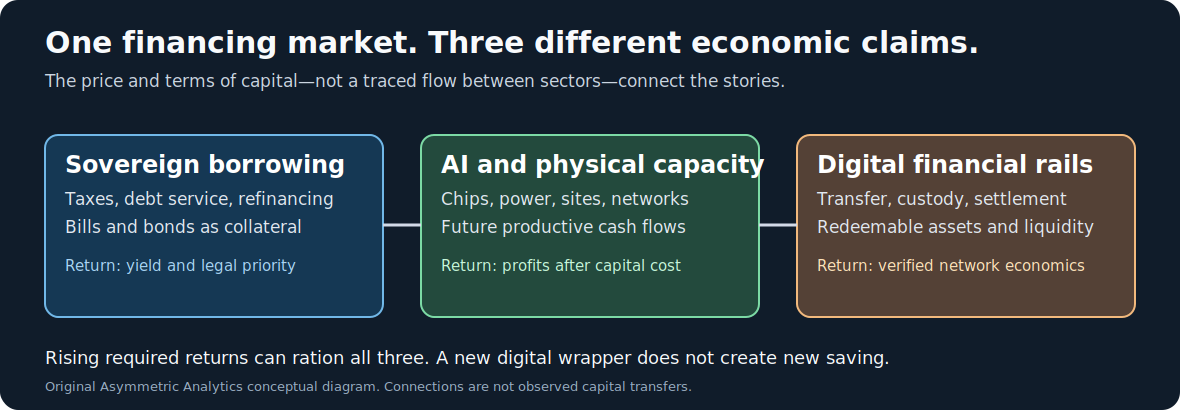
The collision is therefore primarily about the terms on which marginal funding is available. Higher rates can encourage short-duration saving and penalize long-payback projects. Lower rates may revive duration-sensitive assets, but a collapse in credit confidence can overwhelm the benefit. Tokenization can reduce operational friction while leaving the underlying borrower, credit quality and collateral requirements intact.
This extends our earlier investigation, *When AI Reprices Money* . That essay asked what AI capital demand does to the cost of money. Here the question is what investors actually choose when several immense sectors compete for that money—and how to tell a true rotation from a change in relative prices.
Detailed investigation
### 1. AI's capital spending is real. So is the burden of earning it back.
The distinction between narrative and expenditure begins in corporate reports. Amazon disclosed about $53.1 billion in second-quarter 2026 cash capital investment, versus $31.4 billion a year earlier; its first-half total was roughly $96.3 billion, versus $55.6 billion. Amazon's cash-capital-investment measure is net of certain asset-sale proceeds and incentives, rather than the gross purchases-of-property line. The amounts are company-wide, not a separate audited measure of AI-only investment. Amazon SEC filing .
Alphabet reported first-half purchases of property and equipment of approximately $80.6 billion, versus $39.6 billion in the comparable 2025 period. Alphabet SEC filing .
Meta's nine-month 2026 property purchases were approximately $83.1 billion, versus $48.3 billion a year earlier. Those are cash purchases; adding lease-inclusive guidance to those cash figures would mix definitions. Meta SEC filing . Microsoft's June quarter reported about $35.8 billion in cash property additions, versus $17.1 billion a year earlier. A broader capex figure including leases answers a different accounting question. Microsoft earnings .
The financing distinction is already visible in the same filings. Alphabet generated $84.9 billion of operating cash in the first half of 2026 against $80.6 billion of cash property purchases; Meta generated $96.9 billion of operating cash over nine months against $83.1 billion of property purchases. Amazon's own reconciliation shows a different pressure point: trailing-twelve-month free cash flow of negative $7.6 billion at June 30, 2026, versus positive $18.2 billion a year earlier, despite stronger operating cash generation ( Amazon's July 30, 2026 earnings release ). These periods and company definitions are not identical, but they show the difference between paying for infrastructure from current operations and absorbing an investment surge on the balance sheet. Those investment sums are extraordinary. So are the opportunities they are financing. An investor who totals the cost of constructing the AI economy but undervalues the economic activity that infrastructure will enable may misunderstand both sides of the investment. More abundant computation can reduce the cost of producing software, accelerate research, change how businesses operate and make products possible that do not exist today. The value created can extend well beyond the companies that own the data centers, flowing to their customers and ultimately to the wider economy.
The central analytical question is therefore not simply how much the AI builders spend, but how much new economic value their infrastructure enables—and how much of that value the builders can capture. Revenue growth, infrastructure utilization, the cost per unit of useful computation, customers' realized productivity and incremental operating cash flow will tell us more than an isolated negative free-cash-flow figure. Construction spending can depress today's free cash flow while financing an immensely valuable future asset. It can also disappoint if utilization, pricing or competitive returns fall short. Share prices can fall even while construction continues; a secondary-market repricing does not undo committed physical investment.
This is also why treating a technology selloff as an immediate withdrawal of funding from the real AI economy can mislead. A secondary-market stock sale ordinarily transfers shares from one holder to another. It does not retrieve the cash already spent building servers.
### 2. Higher safe yields change the hurdle, not the laws of economics.
The ten-year Treasury yield of 4.96% on October 22 was a one-day low amid a higher-rate week; it returned to 5.00% on October 23 and 26. Those yields did not make all private investment unattractive. They raised the return a competing risky project needed to offer. Long-duration ventures, leveraged holders and companies whose profits lie years in the future are especially sensitive to that comparison.
BlackRock Investment Institute's published October 2026 tactical view was neutral on U.S. equities, overweight short U.S. Treasuries, and selective about AI and technology opportunities. That is a useful expression of risk management, not proof that BlackRock itself liquidated AI exposure to buy Bitcoin or that every institutional manager followed.
There is a healthy interpretation: expensive capital forces weak projects to improve or stop, while cash-rich firms finance the strongest opportunities. There is also a destabilizing interpretation: rising refinancing costs expose leverage, force collateral sales and raise funding costs further. Our France sovereign-debt investigation illustrates how a fast leveraged trading unwind can intersect with a much slower public-debt refinancing problem.
The indicators that would distinguish the scenarios are not one day's sector returns. They are financing issuance, credit spreads, new project commitments, refinancing terms, realized earnings and the persistence of investor subscriptions.
### 3. A defensive rotation is not automatically a crypto rotation.
Our three-part October investigation compared corporate funding, digital-asset flows and the skeptical countercase. It established no trail of proceeds moving from AI-equity sales into crypto, and its retained evidence does not independently validate a sector-by-sector relative-return claim.
The clearest friction comes from funds, rather than headlines. In the trading week October 5–9, the original Farside Bitcoin ETF table yielded roughly $678.9 million of net outflows and its Ether table approximately $542.2 million of net outflows in the research team's contemporaneous compilation. For October 12–16, the compiled numbers were approximately $228.4 million of net Bitcoin redemptions and $320.1 million of Ether redemptions.
The following four trading sessions, October 19–22, were more mixed: the research team's retained daily Farside compilation recorded approximately $439.1 million of net Bitcoin ETF inflows but $225.1 million of net Ether ETF outflows. That is not a completed October 19–23 weekly tally. Together these observations rule out casually describing October as a continuous ETF-funded migration into crypto; neither the early outflows nor the later partial-week Bitcoin inflows identify who sold AI shares.
Nor can a short price correlation trace an investor's funding source. A selloff in AI shares and a rise in a defensive equity sector may occur while both groups of investors maintain their positions. Conversely, Bitcoin can move with other risk assets even while a subset of investors rotates into it. Proving an actual transfer requires evidence of net funding and exposure, not an arrow drawn between two price charts.
The useful implication is counterintuitive: a great capital rotation may happen eventually, but we should not need to believe in one to evaluate the investments that benefit from changing money and collateral.
### 4. Digital finance has three different businesses hiding under one label.
The monetary-asset proposition. Bitcoin offers a specified issuance schedule and a globally traded monetary asset. Its possible value under monetary expansion, fiscal distrust or financial repression is different from its short-run behavior in a leveraged market selloff. If an investor must sell liquid holdings to meet collateral calls, scarcity does not prevent the sale.
The settlement-and-collateral proposition. Tokenized government debt, deposits and securities may reduce transfer friction and expand operational availability. But the investor still needs to know who owes the underlying claim, what happens on insolvency, who can redeem it and whether the settlement venue has access to credible money. A token representing a Treasury bill remains economically exposed to that bill.
The native-network-asset proposition. Ethereum, the XRP Ledger and other networks can grow activity without creating proportional demand for ETH or XRP holdings. The question is the required economic capital: balances intermediaries must actually retain, fees paid, collateral locked, capacity secured and economic rents captured by the native asset rather than an intermediary. On XRPL, the standard minimum transaction fee is measured in tiny fractions of XRP. Fee destruction by itself is not a valuation model.
This distinction also explains why a growing stablecoin market is not synonymous with broad token appreciation. Circle discloses USDC circulation and reserves ; Ripple separately discloses RLUSD circulation and reserve information . These are claims on dollars supported by backing assets. They are not purchases of every native token whose network may handle them.
### 5. Stablecoins can finance Treasuries—and still displace other Treasury buyers.
Dollar-backed stablecoins may create additional demand for short Treasury bills. The San Francisco Fed's September 2026 analysis documents the growing reserve holdings and explains why the benefit depends on the mix of new and existing Treasury investors. New users seeking dollar claims may add to Treasury demand; savers merely changing from an existing Treasury-backed instrument may not.
The Treasury Borrowing Advisory Committee's April 30, 2025 report for the May refunding cycle made the mechanism explicit: new demand from previously unbanked users could help bills, while substitution out of money-market funds could be largely neutral and movement out of bank deposits could affect bank credit. In its July 2025 report , the committee acknowledged those offsets but was broadly optimistic about fresh short-bill demand. The government's net financing benefit therefore depends on who funds stablecoin issuance, not just the issuer's gross purchases.
The deeper development is not simply that digital finance 'replaces the dollar.' It may extend the dollar's reach into new payment channels while reordering bank deposits, collateral demands, monetary control and who earns the spread.
### 6. Who wins the capital collision?
Short Treasuries and liquid collateral benefit when investors prefer reliable near-term claims and when lenders demand stronger security. The trade-off is reinvestment risk if policy rates subsequently fall.
Profitable AI platforms and infrastructure suppliers can thrive if newly installed systems earn more than their full capital cost. Weak competitors and marginal projects can be squeezed even while total industry investment remains high.
Energy, transmission and physical capacity may gain bargaining power wherever power and construction, not compute algorithms, are the binding inputs. The beneficiaries depend on pricing arrangements and the ability to expand supply rather than on a vague 'AI infrastructure' label.
Bitcoin could benefit from future liquidity expansion or a changed monetary-confidence regime, yet perform poorly during a margin-call phase. These two outcomes are not contradictory; they correspond to different stages of a financial cycle.
ETH, XRP and other network assets require proof that real adoption produces persistent native-asset inventory demand, security economics or fees that matter relative to outstanding supply. A successful dollar stablecoin or tokenized Treasury platform does not answer that question on its own.
Sovereign borrowers can gain a deeper market for short bills while still facing longer-term fiscal pressures. Cheaper settlement is not the same as cheaper long-dated refinancing.
### 7. Three paths—and the evidence that would change our minds
The productive-investment path. AI investment begins generating durable revenues and measurable productivity. Credit remains available, high-quality businesses defend margins, and rates need not fall dramatically. Financial networks benefit where they demonstrably save time, collateral or transaction costs. This path weakens a simple bubble-to-crypto-rotation thesis.
The financing-squeeze path. High real borrowing costs and tightening private credit expose leveraged projects. Investors favor liquidity and short-duration assets. Correlated forced sales can hurt both equities and crypto before monetary authorities respond. We would look for widening financing spreads, cancelled capex, deteriorating cash flows and persistent fund redemptions.
The monetary-response path. Financial stress eventually brings easier policy or stronger fiscal support. Risk assets may recover, with digital assets potentially benefiting if liquidity and actual demand follow. But easing during a deep economic downturn is not a guarantee of immediate asset appreciation. The decisive data are subsequent funding conditions, net subscriptions, market depth and real network usage.
Our standing test for the strongest version of the rotation thesis is demanding and specific: show sustained, independently reconciled capital moving out of defined AI exposures and into defined digital-asset exposures, with the holding entities, dates and funding mechanism identified. Show separately that adoption of new settlement rails requires more native-token economic capital. Until then, speak of competing possibilities rather than a completed migration.
What we are watching
The dashboard should connect corporate investment to actual funding, not to promotional forecasts: new SEC filings, financing terms and free-cash-flow yield; Treasury nominal and real yields; short-term collateral prices; credit spreads; institutional fund net subscriptions by asset class; spot ETF creations and redemptions; stablecoin net issuance by consistent definition; tokenized collateral with legal redemption rights; and measured token holdings required for settlement or security.
These observations will not always agree. That is precisely their value. A market can reward a stablecoin issuer, a bank offering tokenized deposits, a Treasury-bill holder and an AI infrastructure builder for different reasons at the same time.
The result may not be one grand transfer of wealth from yesterday's technology to tomorrow's coins. It may be a more consequential sorting process: capital will reward the institutions that turn promises into cash flows, collateral and enforceable claims. The cost of funding—and who can bear it—will decide the order.
Evidence and reading
Amazon second-quarter 2026 SEC filing and issuer earnings release , Alphabet second-quarter 2026 SEC filing ,
Meta third-quarter 2026 SEC filing , and Microsoft fiscal 2026 fourth-quarter results .
Federal Reserve ten-year and two-year Treasury observations; October 22 data used above.
BlackRock Investment Institute , October 2026 tactical positions; the page updates over time, so this edition makes no unsupported claim about a dated change in stance.
Farside Bitcoin and Ether daily ETF flow compilations retained by the investigation team; two complete early-October weeks and the four October 19–22 sessions compared without inventing an October 23 result.
Treasury Borrowing Advisory Committee April 30, 2025 report and July 2025 discussions, plus September 2026 San Francisco Fed research , on incremental versus displaced Treasury demand.
Circle USDC transparency , Ripple RLUSD transparency and XRPL transaction cost documentation .