Taiwan
Updated
Summary
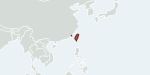
Taiwan is a self-governed island democracy that Beijing claims as its territory. It is home to TSMC, whose 7-nanometer-and-smaller processes made up 79% of its own Q3 2026 wafer revenue. Computers and integrated circuits were about two-thirds of its exports in January-August 2026. The central bank expects 11.48% GDP growth in 2026. China runs frequent military activity around the island -- MND tracked 9 PLA aircraft sorties crossing the median line in 24 hours on 2026-10-14 alone -- and Taiwan's 2026 defence budget is 3.32% of GDP.
Key numbers
TSMC Q3 2026 revenue (growth y/y in US$): US$46.72 billion (+41.2%); NT$1,494.24 billion (+50.9%) (as of 2026-09-30). Source: pr.tsmc.com
TSMC Q4 2026 guidance: revenue / gross margin: US$52.3-54.3 billion / 65-67% (as of 2026-10-15). Source: pr.tsmc.com
TSMC wafer revenue from 7nm and below (2nm share): 79% (2nm 8%) (as of 2026-09-30). Source: pr.tsmc.com
Exports, September 2026 (y/y); trade surplus: US$87.22 billion (+60.9%); US$23.63 billion (as of 2026-09-30). Source: mof.gov.tw
Export share, Jan-Aug 2026: computers / integrated circuits: 33.5% / 33.1% (ICs: 48.4% to China and Hong Kong) (as of 2026-08-31). Source: service.mof.gov.tw
2025 exports; share to US vs China and Hong Kong: US$640.7 billion (+34.9%); 30.9% vs 26.6% (as of 2025-12-31). Source: service.mof.gov.tw
Central bank GDP forecast 2026 / 2027; 2026 CPI: 11.48% / 5.82%; 2.03% (as of 2026-09-17). Source: cbc.gov.tw
Central bank discount rate: 2% (unchanged) (as of 2026-09-17). Source: cbc.gov.tw
Foreign exchange reserves: US$600.75 billion (as of 2026-09-30). Source: cbc.gov.tw
Total national defence budget 2026 (NATO standard): NT$949.5 billion; 3.32% of GDP (as of 2025-10-01). Source: mnd.gov.tw
Special defence budget: proposed vs Legislature cap: NT$1.25 trillion (2026-2033) vs NT$780 billion (as of 2026-05-14). Source: english.ey.gov.tw
U.S. tariff cap on Taiwan goods; Taiwan investment pledge: 15%; US$250 billion direct + US$250 billion credit guarantees (as of 2026-01-15). Source: commerce.gov
Timeline
2026-10-15 — TSMC reports Q3 revenue of US$46.72 billion (+41.2% y/y) and guides Q4 to US$52.3-54.3 billion. (Source: pr.tsmc.com)
2026-10-14 — MND reports 9 PLA aircraft sorties, all crossing the median line, plus 6 navy and 6 official ships in 24 hours. (Source: air.mnd.gov.tw)
2026-10-10 — President Lai's National Day Address cites 14.15% first-half growth and continued Chinese military pressure. (Source: english.president.gov.tw)
2026-10-08 — MOF reports September exports up 60.9% to US$87.22 billion. (Source: mof.gov.tw)
2026-10-05 — Central bank reports FX reserves of US$600.75 billion, citing intervention to smooth volatile capital flows. (Source: cbc.gov.tw)
2026-09-17 — Central bank holds the discount rate at 2%, raises its 2026 growth forecast to 11.48% and eases a housing-loan cap. (Source: cbc.gov.tw)
2026-05-28 — U.S. notice implements the MOU's 15% Section 232 caps on Taiwanese auto parts and wood. (Source: federalregister.gov)
2026-05-14 — Legislature caps the special defence budget at NT$780 billion and excludes drones. (Source: english.ey.gov.tw)
2026-04-30 — Executive Yuan sets out a NT$1.25 trillion 2026-2033 special defence budget, including T-Dome air defence. (Source: english.ey.gov.tw)
2026-02-12 — Taiwan and the U.S. sign the Agreement on Reciprocal Trade in Washington; it goes to the Legislative Yuan for review. (Source: english.ey.gov.tw)
2026-01-15 — U.S.-Taiwan MOU: 15% tariff cap, preferential chip treatment, US$250 billion investment plus US$250 billion guarantees. (Source: commerce.gov)
2026-01-14 — U.S. imposes a 25% Section 232 duty on certain advanced computing chips and signals broader chip tariffs may follow. (Source: whitehouse.gov)
2025-12-29 — MOFA condemns the PLA Eastern Theater Command's 'Justice Mission 2025' joint exercise, announced for around Taiwan on 2025-12-30. (Source: en.mofa.gov.tw)
2025-10-01 — MND publishes a 2026 defence budget of NT$949.5 billion, 3.32% of GDP. (Source: mnd.gov.tw)
2025-04-01 — China's Eastern Theater Command holds joint drills around Taiwan; MOFA condemns them. (Source: en.mofa.gov.tw)
Key actors and links
China (country:china): Claims Taiwan and runs recurring military drills and air and sea activity around it -- 9 PLA aircraft sorties in 24 hours on 2026-10-14 alone -- and takes 48.4% of Taiwan's integrated-circuit exports (with Hong Kong).
United States (country:united-states): Largest export market (30.9% in 2025); agreed Taiwan's tariff terms via the January 2026 MOU's 15% cap and Section 232 chip treatment, with the broader Agreement on Reciprocal Trade still pending Legislative Yuan review.
US-China AI (theme:us-china-ai-competition): Taiwan's servers go mostly to the U.S., its ICs mostly to China and Hong Kong.
AI productivity (theme:ai-productivity): The central bank ties Taiwan's export surge since July 2026 to AI and other emerging technology demand.
NVIDIA (actor:nvidia): Inference (AA): a major AI-chip designer whose accelerators rely on Taiwan's foundries; TSMC does not disclose customer shares in its Q3 release.
Equities (market:equities): TSMC results and Taiwan export data are read as a gauge of the AI hardware cycle; the TAIEX rose above 49,000 in 2026.
Corporate earnings (indicator:corporate-earnings): TSMC's Q3 2026 net income rose 68.7% y/y; its Q4 guidance is a key AI-supply-chain earnings signal.
Trade fragmentation / tariffs (theme:trade-fragmentation): U.S. Section 232 chip tariffs and the U.S.-Taiwan deal tie Taiwan's tariff rate to chip investment in the U.S.
US dollar (asset:usd): TSMC guides at NT$31.8 per dollar; the central bank smooths capital flows with US$600.75 billion of reserves.
Federal Reserve (actor:federal-reserve): Taiwan's central bank cites U.S. policy shifts, including the Fed, as an uncertainty in its 2026-09-17 decision.
Geopolitical fragmentation (theme:geopolitical-fragmentation): Inference (AA): Taiwan sits on the U.S.-China fault line; a cross-strait crisis would hit chip supply worldwide.
Defense Industrial Base (concept:defense-industrial-base): Taiwan's special budget aims to build a domestic drone and defence industry; the Legislature excluded drones in May 2026.
Netherlands (Kingdom of the) (country:netherlands-kingdom-of-the): Inference (AA): home of ASML, whose lithography tools leading-edge fabs such as TSMC's depend on.
Why it matters now
AI data-center demand is flowing straight through Taiwan's data. The central bank says exports rose sharply from July on AI and other new technology demand. September exports rose 60.9% to US$87.22 billion. TSMC's Q3 revenue rose 41.2% in US dollars, and it guided Q4 to US$52.3-54.3 billion. About 63% of Taiwan's computer exports go to the U.S., while 48% of its integrated-circuit exports go to China and Hong Kong.
Trade policy and security set the risk around that boom. In January 2026 the U.S. put a 25% Section 232 tariff on certain advanced computing chips and warned broader chip tariffs may follow. Taiwan agreed to a 15% tariff cap and preferential chip treatment in a January 2026 MOU, in return for at least US$250 billion of U.S. investment plus US$250 billion of credit guarantees; the Federal Register's May 2026 notice implementing the MOU's tariff elements covers only auto parts and wood products, contains no semiconductor tariff provisions, and states the broader Agreement on Reciprocal Trade had not yet entered force as of 2026-05-28. China announced the 'Justice Mission 2025' drill for 2025-12-30, which MOFA condemned in advance, and nine PLA aircraft crossed the median line on 2026-10-14 alone. At home, the Legislature capped a NT$1.25 trillion special defence budget at NT$780 billion. Inference (AA): the mechanism is that Taiwan's growth rests on concentrated chip output, which depends on U.S. tariff terms and cross-strait calm.
Risks and open questions
Bull case: AI demand keeps lifting Taiwan's exports and TSMC's sales. The central bank expects 11.48% growth in 2026 and 5.82% in 2027, with CPI near 2%. TSMC guided Q4 revenue higher and margins at 65-67% even as 2nm ramps. The January 2026 U.S.-Taiwan MOU sets a 15% tariff cap and preferential Section 232 chip treatment, though the broader Agreement on Reciprocal Trade had not yet entered force as of 2026-05-28. FX reserves of US$600.75 billion give the central bank room to smooth capital flows.
Bear case: The boom is narrow: computers and ICs are about two-thirds of exports, so an AI capex pause would hit trade and GDP fast. Broader U.S. chip tariffs remain possible, and the trade agreement still awaits legislative review. The US$250 billion investment pledge could shift future capacity offshore. PLA activity around Taiwan recurs frequently and large drills recur. The Legislature cut the special defence budget by NT$470 billion, which could strain readiness and U.S. ties. Inference (AA): a blockade would disrupt chip supply to the rest of the world.
Falsifiers: - Bull weakens if Taiwan's monthly exports turn negative year on year while U.S. AI capex is still rising. - Bull weakens if TSMC cuts its Q4 range or gross margin falls below 65%. - Bull weakens if the U.S. imposes broad Section 232 chip tariffs that do not honour Taiwan's preferential terms. - Bear weakens if the Legislative Yuan approves the trade agreement and restores defence funding without a political crisis. - Bear on security strengthens if the PLA moves from one-day drills to a sustained exercise or inspection regime around Taiwan.
What to watch
Central bank FX reserves release for October (watch intervention language). (2026-11-05); Source: cbc.gov.tw
Central bank quarterly policy meeting: rate decision and updated 2026-27 growth forecasts. (2026-12-17); Source: cbc.gov.tw
MOF October trade data: does AI-led export growth hold above 50% y/y? (early November 2026 (September data came on 2026-10-08)); Source: mof.gov.tw
Legislative Yuan review of the U.S.-Taiwan Agreement on Reciprocal Trade and investment MOU. (no scheduled date); Source: english.ey.gov.tw
Possible U.S. second-phase Section 232 semiconductor tariffs and how Taiwan's preferential terms apply. (no scheduled date); Source: whitehouse.gov
Government follow-up on defence items the Legislature cut: a new special bill, supplementary budget or larger annual budget. (no scheduled date); Source: english.ey.gov.tw
TSMC October revenue against its US$52.3-54.3 billion Q4 range. (around 2026-11-10); speculative, no scheduled source
DGBAS advance Q3 2026 GDP estimate and any change to the 2026 growth outlook. (late October 2026); speculative, no scheduled source
AA inference
Inference (AA): Taiwan is the graph's choke point between AI demand and AI supply. U.S. AI spending becomes TSMC revenue, Taiwanese exports and GDP growth, so Taiwan shows the AI capex cycle first in hard data. The same concentration makes it the largest geopolitical tail risk for AI equities: a blockade, a tariff shock or a defence-budget crisis would hit chip supply before demand. AA reads Taiwan's export and TSMC revenue data as an early gauge of AI capex, not proof of AI returns. The thesis weakens if Taiwan's exports slow while U.S. AI capex holds.
Sources
TSMC reported Q3 2026 revenue of NT$1,494.24 billion (US$46.72 billion), up 50.9% year on year in NT dollars and 41.2% in US dollars; net income NT$763.06 billion (+68.7%); diluted EPS NT$29.43 (US$4.60 per ADR); gross margin 66.4%, operating margin 58.7% (TSMC, 2026-10-15). (Source: pr.tsmc.com, accessed 2026-10-16)
In Q3 2026, 2nm was 8%, 3nm 33%, 5nm 28% and 7nm 10% of TSMC wafer revenue; 7nm and below made up 79%. TSMC guided Q4 2026 revenue to US$52.3-54.3 billion, gross margin 65-67% and operating margin 56.5-58.5%, assuming US$1 = NT$31.8. (Source: pr.tsmc.com, accessed 2026-10-16)
Taiwan's September 2026 exports rose 60.9% year on year to US$87.22 billion; imports rose 51.7% to US$63.59 billion; the trade surplus was US$23.63 billion (Ministry of Finance, released 2026-10-08). (Source: mof.gov.tw, accessed 2026-10-16)
In 2025 Taiwan's exports were US$640.7 billion (+34.9%); exports to the US were US$198.3 billion (+78.0%), 30.9% of the total, versus 26.6% for mainland China and Hong Kong; ICT and audio-video products were 39.2% of exports and electronic parts 34.8% (MOF, 2026-02-23). (Source: service.mof.gov.tw, accessed 2026-10-16)
In January-August 2026, automatic data processing machines were 33.5% of Taiwan's exports (US$192.6 billion, +87.5%, 62.8% to the US) and electronic integrated circuits 33.1% (US$190.3 billion, +47.5%, 48.4% to China and Hong Kong, 4.3% to the US) (MOF Statistical Bulletin No. 15, 2026-09-17). (Source: service.mof.gov.tw, accessed 2026-10-16)
On 2026-09-17 the Central Bank of the Republic of China (Taiwan) held its discount rate at 2%, raised its 2026 GDP growth forecast to 11.48% (5.82% for 2027), forecast 2026 CPI at 2.03%, said exports grew significantly from July on AI and other emerging technology demand, named shifting U.S. economic and trade policy as an uncertainty, and raised the LTV cap on second home loans from 60% to 70%. (Source: cbc.gov.tw, accessed 2026-10-16)
Taiwan's foreign exchange reserves were US$600.75 billion at end-September 2026, down US$1.15 billion in the month; the central bank cited intervention to smooth volatile capital flows among the factors. The next release is scheduled for 2026-11-05. (Source: cbc.gov.tw, accessed 2026-10-16)
The central bank's 2026 monetary policy meetings are scheduled for March 19, June 18, September 17 and December 17 (provisional). (Source: cbc.gov.tw, accessed 2026-10-16)
In his 2026-10-10 National Day Address, President Lai said first-half 2026 growth was 14.15%, full-year growth could exceed 11% (a 39-year high), per capita GDP is projected at US$45,332, the TAIEX rose above 49,000, and 'China continues to apply pressure through military and gray-zone activities.' (Source: english.president.gov.tw, accessed 2026-10-16)
Taiwan's total 2026 national defence budget (NATO-standard, including coast guard and veterans' pensions) is NT$949.5 billion, or 3.32% of GDP; the MND budget is NT$806 billion, up 25% from 2025; MND aims to keep defence spending at or above 3% of GDP (MND, issued 2025-10-01). (Source: mnd.gov.tw, accessed 2026-10-16)
The Executive Yuan's special defence budget proposal is NT$1.25 trillion over 2026-2033, funding the 'T-Dome' air and missile defence system, an AI-integrated kill chain, drones and Taiwan-U.S. cooperation (Executive Yuan, 2026-04-30). (Source: english.ey.gov.tw, accessed 2026-10-16)
The Legislative Yuan capped the special defence budget at NT$780 billion for U.S. arms procurement and excluded commercial purchases and commissioned production, including drones; Premier Cho Jung-tai said the cuts 'will seriously undermine the integrity of military force development' (Executive Yuan, 2026-05-14). (Source: english.ey.gov.tw, accessed 2026-10-16)
On 2026-01-14 the U.S. President imposed a 25% Section 232 duty on certain advanced computing chips, effective 2026-01-15, with exemptions including U.S. data-center use, and said broader 'significant' semiconductor tariffs may follow depending on negotiations. (Source: whitehouse.gov, accessed 2026-10-16)
Under the 2026-01-15 U.S.-Taiwan agreement, Taiwanese firms will invest at least US$250 billion directly in U.S. semiconductor, energy and AI production, Taiwan will provide at least US$250 billion of credit guarantees, the U.S. reciprocal tariff on Taiwan is capped at 15%, and firms building U.S. chip capacity may import up to 2.5 times that capacity free of Section 232 duties during construction (U.S. Commerce). (Source: commerce.gov, accessed 2026-10-16)
Under the U.S.-Taiwan Agreement on Reciprocal Trade, the U.S. applies the higher of MFN or 15% to Taiwan goods; Taiwan commits to buy US$44.4 billion of LNG and crude, US$15.2 billion of civil aircraft and US$25.2 billion of power and other equipment over 2025-2029 and to remove or cut 99% of tariff barriers (USTR, February 2026). (Source: ustr.gov, accessed 2026-10-16)
The Agreement on Reciprocal Trade was signed in Washington on 2026-02-12; the Executive Yuan said it would submit it, with the investment MOU, to the Legislative Yuan for deliberation. (Source: english.ey.gov.tw, accessed 2026-10-16)
A Federal Register notice published 2026-05-28 implemented the January MOU's tariff elements (15% cap on Section 232 duties for Taiwanese auto parts and wood products; aircraft-component relief) for goods entered from 2026-05-01; it contains no semiconductor tariff provisions and states the Agreement on Reciprocal Trade had not yet entered into force. (Source: federalregister.gov, accessed 2026-10-16)
In the 24 hours to 06:00 Taiwan time on 2026-10-14, Taiwan's MND tracked 9 PLA aircraft sorties, all of which crossed the median line and entered Taiwan's ADIZ, plus 6 PLA Navy ships and 6 official ships. (Source: air.mnd.gov.tw, accessed 2026-10-16)
On 2025-12-29 Taiwan's MOFA condemned 'Justice Mission 2025', a joint exercise announced by the PLA Eastern Theater Command to be held around Taiwan on 2025-12-30, saying it could affect global shipping and trade. (Source: en.mofa.gov.tw, accessed 2026-10-16)
MOFA reported on 2026-01-02 that the U.S. State Department said China's military activities around Taiwan 'increased tensions unnecessarily' and urged Beijing to show restraint. (Source: en.mofa.gov.tw, accessed 2026-10-16)
On 2025-04-01 MOFA condemned joint military drills held around Taiwan that day by China's Eastern Theater Command. (Source: en.mofa.gov.tw, accessed 2026-10-16)