Brazil's Debt Trap: When Elections Meet the Bond Market
By Asymmetric Analytics
Analysis
What We're Watching | November 1, 2026 | Original investigation — draft for owner review
Brief
Brazil's presidential election did not create the country's debt problem. It changed how investors priced that problem—almost overnight.
On October 26, the first trading session after President Luiz Inácio Lula da Silva's reelection, Brazil's Ibovespa fell 13.88% and the dollar jumped roughly 8% against the real. The Banco Central had already reported government debt at 82.9% of GDP. Its latest September figures show that trailing annual nominal interest costs alone reached 8.99% of GDP, dwarfing the 0.52% primary deficit.
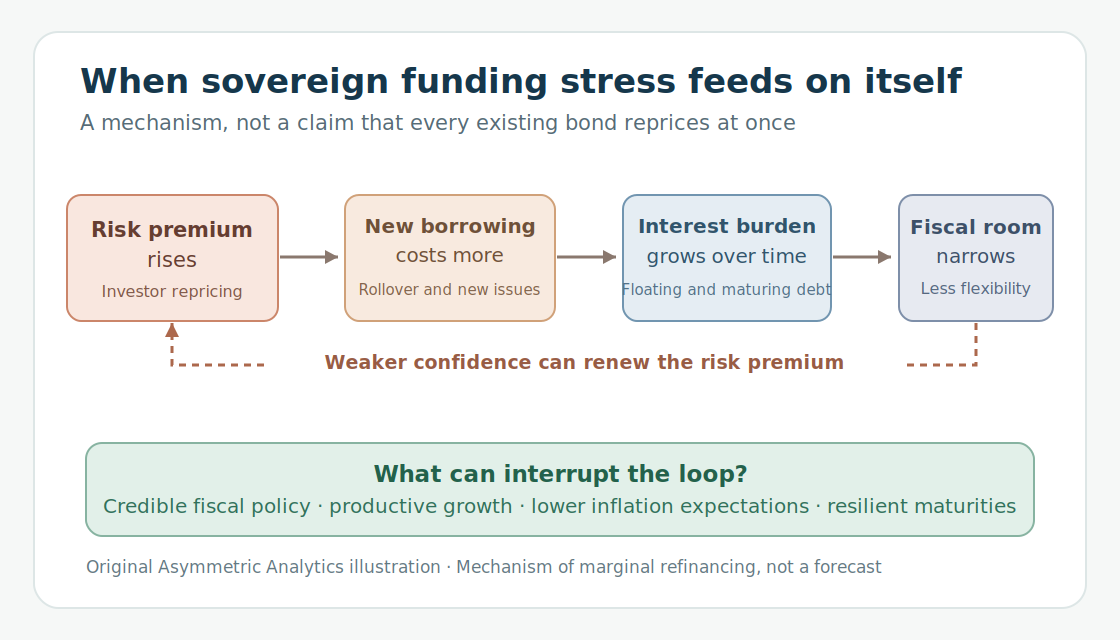
This is the trap: expensive debt feeds a larger deficit, the deficit can undermine confidence, and declining confidence makes refinancing more expensive. Brazil's market shock is a particularly vivid example of a much wider contest for financing—between sovereign borrowers, AI infrastructure, industrial investment and war.
Meanwhile, dollar stablecoins offer businesses a new way to seek dollar exposure. That may strengthen the dollar's reach long before native crypto networks capture comparable economic value.
Standard: A vote reprices a debt problem that existed yesterday
A country's public debt does not reset on election night. Its financing conditions can.
On Monday, October 26, investors unwound bets built around a different electoral outcome. B3 reported that the Ibovespa fell 13.88% to 176,608.23, trading was temporarily halted, and the U.S. dollar gained approximately 8.25% against the real. The election was the trigger. The public balance sheet was the combustible material already in place.
The latest Banco Central fiscal release, dated October 29 , supplies the arithmetic. At the end of September, gross general-government debt stood at 82.9% of GDP. Over the preceding twelve months the public sector recorded nominal interest costs of 8.99% of GDP, a primary deficit of 0.52%, and a nominal deficit—including interest—of 9.51%.
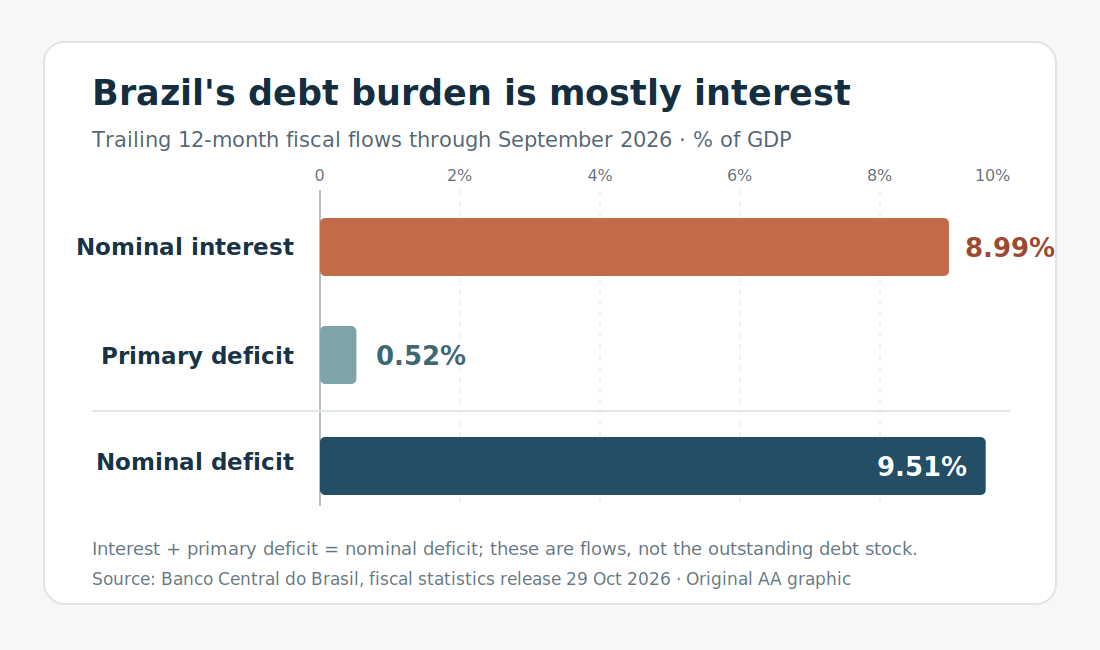
The headline deficit is therefore not mostly explained by a single month's new spending announcements. Existing debt and its financing cost matter enormously. Even a government that eliminates its primary deficit tomorrow would still face a formidable interest bill.
That creates a feedback loop. Investors demand a higher risk premium; new debt is issued more expensively; the future interest burden grows; fiscal room narrows; and investors can demand still more compensation. Existing fixed-rate obligations do not all reprice immediately, so the force arrives through new issuance, floating-rate exposure, rollover and the maturity structure—not a magical overnight reset.
Brazil is not alone. France's statistical agency reported 119.0% Maastricht general-government debt to GDP in the second quarter of 2026. The definitions, currencies and financial institutions differ, but the shared constraint is recognizable: when financing becomes expensive, governments have fewer attractive choices. This is why the apparent abundance of money in global finance can coexist with intense competition for the next marginal dollar—or euro—of affordable capital.
There is also a digital-money consequence. The October 27 account of Mercado Bitcoin's exchange activity described a dramatic election-day surge in USDT turnover. That is evidence of demand for a convenient dollar instrument at one venue, not proof of equivalent capital flight. The IMF explains why the distinction matters: almost all stablecoins are dollar-denominated, but gross transaction volume overstates actual payments and new financing.
A changing financial system may therefore extend the dollar rather than replace it. Brazil provides a laboratory for seeing that mechanism in action.
I. The election was the trigger, not the origin
Brazil's October 25 election overturned many investors' positioning assumptions. The following Monday delivered a violent mark-to-market adjustment. B3's October 26 account documents the 13.88% stock-market decline, the trading halt and a dollar rate near R$5.40. Agência Brasil independently reported an 8.21% USD/BRL rise to R$5.403; the small percentage difference reflects reporting conventions and should not be presented as two separate market shocks.
The market reaction was an assessment of expected future policy and risk, not a verdict that all debt suddenly became unpayable. Investors were reconsidering spending priorities, expected fiscal rules, currency risk, inflation and the probability of future government adjustment. They also had to close election trades that had been profitable under a different scenario.
That second mechanism matters. Some of a sudden collapse may come from the speed of position unwinding rather than a comparable one-day deterioration in fiscal fundamentals. Markets can overshoot. The extent of any recovery depends on subsequent decisions, not on whether the initial selloff was dramatic.
The institutional dimension adds another layer. Electoral litigation and disputes over courts can reduce perceived predictability, but political controversy and market risk should not be collapsed into an unsupported claim of illegitimacy or criminality. The related AA News institutional article remains separately in editorial review. The WWW question is economic: what price must Brazil pay to finance its commitments when investors demand greater assurance?
II. The numbers that precede the vote
Brazil's October 29 central-bank release is more current than the August fiscal figures available when this investigation was first commissioned.
At the end of September, gross general-government debt was R$11.1 trillion, or 82.9% of GDP. The debt ratio had climbed 4.3 percentage points during 2026. Over the twelve months to September, the public sector's primary balance was a 0.52% of GDP deficit, while nominal interest costs were 8.99%. The resulting overall nominal deficit was 9.51%.
These are not interchangeable measures. The 82.9% is a stock of gross obligations divided by annual output. The 8.99%, 0.52% and 9.51% are trailing flows divided by GDP. The central bank's nominal-interest measure also reflects accrued interest and aspects of currency-swap accounting; it is not simply cash coupons paid this month.
A useful implication follows. Interest accounts for roughly 94.5% of the 9.51%-of-GDP nominal shortfall, using the BCB's reported totals. That does not make primary spending unimportant; fiscal policy influences debt growth, credibility and interest expectations. It means the government inherits a heavy cost from past financing conditions even before choosing its next program.
Brazil's benchmark Selic was 13.75% around the October release, reflecting the high price of monetary restraint. Reducing interest rates could eventually ease fiscal pressure, but doing so in the face of inflation or depreciation risk could weaken the currency and force rates back up. The central bank and the Treasury face related constraints without having identical mandates.
III. The bond-market feedback mechanism
A sovereign government is not a household. It taxes, issues debt, manages public assets, affects regulation and—depending on institutional arrangements—operates in an economy with a monetary authority. Still, investors demand a return for lending.
Suppose a treasury must refinance a maturing bond. If the marginal yield rises, refinancing becomes more expensive unless the government changes the maturity mix, financing channel or quantity borrowed. Floating-rate debt can transmit changes sooner. Long-duration fixed-rate debt softens immediate transmission, but only until it matures or new financing becomes necessary.
That is the real source of danger: a persistent increase in the marginal cost of funding can compound over several years. The mechanism becomes more powerful when interest is financed with additional borrowing, when growth weakens, or when the government's spending is rigid.
Brazil's National Treasury had already published its fourth-quarter issuance calendar on September 18 . That pre-election calendar is useful evidence: financing needs and bond maturities existed regardless of the vote. Subsequent changes in auction participation, accepted yields, buybacks and debt maturity would show whether the shock is fleeting or becoming a structural financing problem.
The strongest corrective signal would not necessarily be a speech. It would be a credible fiscal path, consistent central-bank policy and an improving price at which investors willingly absorb new paper.
IV. Stablecoins: the dollar's new emergency exit
Another market stayed open on election day: cryptocurrency trading.
CoinDesk's October 27 report relayed Mercado Bitcoin's claim that corporate accounts represented 78% of its October 25 trading volume, and that USDT turnover rose nearly 800% versus the preceding Sunday. The figures are potentially important, but they are exchange-origin claims about activity on one platform. They are not audited economy-wide dollar purchases, not proof of sustained migration, and not a measurement of net capital leaving Brazil.
Their significance is nevertheless clear. A business need not wait for Monday's domestic securities session to seek a tokenized claim on a dollar. A dollar stablecoin can serve as an easily transferable instrument of foreign-currency exposure, subject to redemption, issuer, exchange, legal and operational risks.
The IMF's August 7 assessment says nearly 99% of stablecoins are dollar-denominated. It also distinguishes more than $30 trillion of reported 2025 gross on-chain volume from a much smaller $390 billion estimate of payment-related activity. Exchange churn, arbitrage and transfers among intermediaries are not the same as real-economy settlement.
Dollar stablecoins can therefore reinforce use of the dollar unit without requiring widespread consumer adoption of native blockchain tokens. Reserves invested in Treasury bills do create a potential link to U.S. financing, but there is a crucial accounting distinction: if buyers shift from existing dollars or dollar deposits, the resulting stablecoin reserves need not represent a net new global purchase of dollar assets.
This is the companion mechanism explored in Crypto Adoption May Strengthen the Dollar, Not Replace It . The token may carry the transaction while the dollar remains the balance-sheet unit.
V. France is a related—but different—financing problem
France illustrates how fiscal constraints can emerge in a very different monetary setting. According to INSEE's September 29 release , French Maastricht public debt reached 119.0% of GDP at the end of the second quarter of 2026. Eurostat's October 21 release puts the harmonized figure near 119.1%; a rounding/revision difference should not be mistaken for a new debt increase.
These ratios should not be directly ranked against Brazil's 82.9% using different national accounting definitions. France borrows in euros inside a monetary union and benefits from deeper regional sovereign markets and different central-bank structures; Brazil issues predominantly into its own domestic monetary and financial system, with a more immediate emerging-market currency-risk channel.
The shared constraint is not an identical default probability. It is the increasingly expensive contest over how to finance existing commitments while preserving investment capacity.
France's industrial energy costs, pension obligations, taxation, politics and growth prospects create one version of that contest. Brazil's inflation history, real volatility, fiscal rules and debt indexation create another. Both point toward the same uncomfortable arithmetic: persistent deficits plus expensive financing eventually require policy adjustment, faster productive growth, or an inflationary transfer of purchasing power.
The comparison also cautions against a simplistic story. Sovereigns have distinct maturities, domestic investor bases, external obligations and institutional support. Those differences can determine whether financing stress remains manageable, escalates, or reverses.
VI. The great capital collision
A global capital market is not a fixed pool of savings that vanishes when one government borrows. Banks create credit; profits fund investment; central banks influence conditions; investors rebalance across borders; productive investment can generate future wealth. Yet the price of marginal risk-bearing capital is real.
Brazil must refinance debt. France must finance its state and industry. American companies are building enormous AI data-center, power and networking systems. Governments are restocking weapons and repairing industrial supply chains. These are distinct credit channels, but they interact through interest rates, risk appetite, bank capital, collateral and savings.
The economic question is not merely who can borrow. It is which projects turn capital into durable future productive capacity, and which absorb it without improving the ability to meet tomorrow's obligations.
That is why Brazil's shock connects to The Great Capital Collision and The AI Investment Paradox . Investors can misprice the future in either direction: they can underestimate the value of building productive infrastructure, or assume every expensive project will be productive simply because it is labeled strategic.
For sovereigns, the same distinction governs policy. A debt-funded investment that raises future output and tax capacity is not economically equivalent to spending that creates only recurring obligations. The financing terms, implementation quality and realized productivity determine the difference.
VII. What would confirm the thesis—or change it?
Brazil's next months offer unusually measurable tests. Watch the Treasury's actual auction coverage, yields and debt composition against its announced calendar; BCB's monthly debt stock and interest-flow releases; inflation and currency expectations; and the government's fiscal measures. Compare any recovery in equities with the longer-dated bond market rather than assuming one rebound settles the issue.
For digital dollarization, watch stablecoin balances and net fiat on- and off-ramps, not just gross token turnover. Seek independently reported corporate flows rather than extrapolating from one venue's Sunday trading. Track whether demand persists after the market shock fades.
The positive path is straightforward to describe: credible fiscal adjustment, stronger growth, declining inflation expectations and an orderly domestic bond market can make even a frightening market day a temporary repricing. The negative path is also clear: rising refinancing costs, currency weakness and political paralysis reinforce one another while productive investment is crowded out.
Brazil will reveal which path investors are prepared to finance. The larger lesson belongs to every heavily indebted society trying to fund the next industrial era: capital is not merely a quantity to be found. Its cost—and what we build with it—will shape the next economic order.
Sources and methodological notes
Primary sources are Banco Central's October 29 fiscal statistics , B3's October 26 market close , Brazil National Treasury's fourth-quarter issuance calendar , the IMF August stablecoin assessment and INSEE Q2 debt statistics . Agência Brasil's close gives a separate FX return. CoinDesk attributes the exchange-volume numbers to Mercado Bitcoin, which must remain labeled as a venue's claims until independent methodology is obtained.
The BCB October 29 release supersedes the August 2026 snapshot cited in the original October 28 development issue. The fiscal-flow ratios and debt stock refer to different measures and periods. Crypto trading turnover is not a payment-flow or net-capital-flight estimate. ELSI identifiers in draft front matter are reuse candidates and require read-only canonical graph verification before public promotion.
Places in this story




Brazil, France, United States
Made with Natural Earth